
Seven Departments Issue the “15th Five-Year Plan” for the New Battery Industry: All-Solid-State Batteries to Reach Initial Scale-Up, Storage Application Scenarios to Expand Further
On September 28, 2026, seven departments — the Ministry of Industry and Information Technology (MIIT), the National Development and Reform Commission, the Ministry of Transport, the Ministry of Commerce, the State Administration for Market Regulation, the National Energy Administration, and the National Railway Administration — jointly issued the 15th Five-Year Plan for the Development of the New Battery Industry (hereinafter “the Plan”).
New batteries are high-efficiency electrical energy storage and conversion devices or systems centered on innovation in new mechanisms, new materials, new structures, and new processes. Represented by lithium batteries, sodium batteries, and flow batteries, they are characterized by fast technological iteration, wide application, and strong spillover effects.
The Plan sets out development goals: by 2030, China’s new battery industry will achieve steady growth in scale. Full-chain innovation capacity will be continuously strengthened, with new breakthroughs in advanced electrode materials, new electrolytes, and high-end auxiliary materials; major progress in the R&D of new battery systems; initial scale-up application of all-solid-state batteries; cycle life of long-life lithium batteries reaching 15,000 cycles; and product defect rates at leading enterprises reaching PPB level. The all-scenario application ecosystem will accelerate, with new battery technologies integrating more quickly with clean energy and end-use terminals, efficiently empowering the iterative upgrading of smart terminal products and the electrification of automobiles, ships, aviation, intelligent robots, construction machinery, and agricultural equipment. Meeting the needs of the new power system, storage application scenarios on the power supply side, the grid side, and in industrial parks, data centers, and other settings will be further expanded. International trade and investment integration will advance in depth, serving global green and low-carbon development.
Centering on the main goals, the Plan proposes 19 key tasks and 5 feature columns across five areas: accelerating full-chain innovation, promoting industrial transformation and upgrading, improving the industry system, enhancing industrial technology services, and raising the quality and level of trade and investment cooperation.
1. Strengthening frontier and common technology breakthroughs. Focusing on key directions such as improving ionic conductivity and cycling stability and optimizing costs, accelerate breakthroughs in all-solid-state battery industrialization technologies. Make forward-looking arrangements for next-generation battery systems such as new alkali metal-ion batteries, multivalent-ion batteries, metal-air/sulfur batteries, multifunctional composite structure batteries, and nuclear batteries.
3. Enriching the supply of high-end battery products. Targeting diverse application scenarios, accelerate the high-end, diversified, and integrated development of new battery products and improve product safety and reliability. Build a new battery product supply system led by lithium batteries with coordinated development of sodium batteries, flow batteries, and others. Improve the power and energy density of sodium batteries, develop flow batteries with high conversion efficiency, and promote the iteration of products such as hybrid supercapacitors. Upgrade thin, lightweight, flexible batteries for consumer electronics; optimize high-safety, all-climate traction batteries for new energy vehicles; develop long-life, high-safety storage batteries meeting long-duration storage needs; and raise the supply of batteries for low-altitude equipment and intelligent robots, as well as high-tolerance batteries for extreme environments such as aviation, deep-sea, and polar regions. Improve the industrialization capacity of all-solid-state batteries, aqueous batteries, and ultra-fast-charging batteries.
4. Strengthening system integration innovation. Focusing on dimensions such as structural integration, thermal management systems, battery management systems, energy management systems, high-voltage electrical systems, and system safety, develop integration technologies featuring structural optimization, multi-domain fusion, and safety and efficiency.
5. Promoting innovation-driven applications across multiple fields. Actively advance electrification in public transport, heavy trucks, aviation, inland shipping, and agricultural machinery, and carry out innovative applications of new-type energy storage in scenarios such as intelligent computing centers and industrial green microgrids. Explore innovations in application models such as direct green power connections, virtual power plants, and computing-power-energy coordination.
6. Improving the recycling and utilization system. Implement the extended producer responsibility system, and promote enterprises to establish waste battery recycling systems matching their product sales through self-building or commissioning. Accelerate the construction and operation of waste battery recycling service outlets; support the R&D and industrial application of technologies and equipment for fine disassembly, low-cost utilization, and efficient extraction of valuable elements from waste batteries; improve the refinement and automation of dismantling, crushing, sorting, and smelting processes; and promote the efficient utilization of secondary resources. Guide localities to rationally arrange processing capacity matching regional waste battery volumes and promote the concentration of resources in advantaged enterprises. Guide enterprises to lay out waste battery comprehensive utilization capacity in major export markets where conditions permit, enhancing resource security.
Notice on the Issuance of the 15th Five-Year Plan for the Development of the New Battery Industry by MIIT and Six Other Departments
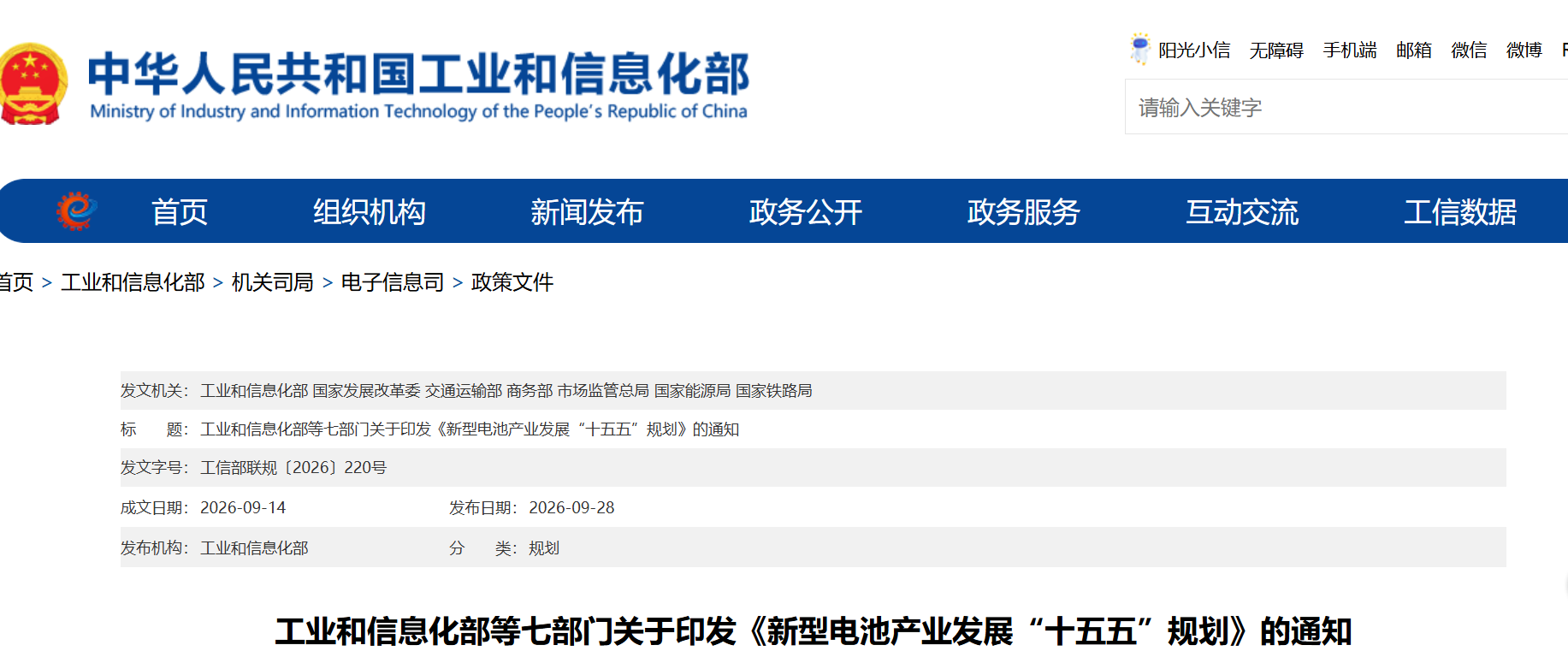
MIIT Joint Regulation No. 220 [2026]
To the competent departments of industry and information technology, development and reform, transport, commerce, market regulation, and energy of all provinces, autonomous regions, municipalities directly under the Central Government, cities with independent planning status, and the Xinjiang Production and Construction Corps; to all regional railway regulatory bureaus; to the communications administration bureaus of all provinces, autonomous regions, and municipalities directly under the Central Government; and to all relevant entities:
The 15th Five-Year Plan for the Development of the New Battery Industry is hereby issued to you. Please implement it earnestly in light of your actual conditions.
Ministry of Industry and Information Technology
National Development and Reform Commission
Ministry of Transport
Ministry of Commerce
State Administration for Market Regulation
National Energy Administration
National Railway Administration
September 14, 2026
