
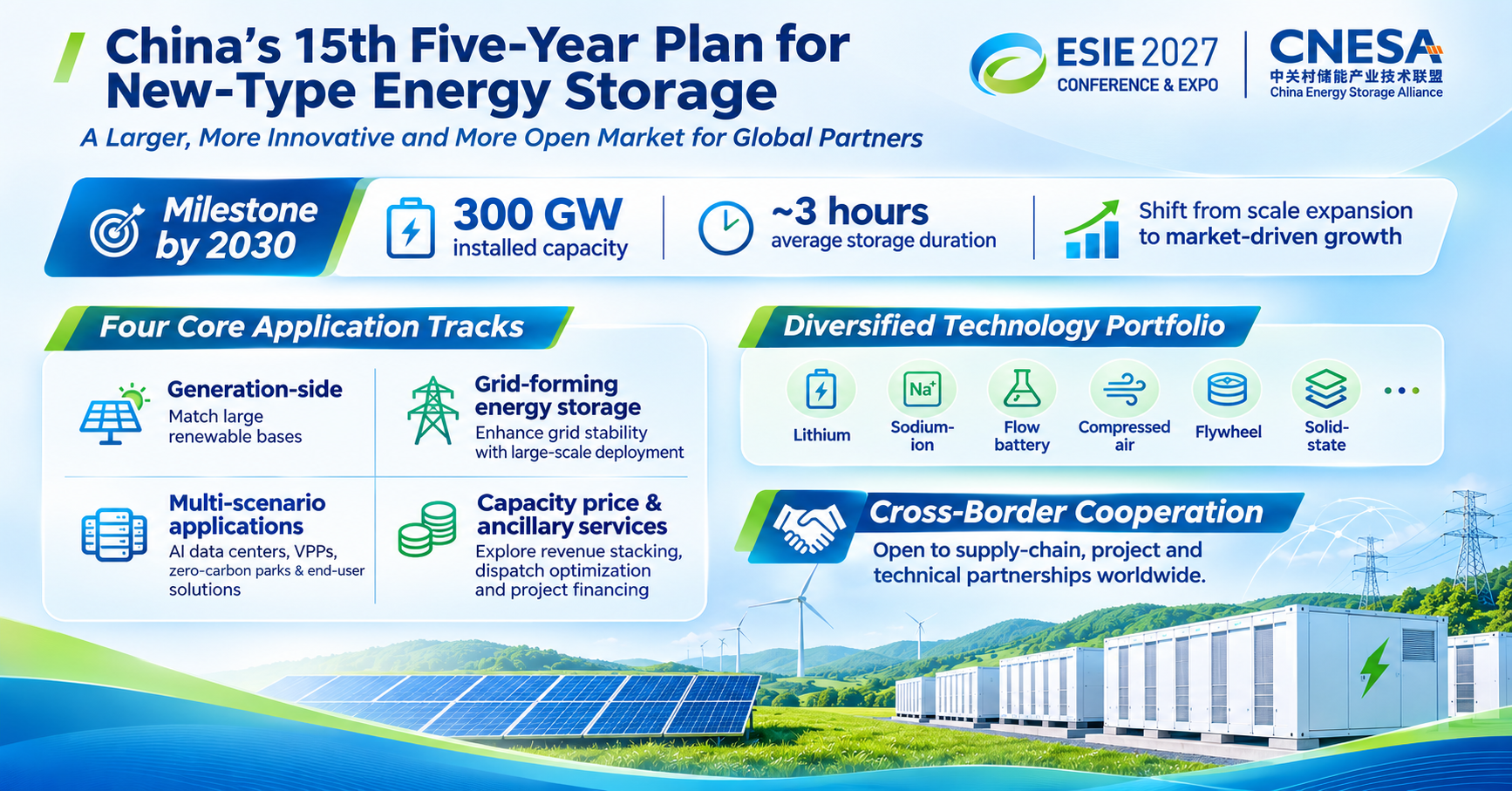
By 2030, China’s new-type energy storage sector will complete its transition from large-scale capacity build-out to market-driven commercial operation. The national target sets the installed capacity of new-type energy storage at 300 GW, with an average storage duration of roughly 3 hours. This milestone is designed to enable deeper integration and interactive coordination across generation, grid, load and storage segments within the power system, unlock the multi-dimensional value of energy storage, and underpin the construction of a new-type power system.
Overarching Guideline & Foundational Principles
The core development guideline is to foster new strategic emerging industries and vigorously advance new-type energy storage deployment. The plan is guided by four foundational principles:
1. Scientific planning and optimized allocation: Deploy storage resources rationally across regions to match local demand.
2. Technology leadership and innovation-driven growth: Prioritise R&D and commercialisation of diversified storage technologies.
3. Standardised governance with safety and efficiency: Establish robust regulatory frameworks to secure reliable, safe operation.
4. Market-led, orderly development: Let market mechanisms steer project rollout while avoiding unregulated overexpansion.
Six Core Development Objectives
1. More rational scale and spatial layout: The plan defines quantified development targets for the 15th Five-Year period. It guides new storage assets toward regions with pressing needs for peak-load relief, renewable integration and power system stability.
2. Diversified technological innovation: China will consolidate its existing strengths in lithium-ion battery storage, scale up sodium-ion and flow battery solutions, and push compressed-air and liquid-air storage toward full commercial maturity.
3. Well-ordered industry governance: Standardised management will cover the full lifecycle of new storage projects, including planning approval, grid connection scheduling and ongoing monitoring.
4. Rich and expanded application scenarios: Beyond traditional power-source and grid-side deployment, the policy strongly supports storage adoption in green direct-wire supply, zero-carbon industrial parks, virtual power plants and other innovative use cases.
5. Improved market frameworks: The reform agenda targets refined electricity market rules and pricing systems, enabling storage assets to fairly participate in spot, auxiliary service and capacity markets and capture their full economic value.
6. Resilient and robust industrial ecosystem: Policy support will strengthen the whole supply chain, reinforce safety standards, and facilitate the healthy, large-scale expansion of the domestic new energy storage industry.
Three Pillars of Deployment: Eleven Application Scenarios
1. Generation-side new-type energy storage
By 2030, new energy bases will be equipped with approximately 50 GW–60 GW of supporting new-type energy storage. Both centralised and distributed renewable farms, alongside conventional power plants, will be encouraged to deploy storage as required. Key functions:
· Support the delivery and grid integration of large-scale renewable bases
· Boost local consumption of distributed renewables
· Strengthen the market participation capability of renewable assets
· Improve the flexible regulation capacity of conventional generation
2. Grid-side new-type energy storage
By 2030, standalone grid-side storage capable of peak-load relief will reach around 142 GW. This segment will support the coordinated operation of microgrids and pioneer novel grid storage configurations. Key functions:
· Enhance the overall regulation capability of the power system
· Reinforce regional power supply security
· Enable the build-out of advanced distribution networks
· Substitute for costly traditional power grid infrastructure investment
3. Multi-scenario innovative energy storage
The plan endorses storage deployment in integrated source-grid-load-storage projects, green direct supply lines, smart microgrids, high-renewable distribution networks and virtual power plants. It accelerates the development of zero-carbon parks, cross-sector coupling and non-electrical energy utilisation. Key functions:
· Enable end-users to operate low-carbon, green power loads
· Co-evolve alongside emerging power market models
· Drive cross-industry integration and new business formats
Five Priorities for Technological Innovation
1. Advance new energy storage technologies: Upgrade lithium-ion battery systems, roll out sodium-ion storage, and push compressed air, liquid air and flywheel storage toward commercialisation. Pilot schemes will cover supercapacitors, supercritical carbon dioxide, liquid hydrogen, gravity storage, molten-salt heat storage, solid-state batteries, heat pumps, thermal storage and hydrogen storage.
2. Develop grid-optimised storage: Centred on real-world use cases, authorities will roll out grid-adapted storage portfolios, refine planning methodologies and unify equipment technical standards.
3. Promote mixed-duration storage solutions: Develop safe, long-lifetime short-duration storage as well as large-capacity long-duration storage. Coordinate the matched deployment of electrochemical, thermal and hydrogen storage assets.
4. Achieve breakthroughs in core equipment: Build a complete domestic supply chain for storage hardware and lift independent R&D capacity for critical technical equipment.
5. Solve shared foundational technical challenges: Improve high-efficiency control and scheduling algorithms, explore the integration of energy storage and artificial intelligence, and advance digital and intelligent transformation.
Ten Supporting Policy Measures
1. Boost innovation with multi-pronged incentives: Refine the supporting policy system for storage technologies, accelerate pilot demonstration and real-world deployment, and cultivate specialised technical talent.
2. Strengthen whole-lifecycle project management: Roll out standardised specifications, tighten oversight for standalone grid-side storage, and enforce local regulatory responsibilities.
3. Elevate storage scheduling and operational competence: Improve coordination between grid dispatch and storage resources, optimise synergistic operation of storage paired with wind, solar and conventional generation.
4. Build up the national standard system: Accelerate the formulation and revision of standards covering materials, equipment, construction, operation and safety, while aligning with international norms.
5. Carry out continuous industry supervision: Include new storage within full-cycle market oversight, strengthen compliance inspections and regulate revenue settlement.
6. Enforce rigorous safety management: Implement a full-coverage safety governance system, clarify the primary responsibility of project owners, and carry out end-to-end risk control.
7. Enable storage participation in electricity markets: Remove institutional barriers for storage to trade in auxiliary service, capacity and spot markets.
8. Complete the pricing mechanism framework: Improve capacity pricing, time-of-use tariffs and other compensation rules so that storage can fully reflect its market value.
9. Support sound industrial development: Consolidate domestic manufacturing and R&D capacity, optimise the industrial layout and structure, and avoid disorderly low-quality expansion.
10. Deepen international exchange and collaboration: Establish stable bilateral and multilateral communication channels, create mutually beneficial cooperation frameworks, and support domestic enterprises to explore overseas markets.
Closing Outlook
This implementation plan marks a clear, forward-looking policy signal for global energy stakeholders. China will continue to open its new-type energy storage sector to international partners, welcoming collaboration on project development, supply chain cooperation, technology exchange and joint market exploration to advance the global clean energy transition together.