
Latest News
Sungrow EnerNeo SST Becomes the World’s First SST with Dual EU-US System-Level Certification: cTUVus + EMC + 13.8kV Reinforced Insulation
The surge in AI computing demand is pushing data center power architectures toward the 800V DC era. The China Energy Storage Alliance (CNESA) has noted that Sungrow’s EnerNeo solid-state transformer (SST) received system-level certification from TÜV Rheinland at the 2026 OCP Global Summit, becoming the world’s first SST to pass both European (IEC/EN) and American (UL) system-level certification and the first to secure a ticket to large-scale commercial deployment in the European and American data center markets. This article examines the substance of the certification, the technology route and the cost calculus behind the milestone.
At the 2026 OCP Global Summit, Zhang Di, President of Sungrow Source Intelligence, received a set of certificates from Sean Tilley, Vice President of the Product Services Business Unit of TÜV Rheinland Americas. The EnerNeo SST became the world’s first SST product to pass both European (IEC/EN) and American (UL) system-level certification, with the complete set of cTUVus, EMC and 13.8kV reinforced insulation certificates.
Not One Certificate, but a Stack
During the days of the OCP Global Summit, the convention center in San Jose, Silicon Valley, was packed with data center professionals. It was there that Sean Tilley handed Zhang Di the system-level and key-component certification certificates based on the UL, IEC, EN and 2 PfG series standards.
This certification covers the complete SST system. TÜV Rheinland conducted a system-level assessment of the EnerNeo against safety standards including UL 2877, IEC/EN 62477-1, IEC/EN 62477-2 and 2 PfG 3175, as well as EMC standards including EN 61000-6-2, EN 61000-6-4 and FCC Part 15. The core component, the high-frequency isolation transformer, additionally passed the dedicated 2 PfG 3179 certification, meeting the 13.8kV reinforced insulation requirement.
The outcome: the EnerNeo obtained the TÜV Rheinland certification mark, the cTUVus and EMC certificates, and the corresponding test reports. For Chinese equipment makers aiming to enter the European and American data center supply chains, completing this full set is far more difficult than passing any single test.
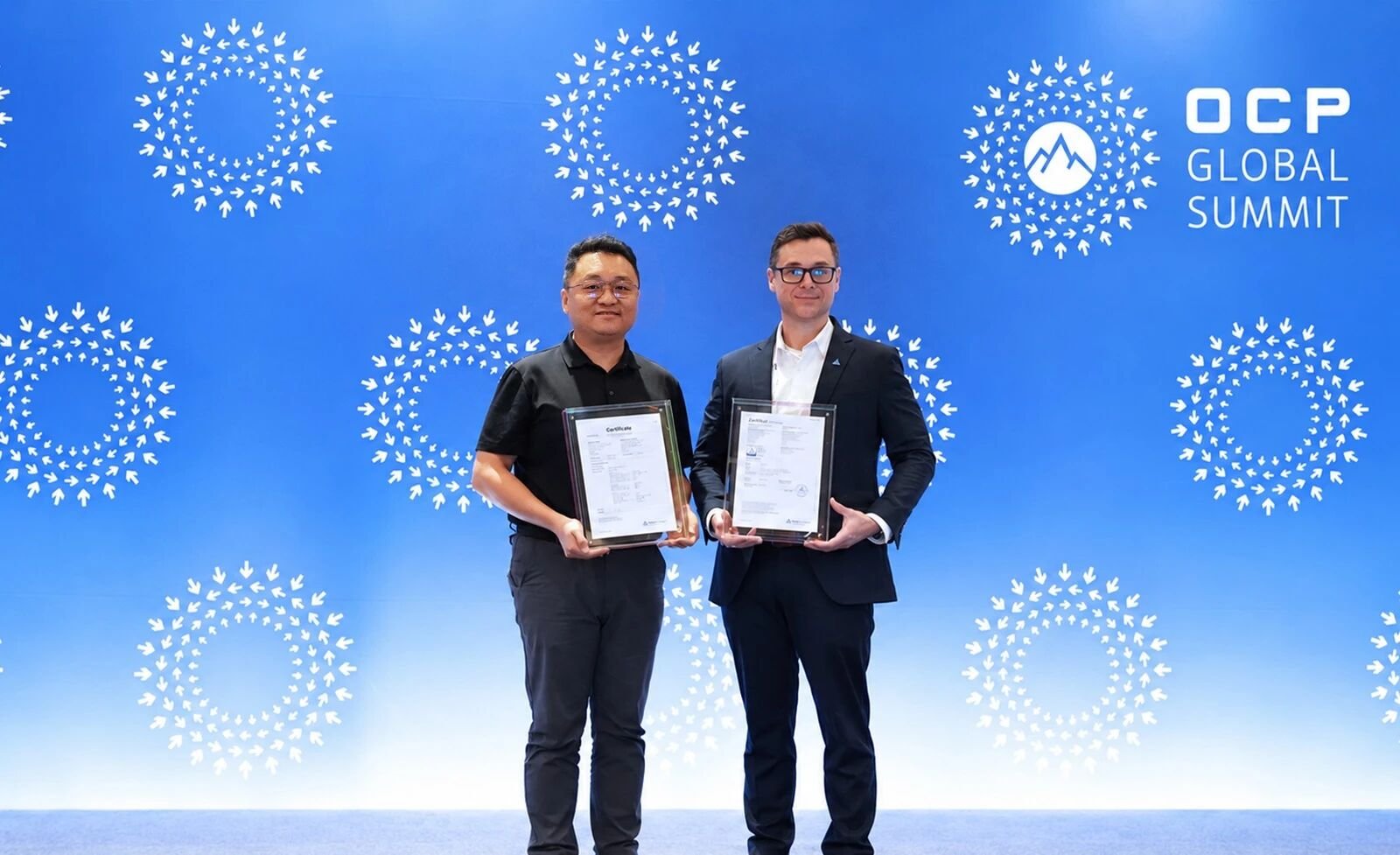
Sean Tilley (right), Vice President of the Product Services Business Unit of TÜV Rheinland Americas, presents the certification certificates to Zhang Di (left), President of Sungrow Source Intelligence.
Why System-Level Certification Is the Real Barrier
Some may ask: SST certification is not news, given that Eaton passed TÜV SÜD’s IEC 62477-2 certification in August. What is the difference?
The key lies in “system-level” and “dual-standard”.
The Solid State Transformer Specification v0.3, effective from June this year under the Open Compute Project (OCP) and jointly developed by Google, Microsoft and NVIDIA, defines the SST as a megawatt-class power electronics converter: a 13.8kV or 34.5kV medium-voltage AC input and an 800V DC output, with a power range corresponding to 5MW or 10MW. The specification covers not only power conversion but also medium-voltage input, low-voltage DC output, auxiliary power, firmware, control and communication, all within the scope of the SST product.
In other words, an SST is no longer just the “transformer” component; it is a complete power electronics system comprising power semiconductors, magnetics, control systems and communication systems. To pass system-level certification, insulation, efficiency, power density and thermal management must all meet the requirements simultaneously, rather than passing part by part.
Certification Dimension
Standards Indicators Involved
US Safety Standards UL 2877
EU Safety Standards IEC/EN 62477-1, IEC/EN 62477-2
Key Component 2 PfG 3175, 2 PfG 3179 (high-frequency isolation transformer,
13.8kV reinforced insulation)
EMC EN 61000-6-2, EN 61000-6-4, FCC Part 15
Certification Marks TÜV Rheinland certification mark, cTUVus, EMC certificates
The European and American markets are particularly strict on this point – UL and cTUVus on the US side, and the IEC/EN series on the European side. For entry into European and American data center procurement lists, system-level dual certification is close to a hard threshold. By securing both at once, the EnerNeo can now compete on equal footing with overseas players such as Delta, Eaton and Vertiv in terms of certification compliance.
800V DC: NVIDIA Sets the Course, Sungrow Delivers First
Why focus on 800V DC? The answer lies in power density.
The white paper “800VDC Architecture for Next-Generation AI Infrastructure”, released by NVIDIA at last October’s OCP Global Summit, has established 800V DC as the standard power architecture for next-generation AI infrastructure, with the SST positioned as the ultimate power supply device in the medium to long term. Sungrow’s 800V solution is also listed in the white paper as a recommended technology route.
The traditional data center power chain is: AC from the grid → step-down via a power-frequency transformer → multi-stage UPS/AC-DC conversion → server racks. Each stage incurs losses, with end-to-end efficiency of about 90%–92%. For megawatt-class racks, hundred-megawatt buildings and gigawatt-scale campuses, these few percentage points of loss translate into enormous electricity bills and thermal loads.
What the EnerNeo does is convert 10–13.8kV medium-voltage AC directly to 800V DC, using SiC power devices and an optimized series-connected H-bridge architecture, eliminating the power-frequency transformer and multi-stage conversion. Published parameters: 98.5% efficiency, 99.999% availability, 312 kW/m² power density, zero partial discharge at rack level (within 21kV), meeting the 42kV power-frequency withstand voltage and 95kV lightning impulse indicators.
According to Sungrow’s own calculation, for a 1GW computing project, the 800V DC architecture can save 400 million kWh of electricity per year. In terms of efficiency difference, 98.5% versus the 90%–92% of the full chain leaves a gap of 6–8 percentage points – no small figure at gigawatt scale.
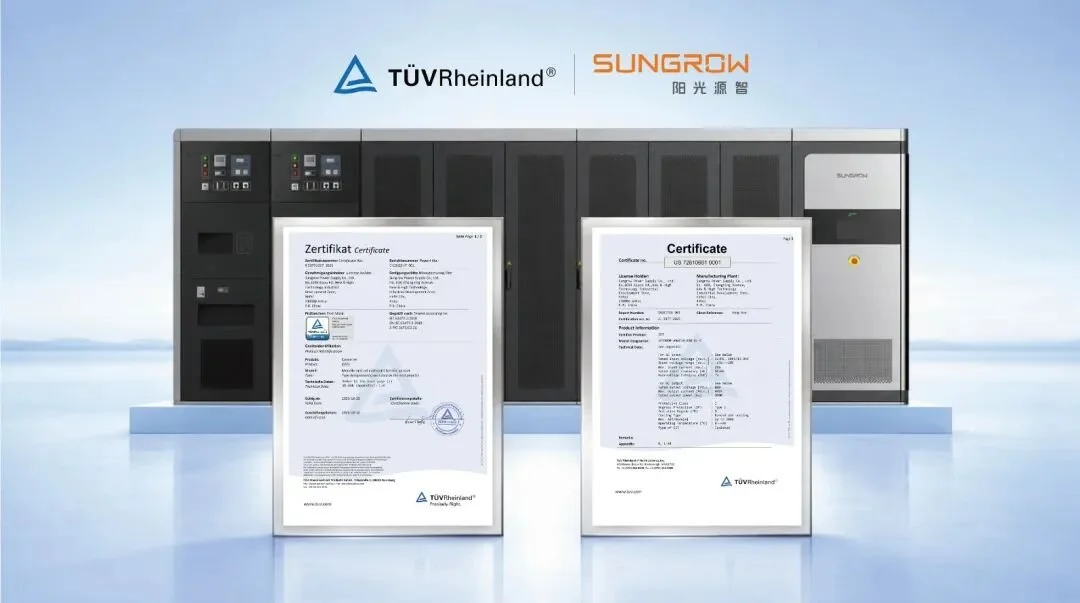
The EnerNeo SST system and the TÜV Rheinland certificates
Evolution of the power architecture for AI supernode full racks: single-rack power leaps from the 100kW class to the megawatt class, making 800V HVDC an inevitable choice.
The Cost Calculus: SST and Traditional Solutions Are Now on the Same Level
Technology, however good, must pass the cost test. The most-cited criticism of the SST used to be its price; that anchor is now beginning to shift.
In August 2026, the SST procurement budget for the data center of the “Zhiyun Changjingkai” platform was RMB 2 million for 2.5MW of capacity, equivalent to a budgeted unit price of about RMB 0.8/W. In the same year, China Mobile Jiangsu purchased four sets of 2500kVA medium-voltage integrated power systems for its Nanjing Jiangbei Data Center at a winning price of about RMB 1.77 million per set excluding tax, or about RMB 2 million including 13% VAT. 2500kVA is AC apparent power; with the data center load power factor close to 1, the two can be compared at similar capacity levels.
Comparison Item SST Solution Traditional Medium-Voltage Integrated Power
Project Sample Zhiyun Changjingkai 2.5MW SST China Mobile Jiangsu 2500kVA integrated power
Procurement Budget / About RMB 2 million (budget) About RMB 2 million per set (incl. 13% VAT)
Winning Price
Unit Price About RMB 0.8/W About RMB 0.8/W (equivalent at similar capacity)
Capacity Class 2.5MW 2500kVA(≈2.5MW, power factor close to 1)
The comparison is noteworthy: the procurement budget of a 2.5MW-class SST is broadly on par with the winning price of a comparable 2500kVA integrated power system. Once costs reach the same level, the advantages in efficiency, footprint and response speed become decisive factors in procurement decisions.
Certification Is a Ticket, Not the Destination
Back to the OCP Summit. Experts from Google, Microsoft and NVIDIA stood in the audience as Zhang Di received the certificates – a scene carrying more information than the certificates themselves: the core initiators of the OCP SST working group are casting a vote of confidence in a Chinese manufacturer’s technology route.
But this vote is only an entry ticket. The industry is still in the stage of small-batch delivery and customer site validation. Between “certification passed” and “large-scale commercialization” lie multiple tests: engineering reliability, O&M systems, supply chain responsiveness, and acceptance by financing and insurance institutions.
What deserves even closer observation is whether Sungrow Source Intelligence can secure its first large-scale order in Europe and America after obtaining dual-standard certification. Eaton and Delta still hold first-mover advantages in overseas data center O&M and brand recognition; the next challenge for Chinese manufacturers is not laboratory parameters, but the long-term trust of overseas customers.
Sign up for our free monthly newsletter to stay informed about the Chinese energy storage market.