
Three Major Application Segments See Shrinking Returns — Can China’s New Energy Storage Resolve Its Profitability Bottleneck?
BEIJING, 15 October 2026
China Energy Storage Alliance (CNESA) has published its latest in-depth analysis on China’s new-energy-storage industry. After years of breakneck capacity expansion, the sector faces a new reality: newly-commissioned installations declined more than 15 % year-on-year in H1 2026, as profitability pressure mounts across generation-side, grid-side and customer-side segments. Having pursued a policy-fuelled “installed-capacity race”, Chinese new energy storage now stands at a crossroads, shifting focus from “building assets” toward profitable operation and tangible system-level value delivery for the carbon peaking and carbon neutrality goals.
Market Performance Review: Three Transformations — Scale, Discharge Duration and Application Mix
China’s new-energy-storage market has delivered remarkable capacity growth alongside profound structural changes in technology, discharge duration and deployment scenarios.
By the end of 2025, China’s total commissioned electric-energy-storage capacity reached 213.3 GW (+54 % YoY), accounting for 43.0 % of global installed volume and ranking first worldwide. Cumulative new-energy-storage capacity hit 144.7 GW, a 45-fold increase compared with the end of the 13th Five-Year Plan. Lithium-ion batteries represent 66 % of the national electric-storage fleet, while pumped-hydro storage contributes 31 %. Both flow-battery and compressed-air-energy-storage cumulative installations have passed the 1 GW milestone, signalling that long-duration technologies are moving from demonstration toward large-scale roll-out.
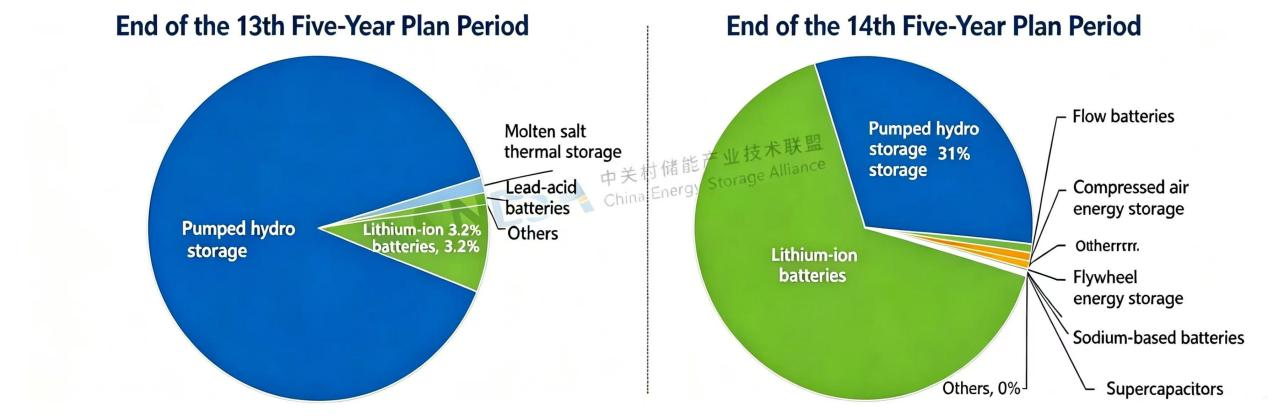
Cumulative Installed Capacity of China’s Electric Energy Storage Market (End-2025), Unit: MW & % | Source: CNESA
Storage project discharge durations keep increasing as the system demands greater long-duration flexibility. The average duration for newly-commissioned projects reached 2.85 hours in 2025, up 58 % versus 2020. Projects offering 4 hours or longer discharge grew 44 % year-on-year and have become the main growth driver.
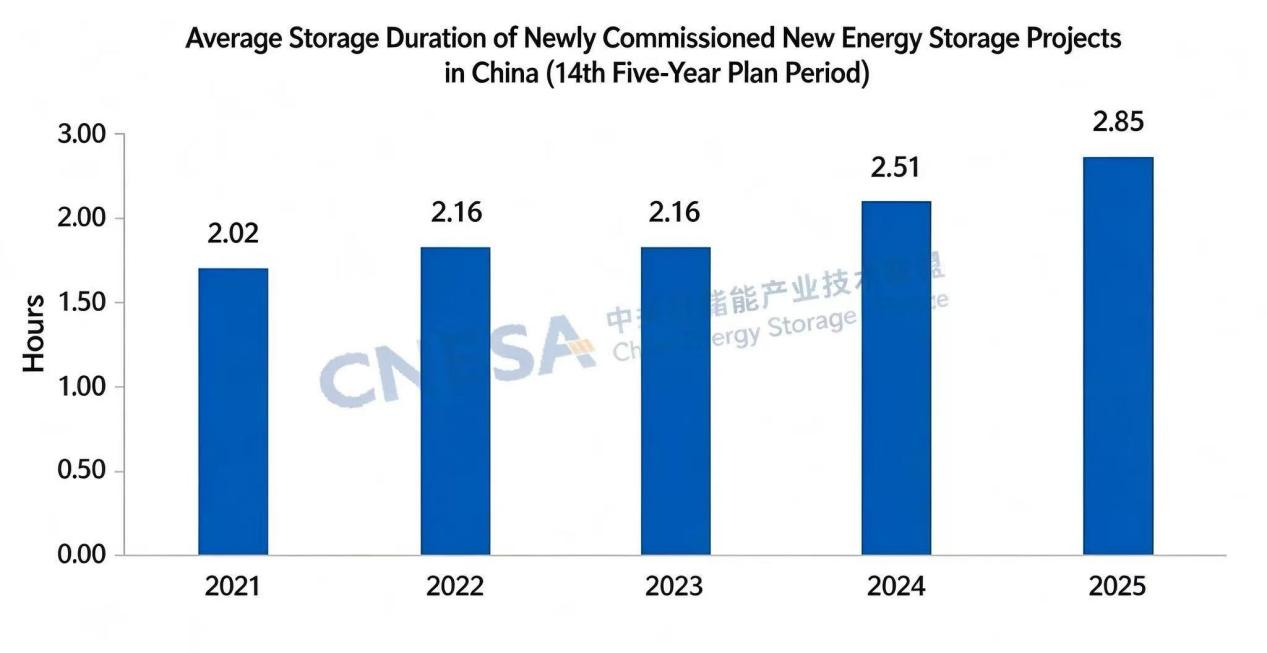
Historical Average Storage Duration of Newly Commissioned New Energy Storage Projects in China during the 14th Five-Year Plan Period, Unit: Hour | Source: CNESA
Application-segment composition has undergone fundamental change. Stand-alone storage now makes up 58 % of cumulative new-energy-storage capacity, 54 percentage-points higher than at the end of the 13th Five-Year Plan. The industry has transitioned from fragmented customer-side deployments toward large-scale, grid-centric stand-alone-storage assets.
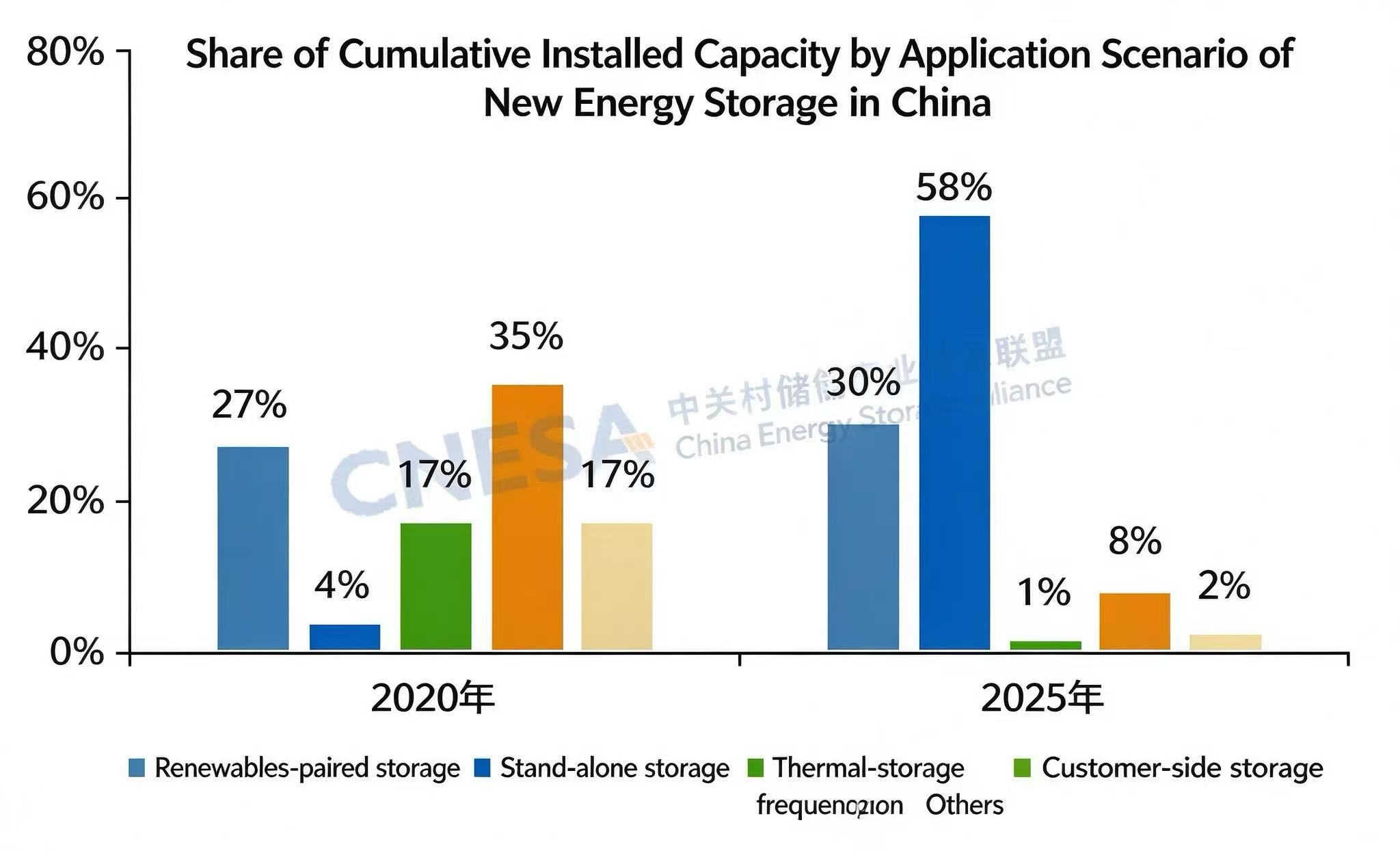
Share of Cumulative Installed Capacity by Major Application Scenarios of New Energy Storage in China, Unit: GW & % | Source: CNESA
Industry Warning: Profitability Compression Triggers First-Ever Installation Downturn
Beneath the capacity expansion, all three core application segments face contracting revenue streams:
· Renewables-paired (generation-side) storage: The abolition of mandatory pairing rules has weakened developer incentives; existing income cannot cover capital and operational expenses.
· Stand-alone (grid-side) storage: Capacity-leasing income, once exceeding 50 % of revenue in some provinces, has sharply fallen following policy adjustments; capacity-tariff mechanisms cannot fully fill the resulting funding gap.
· Customer-side (industrial & commercial) storage: Abolition of administratively-set time-of-use price bands narrows fixed peak-valley spreads, lengthening project payback periods while viable new business models remain under development.
These economic headwinds are reflected in real-world deployment statistics. H1 2026 saw 21.64 GW / 58.20 GWh of new-energy-storage go online; both power and energy metrics dropped by over 15 % year-on-year — the first contraction after multiple years of rapid expansion.
Core Bottlenecks Restraining Storage Profitability
CNESA’s analysis identifies market-design and dispatch-framework shortcomings as the primary obstacles preventing adequate returns for storage assets.
Inefficient dispatch practices limit flexibility utilisation. Renewables-paired-storage utilisation rates remain low, as charge-discharge strategies cannot always adapt dynamically to market signals. A national unified compensation scheme for emergency grid dispatch is absent, so storage’s security-support value cannot be monetised.
Generation-side paired-storage suffers uneven asset quality and narrow revenue streams. Assets built under historic mandatory-pairing requirements often under-perform design specifications and carry safety risks. Projects rely heavily on curtailment-avoidance gains and are frequently prohibited from purchasing power from the public grid, limiting operational flexibility relative to stand-alone storage.
Grid-side stand-alone storage faces unresolved gaps in pricing, cost-recovery, capacity-remuneration and ancillary-service rules. Four concrete market-mechanism bottlenecks constrain commercial performance.
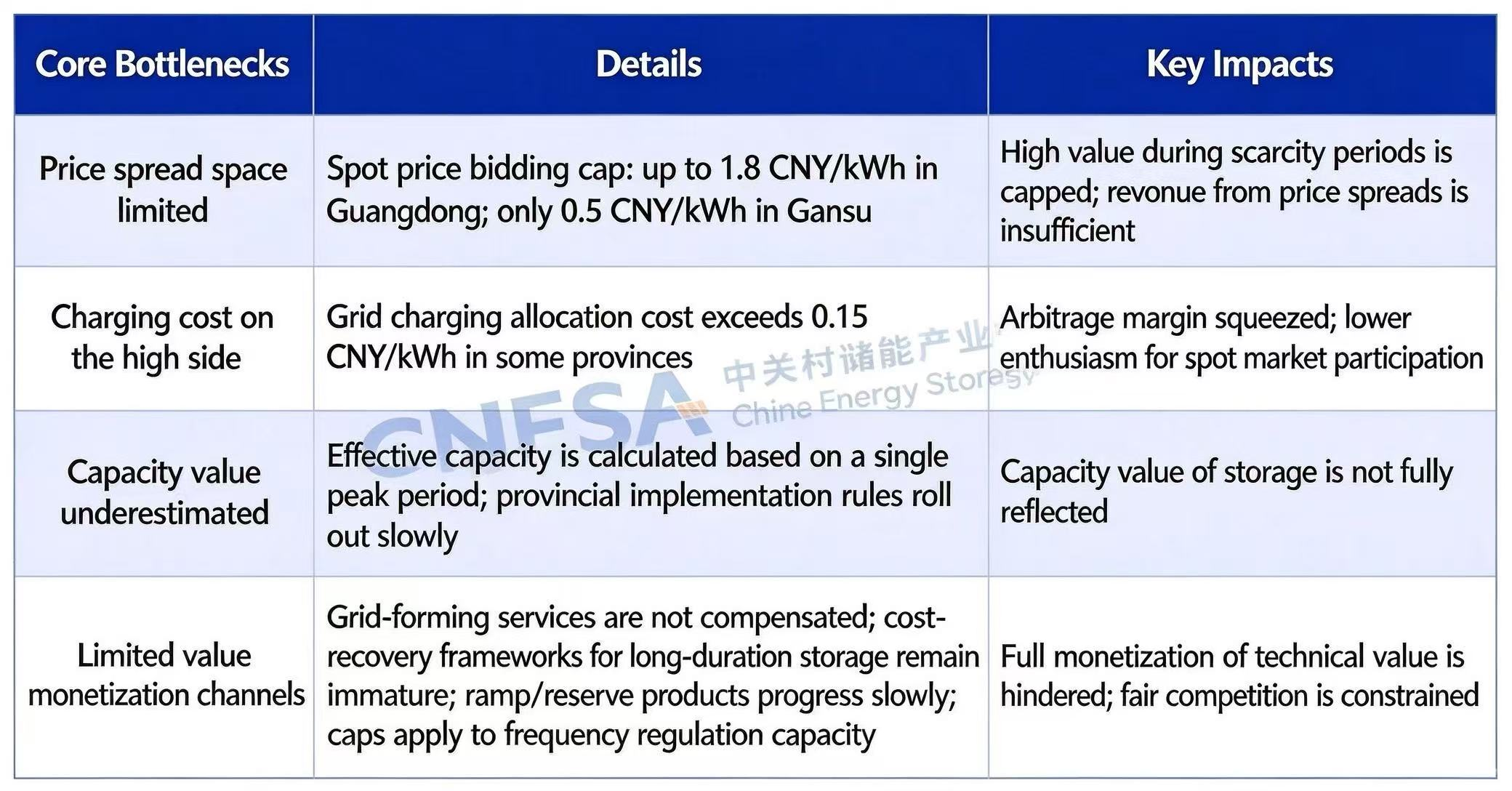
Four Major Market Mechanism Bottlenecks for Stand-Alone Energy Storage | Source: CNESA
Customer-side storage must shift toward multi-market stacked revenue models, yet green-power direct-connection and virtual-power-plant deployments encounter multiple barriers: volatile load-dependent revenues, limited market-product access for VPPs, high forecasting-driven operational risks and incomplete equipment-and-site standards creating safety concerns.
Market Trends: Elevated Strategic Status and Accelerating Power-System Reform
New-energy-storage has advanced from technical-demonstration status to become a core flexible resource for China’s new power system, with successive upward revisions to medium-and-long-term capacity targets:
· 2021: > 30 GW new-energy-storage by 2025
· 2025: > 180 GW new-energy-storage by 2027
· 2026: > 300 GW new-energy-storage by 2030
High-penetration wind-and-solar integration creates sustained structural demand for storage flexibility. CNESA’s dual-modelling outlook (double S-curve plus system-dynamics simulation) forecasts cumulative new-energy-storage power capacity of 365-435 GW by 2030, rising to 527-615 GW by 2035. Decommissioning volumes will generate replacement-equipment demand through the 16th Five-Year-Plan period.
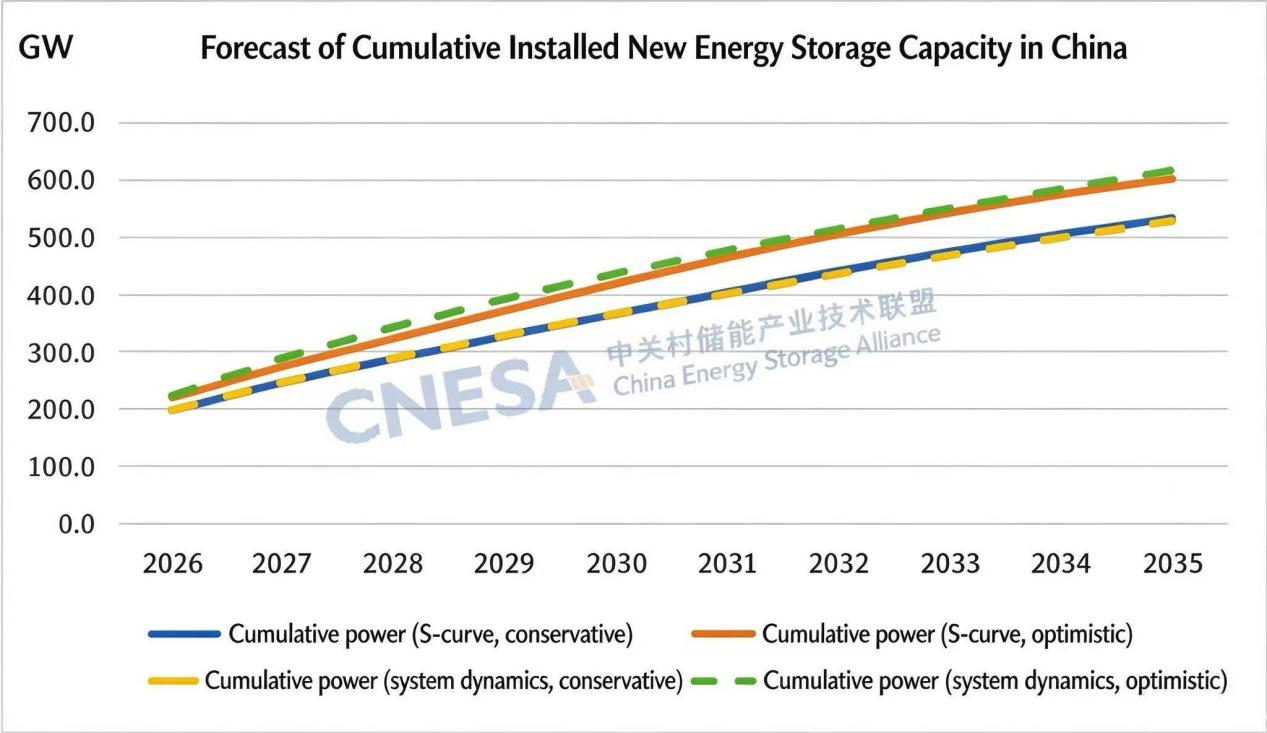
Forecast of Cumulative Installed New Energy Storage Capacity in China, Unit: GW | Source: CNESA
Major national policy documents mark the decisive shift from policy-mandated build-out to market-led growth. Circular 136 removes mandatory pairing as a grid-connection precondition for renewable-energy projects. Circular 114 establishes a national-level capacity-tariff pathway for stand-alone grid-side storage. Updated market rules reform time-of-use pricing and upgrade green-power direct-connection frameworks, while setting clear VPP capacity milestones. Multiple provinces are rolling-out complementary local measures covering spot-market trading, ancillary-service varieties and provincial-level capacity-compensation schemes aligned with national guidance.
Proposed Solutions: Building Multi-Stream Revenue Mechanisms for Storage
CNESA puts forward six policy recommendations to enable the target “capacity remuneration + spot-market income + ancillary-service payment” multi-revenue business model:
1. Refine spot-market price boundaries and push end-users toward spot-indexed tariffs; optimise grid-charge rules to reduce storage operating expenses.
2. Improve dispatch frameworks: permit “renewables + storage” market-entity participation, allow qualified legacy paired-storage assets to convert to stand-alone status, relax grid-power-purchase restrictions and introduce national emergency-dispatch compensation.
3. Enhance capacity-tariff implementation: roll-out provincial detailed rules, adopt time-differentiated effective-capacity assessment, pilot long-duration-storage long-term capacity agreements and progress toward a unified national capacity market.
4. Expand ancillary-service product portfolios including ramp and reserve services; lift frequency-regulation bidding-capacity caps and monetise grid-forming services such as virtual inertia and black-start capability.
5. Support customer-side-storage business-model development: enable re-matching of green-power-direct-connection assets when local loads decline, lower VPP-aggregator entry barriers for multi-market participation.
6. Establish full-lifecycle safety standards; link safety-audit outcomes to market access and capacity-remuneration to build “inspection – rating – revenue” positive incentives.
Strategic Value: Beyond Project Returns — Storage as a Pillar of the New Power System
New-energy-storage delivers peak-shaving, fluctuation-smoothing, inertia and reserve services that stabilise power-system operation amid rising shares of variable renewable generation. It enables wind and solar assets to operate as dispatchable resources and underpins China’s carbon-neutrality transition. National 15th-Five-Year-Plan energy documents clearly define the distinct functional roles of storage across different power-system layers.
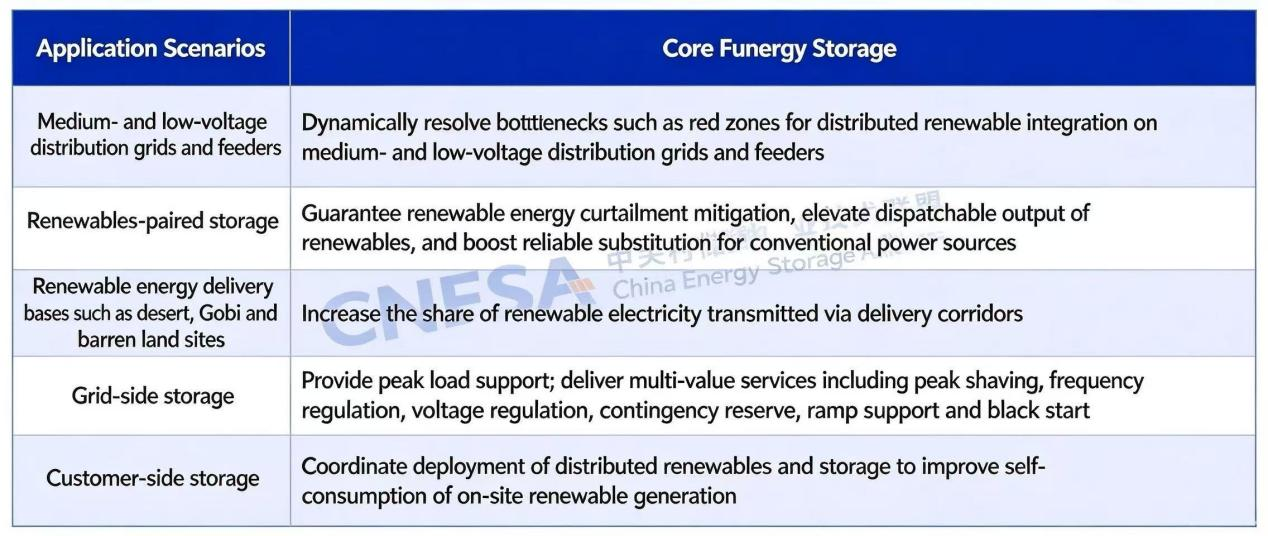
Roles of New Energy Storage within the New Power System | Source: CNESA
Conclusion
Competition in China’s energy-storage sector has moved on from pure installed-capacity racing toward system-value competition. The industry must move past policy-driven expansion and construct complete market-based value-realisation mechanisms that fairly compensate storage for safety, flexibility and economic benefits. This market transition shapes both domestic-industry quality and the operational efficiency of China’s high-renewable-penetration power system.
Contributor: Ran Ze