
A flywheel energy storage project featuring what is reported to be China’s highest-power individual flywheel entered grid-connected operation at Huaneng’s Lanzhou thermal power plant on November 6, 2026. The project uses a dual-flywheel configuration to improve the generating unit’s frequency regulation performance and support grid stability in northwestern China.
The system combines a 5 MW high-power flywheel with a 0.5 MW inertia flywheel. The two units provide complementary, tiered responses: the larger flywheel addresses significant grid frequency deviations, while the smaller unit manages routine, lower-amplitude fluctuations.
According to the report, the thermal generating unit equipped with the dual-flywheel system can respond to grid frequency regulation requests in less than 100 milliseconds, with regulation accuracy exceeding 99.5%.
A 5 MW Flywheel for Fast Frequency Regulation
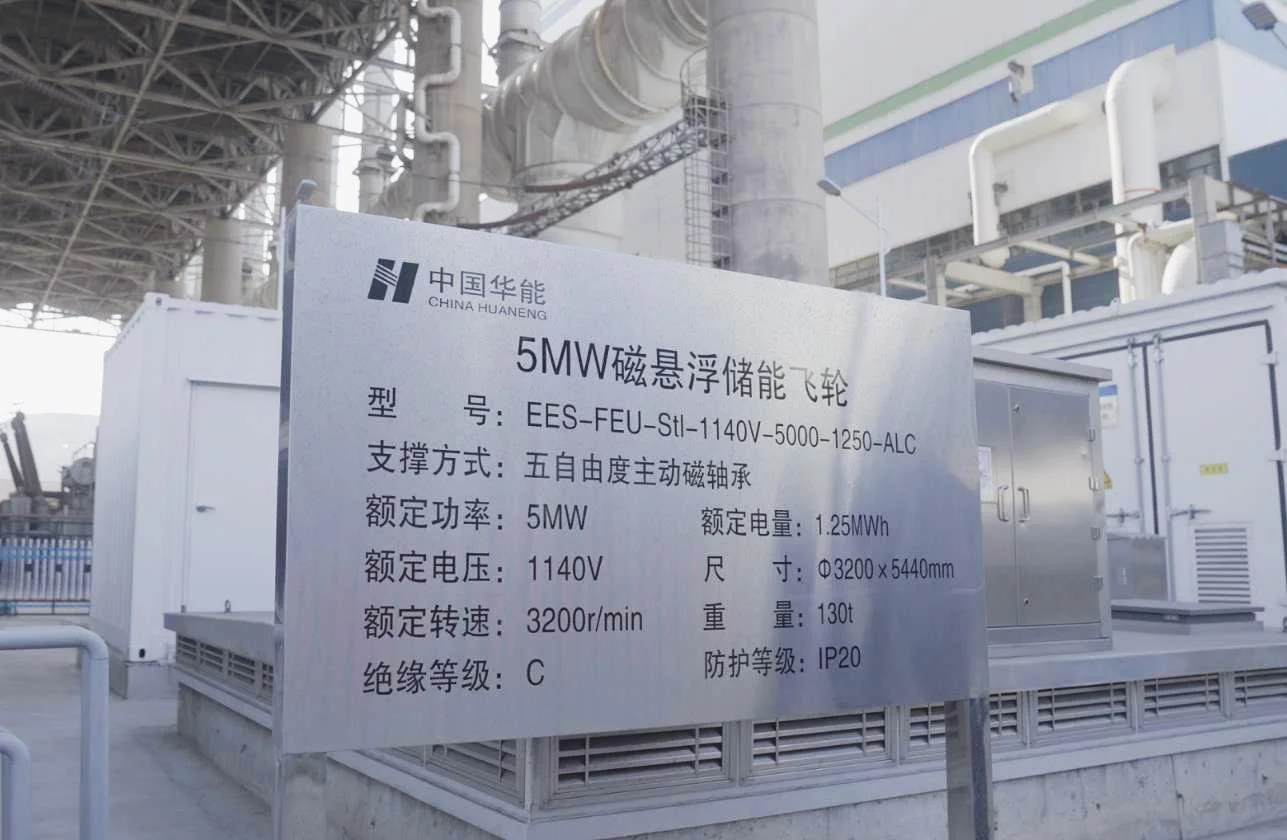
The flywheel energy storage project at Huaneng’s Lanzhou thermal power plant. Photo: China Huaneng.
The 5 MW flywheel is reported to have the highest power rating of any individual flywheel currently operating in China. Its reported specifications include a power ramp rate of 5 MW per second, an energy storage capacity of 1,250 kWh, charge-discharge efficiency above 85%, and a cycle life of up to 10 million cycles.
Flywheel energy storage stores electricity as rotational kinetic energy in a high-speed rotor. During charging, electricity accelerates the rotor; during discharge, the stored kinetic energy is converted back into electricity. Rapid charging and discharging make the technology suitable for applications requiring fast, frequent power adjustments.
Supporting Grid Stability in Northwestern China
The project was led by Huaneng’s Gansu subsidiary, with technology research and development undertaken by Xi’an Thermal Power Research Institute.
The installation is expected to strengthen the plant’s frequency regulation response and improve the regional grid’s ability to withstand disturbances, supporting the safe and stable operation of the power system in northwestern China.
Source: Science and Technology Daily, November 6, 2026. Adapted from the original Chinese report.
Photo credit: China Huaneng.