
Latest News
Sungrow EnerNeo SST Becomes the World’s First SST with Dual EU-US System-Level Certification: cTUVus + EMC + 13.8kV Reinforced Insulation
The surge in AI computing demand is pushing data center power architectures toward the 800V DC era. The China Energy Storage Alliance (CNESA) has noted that Sungrow’s EnerNeo solid-state transformer (SST) received system-level certification from TÜV Rheinland at the 2026 OCP Global Summit, becoming the world’s first SST to pass both European (IEC/EN) and American (UL) system-level certification and the first to secure a ticket to large-scale commercial deployment in the European and American data center markets. This article examines the substance of the certification, the technology route and the cost calculus behind the milestone.
At the 2026 OCP Global Summit, Zhang Di, President of Sungrow Source Intelligence, received a set of certificates from Sean Tilley, Vice President of the Product Services Business Unit of TÜV Rheinland Americas. The EnerNeo SST became the world’s first SST product to pass both European (IEC/EN) and American (UL) system-level certification, with the complete set of cTUVus, EMC and 13.8kV reinforced insulation certificates.
Not One Certificate, but a Stack
During the days of the OCP Global Summit, the convention center in San Jose, Silicon Valley, was packed with data center professionals. It was there that Sean Tilley handed Zhang Di the system-level and key-component certification certificates based on the UL, IEC, EN and 2 PfG series standards.
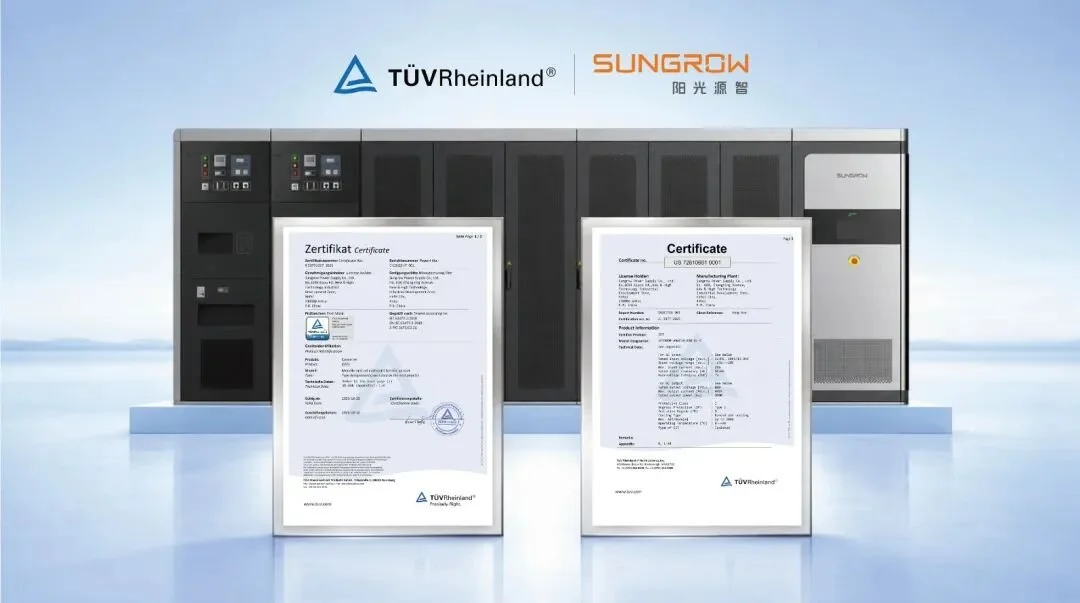
This certification covers the complete SST system. TÜV Rheinland conducted a system-level assessment of the EnerNeo against safety standards including UL 2877, IEC/EN 62477-1, IEC/EN 62477-2 and 2 PfG 3175, as well as EMC standards including EN 61000-6-2, EN 61000-6-4 and FCC Part 15. The core component, the high-frequency isolation transformer, additionally passed the dedicated 2 PfG 3179 certification, meeting the 13.8kV reinforced insulation requirement.
The outcome: the EnerNeo obtained the TÜV Rheinland certification mark, the cTUVus and EMC certificates, and the corresponding test reports. For Chinese equipment makers aiming to enter the European and American data center supply chains, completing this full set is far more difficult than passing any single test.
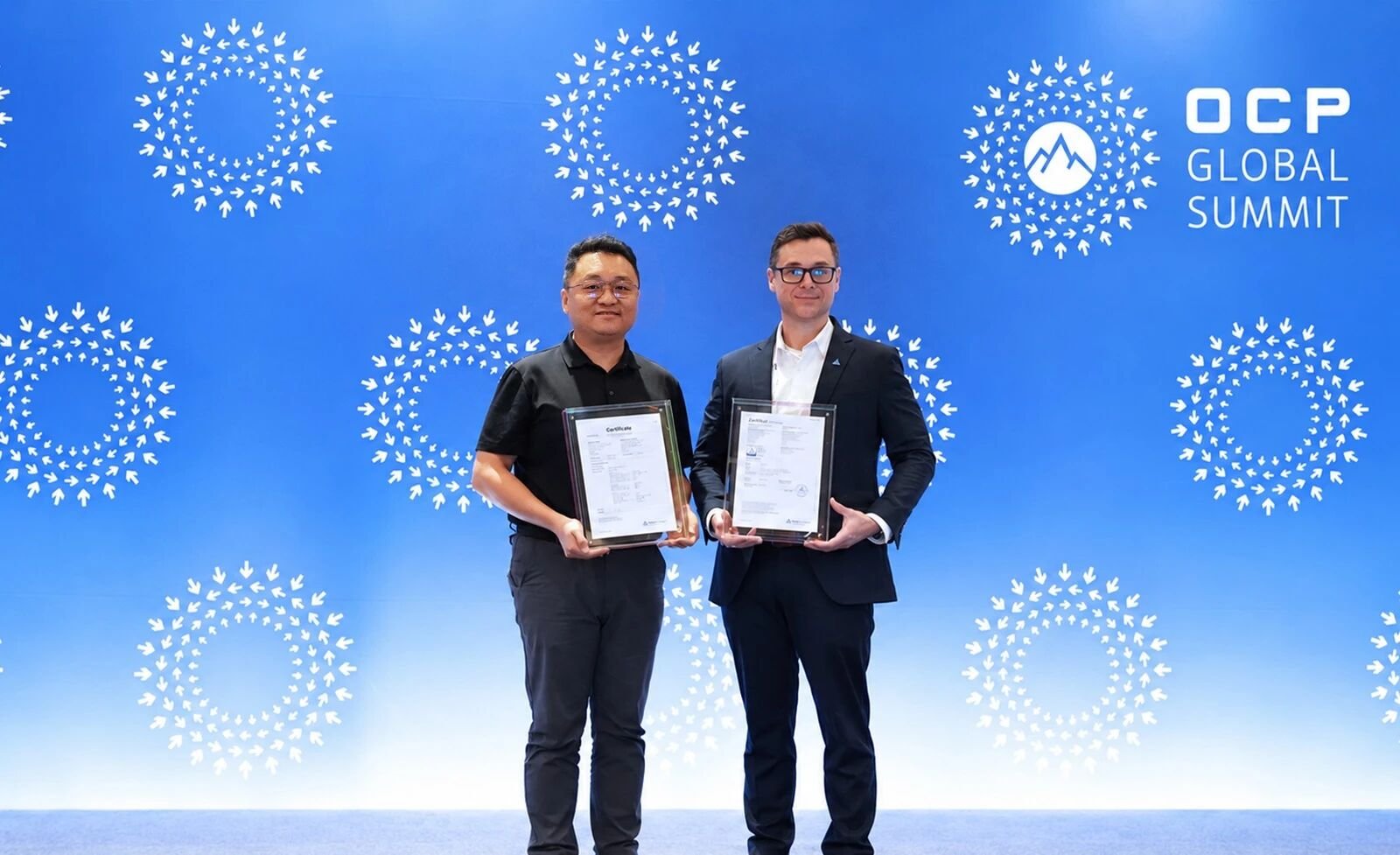
Sean Tilley (right), Vice President of the Product Services Business Unit of TÜV Rheinland Americas, presents the certification certificates to Zhang Di (left), President of Sungrow Source Intelligence.
Why System-Level Certification Is the Real Barrier
Some may ask: SST certification is not news, given that Eaton passed TÜV SÜD’s IEC 62477-2 certification in August. What is the difference?
The key lies in “system-level” and “dual-standard”.
The Solid State Transformer Specification v0.3, effective from June this year under the Open Compute Project (OCP) and jointly developed by Google, Microsoft and NVIDIA, defines the SST as a megawatt-class power electronics converter: a 13.8kV or 34.5kV medium-voltage AC input and an 800V DC output, with a power range corresponding to 5MW or 10MW. The specification covers not only power conversion but also medium-voltage input, low-voltage DC output, auxiliary power, firmware, control and communication, all within the scope of the SST product.
In other words, an SST is no longer just the “transformer” component; it is a complete power electronics system comprising power semiconductors, magnetics, control systems and communication systems. To pass system-level certification, insulation, efficiency, power density and thermal management must all meet the requirements simultaneously, rather than passing part by part.
Certification Dimension
Standards Indicators Involved
US Safety Standards UL 2877
EU Safety Standards IEC/EN 62477-1, IEC/EN 62477-2
Key Component 2 PfG 3175, 2 PfG 3179 (high-frequency isolation transformer,
13.8kV reinforced insulation)
EMC EN 61000-6-2, EN 61000-6-4, FCC Part 15
Certification Marks TÜV Rheinland certification mark, cTUVus, EMC certificates
The European and American markets are particularly strict on this point – UL and cTUVus on the US side, and the IEC/EN series on the European side. For entry into European and American data center procurement lists, system-level dual certification is close to a hard threshold. By securing both at once, the EnerNeo can now compete on equal footing with overseas players such as Delta, Eaton and Vertiv in terms of certification compliance.
800V DC: NVIDIA Sets the Course, Sungrow Delivers First
Why focus on 800V DC? The answer lies in power density.
The white paper “800VDC Architecture for Next-Generation AI Infrastructure”, released by NVIDIA at last October’s OCP Global Summit, has established 800V DC as the standard power architecture for next-generation AI infrastructure, with the SST positioned as the ultimate power supply device in the medium to long term. Sungrow’s 800V solution is also listed in the white paper as a recommended technology route.
The traditional data center power chain is: AC from the grid → step-down via a power-frequency transformer → multi-stage UPS/AC-DC conversion → server racks. Each stage incurs losses, with end-to-end efficiency of about 90%–92%. For megawatt-class racks, hundred-megawatt buildings and gigawatt-scale campuses, these few percentage points of loss translate into enormous electricity bills and thermal loads.
What the EnerNeo does is convert 10–13.8kV medium-voltage AC directly to 800V DC, using SiC power devices and an optimized series-connected H-bridge architecture, eliminating the power-frequency transformer and multi-stage conversion. Published parameters: 98.5% efficiency, 99.999% availability, 312 kW/m² power density, zero partial discharge at rack level (within 21kV), meeting the 42kV power-frequency withstand voltage and 95kV lightning impulse indicators.
According to Sungrow’s own calculation, for a 1GW computing project, the 800V DC architecture can save 400 million kWh of electricity per year. In terms of efficiency difference, 98.5% versus the 90%–92% of the full chain leaves a gap of 6–8 percentage points – no small figure at gigawatt scale.
The EnerNeo SST system and the TÜV Rheinland certificates
Evolution of the power architecture for AI supernode full racks: single-rack power leaps from the 100kW class to the megawatt class, making 800V HVDC an inevitable choice.
The Cost Calculus: SST and Traditional Solutions Are Now on the Same Level
Technology, however good, must pass the cost test. The most-cited criticism of the SST used to be its price; that anchor is now beginning to shift.
In August 2026, the SST procurement budget for the data center of the “Zhiyun Changjingkai” platform was RMB 2 million for 2.5MW of capacity, equivalent to a budgeted unit price of about RMB 0.8/W. In the same year, China Mobile Jiangsu purchased four sets of 2500kVA medium-voltage integrated power systems for its Nanjing Jiangbei Data Center at a winning price of about RMB 1.77 million per set excluding tax, or about RMB 2 million including 13% VAT. 2500kVA is AC apparent power; with the data center load power factor close to 1, the two can be compared at similar capacity levels.
Comparison Item SST Solution Traditional Medium-Voltage Integrated Power
Project Sample Zhiyun Changjingkai 2.5MW SST China Mobile Jiangsu 2500kVA integrated power
Procurement Budget / About RMB 2 million (budget) About RMB 2 million per set (incl. 13% VAT)
Winning Price
Unit Price About RMB 0.8/W About RMB 0.8/W (equivalent at similar capacity)
Capacity Class 2.5MW 2500kVA(≈2.5MW, power factor close to 1)
The comparison is noteworthy: the procurement budget of a 2.5MW-class SST is broadly on par with the winning price of a comparable 2500kVA integrated power system. Once costs reach the same level, the advantages in efficiency, footprint and response speed become decisive factors in procurement decisions.
Certification Is a Ticket, Not the Destination
Back to the OCP Summit. Experts from Google, Microsoft and NVIDIA stood in the audience as Zhang Di received the certificates – a scene carrying more information than the certificates themselves: the core initiators of the OCP SST working group are casting a vote of confidence in a Chinese manufacturer’s technology route.
But this vote is only an entry ticket. The industry is still in the stage of small-batch delivery and customer site validation. Between “certification passed” and “large-scale commercialization” lie multiple tests: engineering reliability, O&M systems, supply chain responsiveness, and acceptance by financing and insurance institutions.
What deserves even closer observation is whether Sungrow Source Intelligence can secure its first large-scale order in Europe and America after obtaining dual-standard certification. Eaton and Delta still hold first-mover advantages in overseas data center O&M and brand recognition; the next challenge for Chinese manufacturers is not laboratory parameters, but the long-term trust of overseas customers.
Abu Dhabi Raises 2035 Energy Storage Target to 15 GW: PV-Storage and AI Computing Drive Growth in Tandem
In September 2026, the Emirates Water and Electricity Company (EWEC) released its latest long-term plan: up to 15 GW of battery energy storage and more than 35 GW of solar PV capacity in Abu Dhabi by 2035. PV-storage pairing on the energy transition side, and new high-reliability power supply demand from AI data centers. Chinese energy storage companies have already secured orders across several links.
1. A Three-Step Target Raise: Over 35 GW Solar and Up to 15 GW Storage by 2035
Abu Dhabi's capacity targets have been raised repeatedly: the 2035 solar target set in 2024 was 18 GW, raised to over 30 GW in May 2026, and raised again in September 2026 to over 35 GW, together with a storage goal of up to 15 GW set for 2035 for the first time. On the interim timeline, the 2030 solar target stands at 14 GW, meaning at least 21 GW more must be added between 2031 and 2035. As Abu Dhabi's sole purchaser and supplier of electricity and water, EWEC stated that as this advanced capacity comes online, the flexibility contribution of gas-fired generation is expected to decline, and storage will take on the main balancing role.
2. Flagship Project First: 5.2 GW Solar + 19 GWh Storage
Abu Dhabi's storage expansion is not confined to planning. Local energy giant Masdar and EWEC are jointly developing a flagship project pairing 5.2 GW of solar PV with 19 GWh of battery storage, designed to deliver 1 GW of continuous renewable power. Construction began in 2025, with commercial operation targeted for 2027. The project involves a total investment of more than AED 22 billion, is expected to create about 10,000 jobs, and will cut about 5.7 million tonnes of CO2 emissions annually. It marks Abu Dhabi's shift from "solar mainly for daytime generation" to "large-scale PV paired with storage to provide dispatchable renewable power". Chinese companies are deeply involved: BYD Energy Storage signed an 11.275 GWh storage system supply agreement featuring 2,710 Ah blade cells; Sungrow secured a 7.5 GWh storage order in the north zone plus a 2.6 GW PV inverter supply agreement; and PowerChina signed the EPC contract for the 2.1 GW + 7.75 GWh RTC solar-storage project, worth about RMB 13.962 billion. Beyond utility-scale projects, Abu Dhabi is also extending into distributed markets: a PV-plus-storage self-consumption policy for agriculture was launched in February 2026 and extended to residential users in April.
3. Emissions Main Line: Power and Water Carbon Emissions Down Over 45%
These moves serve Abu Dhabi's broader emissions reduction goals. EWEC projects that total carbon emissions from power and water production will fall from about 42 million tonnes in 2019 to about 23 million tonnes by 2035, a reduction of more than 45%. Solar power, battery storage, and reverse osmosis desalination are identified as the three core drivers.
4. AIDC: The Second Growth Curve for Storage
The sharp raise of Abu Dhabi's storage targets is closely tied to the region's fast-moving AI data center buildout. In the desert west of Abu Dhabi, a planned "UAE-US AI campus" covering about 26 square kilometers is under construction. Led by UAE artificial intelligence company G42, its first phase, "Stargate UAE", plans a USD 30 billion investment to build a 1 GW compute cluster, with the first 200 MW expected to enter service in 2026. According to Reuters, changes in the regional security situation may shift the project from a single large campus to multiple sites across the UAE, with studies on protective measures such as building some facilities underground or inside mountains and deploying air defense systems and electronic jamming equipment; G42 said the project is "on track".
The power characteristics of AI loads explain exactly why storage is being added in tandem. Unlike traditional data centers, AI training and inference clusters show large, fast power fluctuations, with far higher requirements for supply continuity and power quality than general loads. Khalid, the storage procurement lead of the RTC project, said the project explicitly requires storage to serve both PV peak regulation and the backup needs of nearby new AIDC computing parks; the differing load characteristics of the two forced the drawings to be redone at the design stage. Green power compliance requirements are also driving storage attachment: the UAE requires new large computing projects to use at least 60% green power, and since PV cannot supply stable power around the clock, storage becomes the hard carrier of compliance. Large computing projects without their own storage typically wait three to five years in the municipal grid connection queue, while adding storage reduces reliance on grid expansion. Acceptance standards likewise reflect the special requirements of computing loads: storage PCS power response must be within 10 milliseconds, annual system availability must reach 99.999%, and all suppliers must complete tens of thousands of load impact simulation tests at local laboratories in Abu Dhabi before entering the site. Institutionally, in January 2026 Abu Dhabi announced plans for a dedicated electricity tariff mechanism for AI data centers, offering globally competitive prices to hyperscale data centers.
For Chinese energy storage companies, AIDC scenarios are reshaping the competitive threshold of overseas utility-scale storage projects: response speed, availability, and simulation validation are becoming new entry tickets. The combined "PV + storage + computing" demand in the Middle East is opening new space for storage applications.
Source material: EWEC's plan and public reports by Reuters and other media

Sungrow’s First Energy Storage Plant in the Middle East Launched,with an Annual Capacity of 10 GWh
Egypt has taken a major step toward accelerating its clean energy transition, as Chinese energy storage leader Sungrow and Norwegian renewable developer Scatec partner with the Egyptian government to deliver large-scale solar+storage projects and establish the Middle East’s first battery energy storage manufacturing base, with a planned annual capacity of 10 GWh.
According to foreign media reports, the Egyptian government recently announced that it has signed a series of agreements worth over 1.8 billion USD with Norwegian renewable energy developer Scatec and Chinese energy storage company Sungrow. These agreements aim to build large-scale solar+storage projects and promote local manufacturing of battery energy storage systems. This series of agreements is a key initiative for Egypt to expand its clean energy installed capacity and improve its new energy industry chain.
Scatec will develop the “Energy Valley” project in Minya, which will include the construction of a large-scale integrated solar power and energy storage plant. Meanwhile, Sungrow will build a battery energy storage system manufacturing plant in the Suez Canal Economic Zone (SCZONE) to support energy storage equipment for the project and the regional market.
Both projects are being advanced with the coordination of Egyptian Ministry of Electricity and Renewable Energy and the Suez Canal Economic Zone Authority. Egyptian Prime Minister Mostafa Madbouly stated that these projects highly align with the country’s strategy of localizing new energy industries, and that localizing energy storage and renewable energy manufacturing will be key pillars for enhancing Egypt’s energy security and driving its green transformation.
As part of the project arrangements, the Egyptian Electricity Transmission Company (EETC) has signed a Power Purchase Agreement (PPA) with Scatec, while the New and Renewable Energy Authority (NREA) has signed a land use agreement for the Energy Valley project. Additionally, Sungrow has secured the land use rights for building the battery energy storage manufacturing plant in the TEDA Industrial Zone in SCZONE.
Furthermore, Scatec and Sungrow Energy have signed a battery supply contract, under which Sungrow Energy will provide the battery energy storage systems for the Energy Valley project in Minya.
According to the introduction, the Energy Valley project is positioned as one of the largest integrated clean energy projects in the world, and the first solar+storage project in the region capable of providing stable power supply around the clock. The project will build a 1.7 GW (AC) solar photovoltaic capacity, along with a total of 4 GWh of battery storage systems, distributed across Minya, Qena, and Alexandria. The project will also build new substations and dedicated transmission lines to provide clean electricity to the Wadi El-Sereiriya Industrial Zone in Minya.
On the manufacturing side, Sungrow Energy’s factory in Egypt will become the first battery energy storage system manufacturing base in the Middle East and Africa. Located in the TEDA-Egypt Industrial Zone in Ain Sokhna, the factory will cover an area of about 50,000 square meters and is expected to create around 150 direct jobs. Once operational, the factory will have an annual capacity of 10 GWh, with production expected to begin in April 2027.
Regarding financing, the Egyptian Prime Minister also witnessed the signing of preliminary financing agreements for the Energy Valley project between Scatec and the European Investment Bank (EIB), the European Bank for Reconstruction and Development (EBRD), and the African Development Bank (AfDB), marking the project’s support from multilateral development financial institutions.
__________________________________________________________________
Sungrow Energy has confirmed its sponsorship of the 14th Energy Storage International Conference and Expo (ESIE 2026), register now to attend Asia’s Largest Energy Storage Trade Show for free:
What: The 14th Energy Storage International Conference & Expo
When: Conferences: March 31 - April 2, 2026
Exhibitions: April 1-3, 2026
Where: CIECC Beijing, China
Address: No. 55 Yudong road, Shunyi District, Beijing China

Sign up for our free monthly newsletter to stay informed about the Chinese energy storage market.