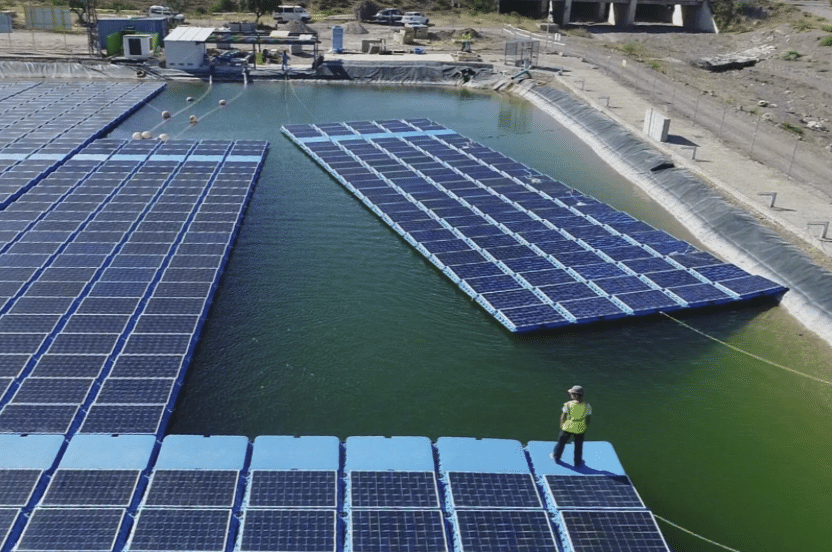
China’s First 300,000 m³ Large-Scale Gas Storage Construction Achieves Important Progress!

By | cnenergynews.cn

Recently, it was learned that the excavation of the underground gas storage cavern at the 300MW advanced compressed air energy storage national demonstration power station being built by China National Energy (Beijing) Technology Co., Ltd. in Xinyang, Henan, has been successfully completed by 50%. This marks an important phased progress in the construction of China’s first 300,000 m³ large-scale gas storage.
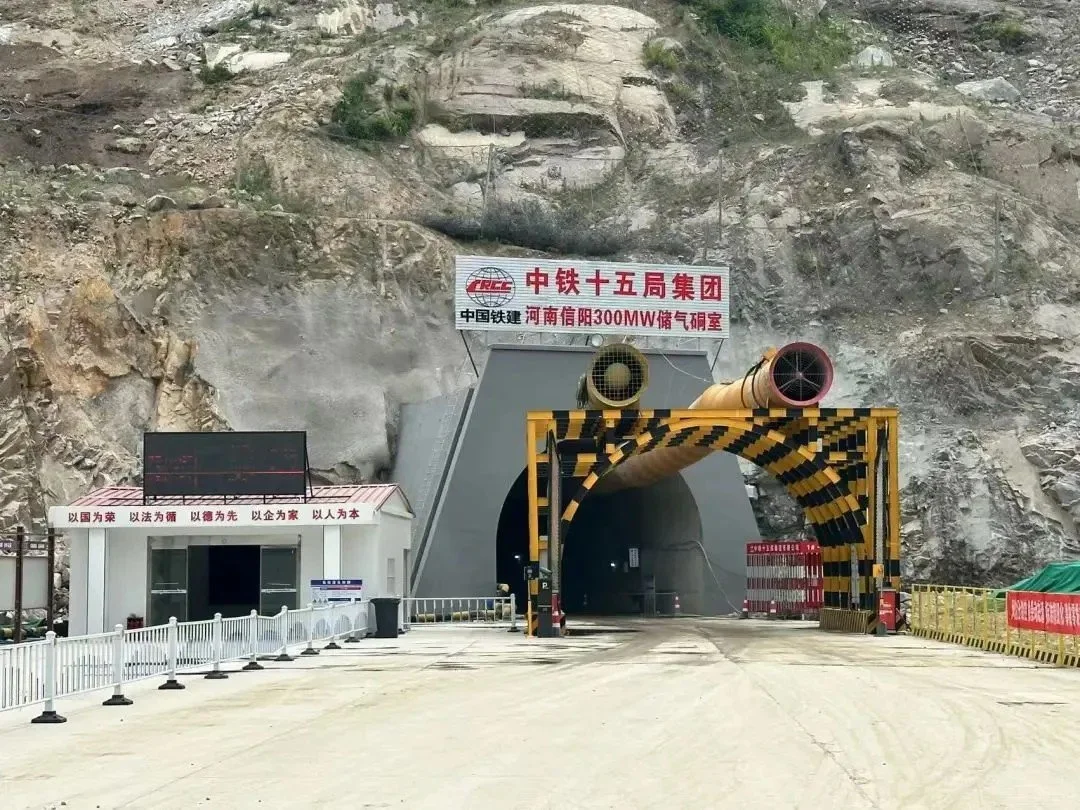
When it comes to a 300,000 m³ underground gas storage cavern, people may have no concept. But if converted, it is equivalent to the volume of 130 Olympic-standard swimming pools filled with water, and you, like me, will be astonished.

So why build an underground gas storage cavern of such scale, and what does it mean for compressed air energy storage?

It is no exaggeration to say that the underground gas storage cavern plays the role of core infrastructure in compressed air energy storage systems. It determines the amount of gas stored, system efficiency, as well as important factors such as safety and stability. Therefore, it is also one of the key technologies for developing long-duration, large-scale compressed air energy storage, and has long been a focus of the industry.

Xinyang Underground Gas Storage Cavern, 300,000 m³ “Hidden Potential Inside”

The Henan Xinyang 300MW advanced compressed air energy storage national demonstration power station is a national new energy storage pilot demonstration project, and was successfully included in the fourth batch of “First (Set) of Major Technical Equipment in the Energy Field” by the National Energy Administration. Once completed, it is expected to generate 420 million kWh annually, effectively improving the efficiency, economics, and reliability of the local power system. In the field of compressed air energy storage, it has technological pioneering significance and major demonstration value.
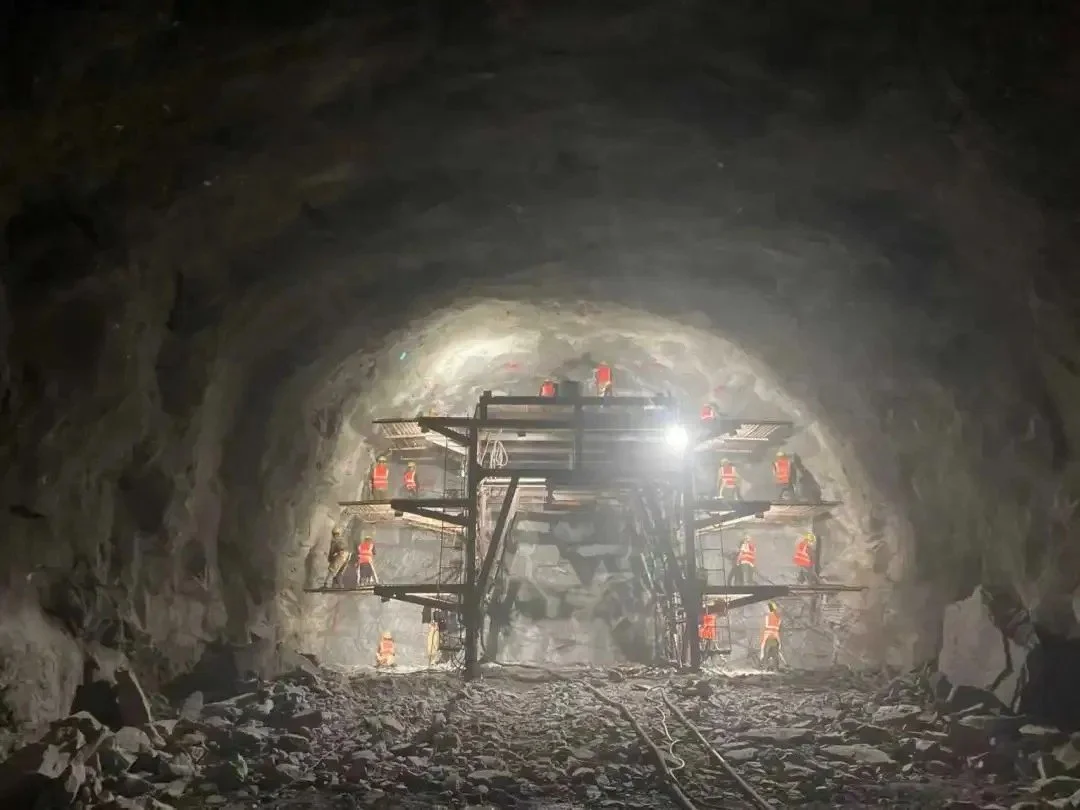
The head of the Xinyang project department revealed to reporters, “The underground gas storage cavern of this power station adopts unique designs such as the ‘high-efficiency self-draining system’ and the ‘breakthrough ultra-large tunnel diameter’.”

High-Efficiency Self-Draining System Shows Remarkable Effect

He further explained: “Accumulated water caused by geological conditions in underground gas storage caverns has long been one of the key technical challenges troubling the safety and construction efficiency of compressed air energy storage underground gas storage caverns. This time, the high-efficiency self-draining system, innovatively designed by technical personnel, through rational design of the longitudinal slope of the gas storage cavern and lowering the internal water level, fundamentally solved this technical problem, significantly improved the long-term safety and operational stability of the system, and provided a brand-new solution for the construction of drainage systems in gas storage caverns under complex geological conditions.”

Cost Reduction and Efficiency Improvement, China’s First 15-Meter Ultra-Large Tunnel Diameter Design

Another highlight of the Xinyang project is the domestic breakthrough of adopting a 15-meter ultra-large tunnel diameter design for the first time. This innovative design increased the effective volume of the gas storage cavern to 300,000 cubic meters, expanding the scale by 300% compared with the previous largest design. While ensuring structural stability, it provided sufficient space support for a 300MW large-scale gas storage system, greatly improving unit cavern storage density and engineering economy. With a 50% increase in tunnel diameter, simple calculations show that this alone reduced costs by 200 million RMB, truly achieving the synergy of safety, efficiency, and economy.

Pioneering Horizontal Excavation Perfectly Solves Geological Problems

So what is the difference between horizontal-entry underground gas storage caverns in compressed air energy storage systems and traditional methods, and what are the advantages?

Traditional vertical-entry or inclined-shaft-entry construction has a long construction cycle and high costs, while horizontal-entry construction has relatively lower risks, lower costs compared with vertical shafts, and more convenient transportation during construction.

The technical team, for the first time in the field of compressed air, adopted horizontal-entry technology, which can extend along the strike of rock formations or stable strata, flexibly avoiding faults, and effectively solving adverse geological problems such as water-inrush zones. Compared with vertical shafts, it can more accurately select rock masses with good integrity and high compressive strength as the main cavern body, reducing construction risks caused by deep geological variations (such as soft rock interlayers, high water pressure zones). It also has obvious advantages in terms of environmental impact and economy.

Pingjiang Underground Gas Storage Cavern, the Starting Point of Underground Gas Storage Innovation

The ingenious design of the underground gas storage cavern at the Henan Xinyang 300MW advanced compressed air energy storage national demonstration power station is just a small reflection of China National Energy Technology’s in-depth cultivation of compressed air energy storage technology and engineering applications in recent years.
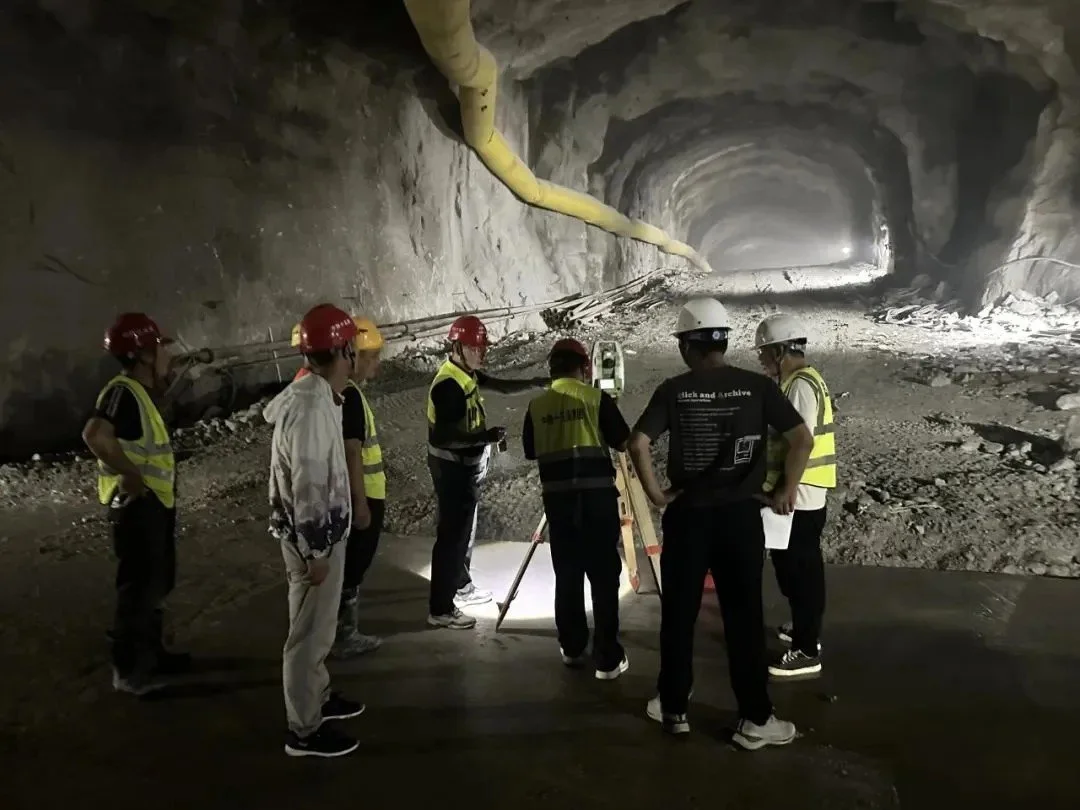
If we trace back this path of innovative exploration, every project shines like a pearl, strung together into a brilliant chain of underground gas storage caverns for compressed air energy storage by China National Energy Technology, China, and even the world. And to look back at the beginning, we must return to 2018…

In 2018, the founding year of China National Energy Technology, its incubator—the Institute of Engineering Thermophysics, Chinese Academy of Sciences—participated in the experimental work of the shallow-buried underground gas storage experimental cavern for compressed air energy storage in Pingjiang, Hunan, together with Central-South Design Institute of Power Construction. This was also the first domestic hard-rock shallow-buried gas storage experimental cavern for compressed air energy storage.

It broke through the limitations of traditional salt-cavern gas storage and provided important technical support for the engineering practice of shallow-buried gas storage caverns in compressed air energy storage, which was also the starting point of China’s underground gas storage cavern development for compressed air energy storage.

Unceasing Exploration, Zhangjiabei International First 100MW Project Achieves New Breakthrough

Soon after the Pingjiang project, starting from 2018, China National Energy Technology and the Institute of Engineering Thermophysics, Chinese Academy of Sciences, launched relevant research topics and project construction for the Zhangjiakou, Hebei, International first 100MW advanced compressed air energy storage national demonstration power station. Among them, the underground gas storage cavern construction was the world’s first underground artificial cavern for a 100MW-level compressed air energy storage system, and also the world’s first 100,000 m³ underground gas storage cavern.
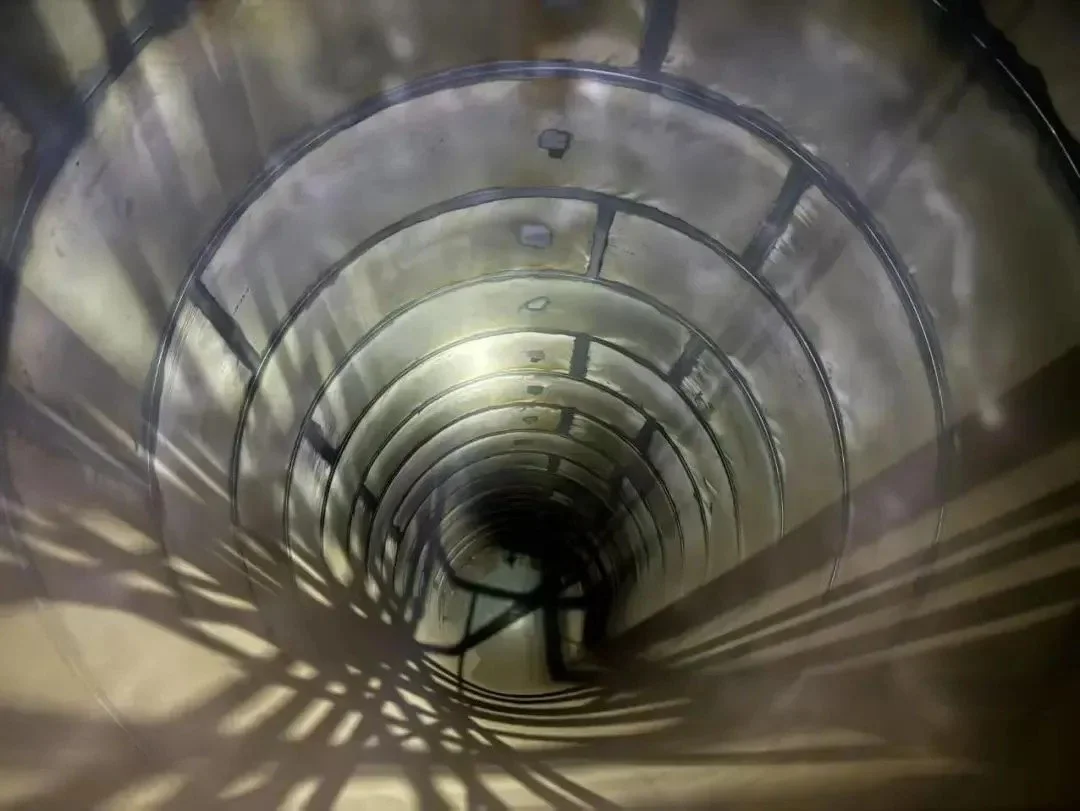
The Zhangjiabei project is a milestone for the world’s new-type compressed air energy storage entering the 100MW-level engineering stage. It greatly advanced the industrialization and engineering application of new compressed air energy storage, adding another powerful tool for long-duration, large-scale energy storage. The power station construction received support from major projects such as the National Renewable Energy Demonstration Zone of the National Development and Reform Commission, and was included in the First (Set) of Major Technical Equipment in the National Energy Field and typical cases of green and low-carbon technology in the Beijing-Tianjin-Hebei region, with extraordinary significance.

Multiple Technical Measures to Solve Complex Geological Problems of Weak Interlayers

By adopting underground artificial caverns, the siting of compressed air energy storage becomes more flexible and can better coordinate with wind and solar power bases. However, China’s vast territory and complex geological conditions also bring various challenges to underground gas storage cavern excavation.

The basalt at the Zhangjiabei project site contains complex geology with weak interlayers, including fractured zones and densely jointed zones, which posed great challenges to construction safety and gas storage cavern stability. Technical personnel creatively adopted systematic anchor-shotcrete support, advanced anchor rods, and other measures to solve the rock mass issues, while also using advanced geological prediction and concrete replacement technologies to improve excavation safety and the stability of surrounding rock under long-term high-pressure air cycling loads. These efforts provided valuable first-hand data for constructing underground gas storage caverns for compressed air energy storage under complex geological conditions.

Unique Sealing Layer Technology Ensures Safe and Efficient Operation

For the first time at the Zhangjiabei project gas storage cavern, China National Energy Technology adopted high-strength steel, effectively solving the problems of safe and stable operation and sealing of the cavern under high air pressure during operation. At the same time, it addressed the external water pressure caused by higher water heads during operation and maintenance periods, strongly ensuring the safe and efficient operation of the underground gas storage cavern under complex geological conditions.

Tailored Drainage Technology Solutions

Just as the weather cannot be accurately predicted, geological conditions are also difficult to fully understand through preliminary surveys. In solving geological seepage and leakage problems, technical personnel, through practice, designed and summarized a professional anti-seepage and drainage solution. This scheme follows the principle of “block first, then drain; combining blocking and draining,” addressing the impact of groundwater on construction safety.

Breaking Through Soft Rock Limitations, Consolidating the Demonstration Role of the Zhongning Underground Gas Storage Cavern

In October 2023, the Datang Zhongning 100MW advanced compressed air energy storage national demonstration power station began construction. It is a project supported by the special fund of the National Development and Reform Commission and has demonstration and leading roles in scientific research innovation, equipment manufacturing, and engineering construction. Once completed, it is expected to generate 120 million kWh annually, providing important support for Ningxia to build a national new energy comprehensive demonstration zone.

Building the First Domestic Fully Artificial Cavern Underground Gas Storage in Soft Rock

Northwest China is the concentration area of the country’s wind and solar energy. The “West-to-East Power Transmission” is a major national energy strategy. Therefore, long-duration large-scale energy storage in the western region has become a focus of industry attention. Overcoming the limitations of soft rock geology in the western region can greatly unleash the potential of new-type compressed air energy storage in long-duration large-scale energy storage, which has great significance for both the industry and national strategic development.

Traditional gas storage cavern construction mostly chooses special geology such as salt rock or hard rock, which severely restricts the siting range of energy storage power stations. Through multiple innovative designs, the Datang Zhongning project overcame this severe limitation on the applicability of compressed air energy storage and built the first fully artificial cavern underground gas storage in soft rock strata in China.

First Domestic Ring-Shaped Gas Storage Cavern Structural Design

In the Zhongning project, technical personnel for the first time innovatively adopted a ring-shaped underground cavern structure. Through a closed-loop design, the surrounding rock stress distribution efficiency was significantly improved, achieving a technical breakthrough of stably constructing large-volume gas storage space in soft rock, greatly improving the utilization rate of underground space. This provided more possibilities for flexible siting of energy storage power stations in regions with soft rock distribution in China.

Unique Entry and Sealing Designs

In the Datang Zhongning project, technical personnel changed the traditional vertical shaft entry method, cleverly combining vertical and inclined shafts, effectively improving construction efficiency, making ventilation and drainage more convenient, while reducing interference in processes such as muck removal and steel lining assembly, thereby improving construction efficiency and results.

In terms of sealing layer design, considering the deformation-prone characteristics of soft rock strata, researchers adopted a composite design: using flexible materials to cope with deformation problems while also using rigid materials to provide stable support, ensuring the safe storage of high-pressure air at a depth of 150 meters, as well as the system’s sealing and safety.
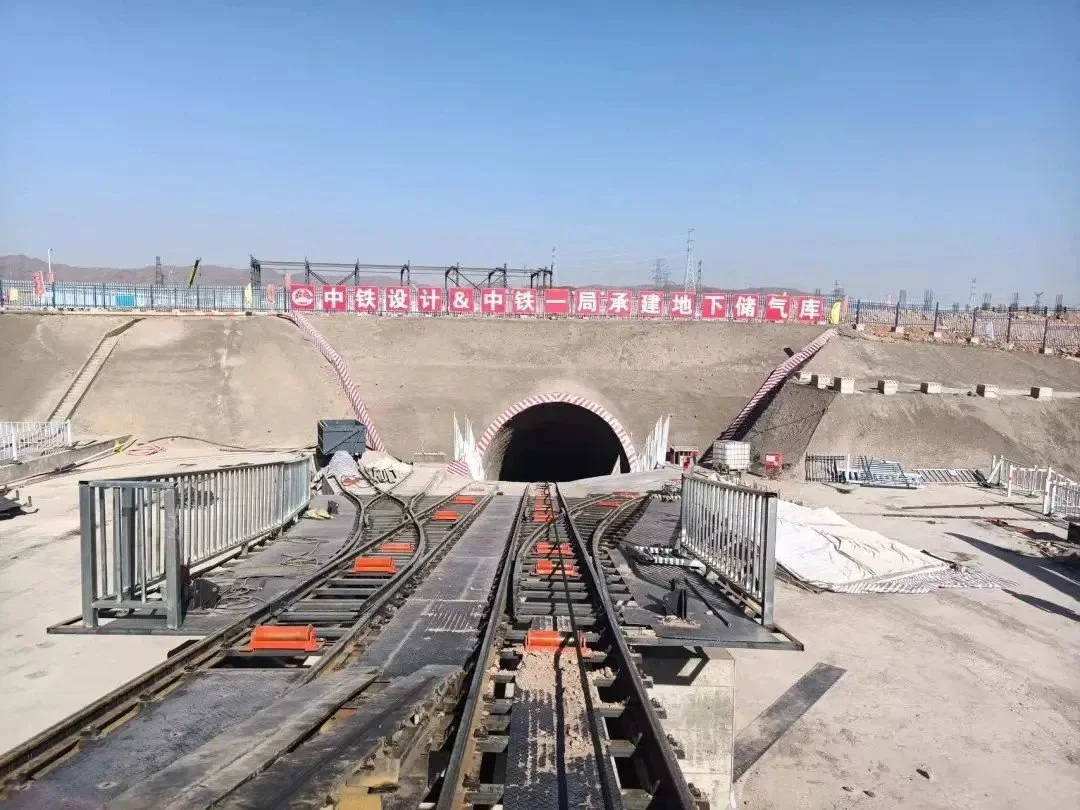
First Multi-Ring Array Design, Yanshan Project Construction Further Upgraded

The Jiangxi Yanshan 300MW advanced compressed air energy storage national demonstration power station is a key national project in new energy storage and the energy field, included in the “New Energy Storage Pilot Demonstration Project List” and the fourth batch of “First (Set) of Major Technical Equipment in the Energy Field.”

From Single-Ring to Multi-Ring, Releasing Infinite Possibilities for Compressed Air Energy Storage

Building upon the “ring array” design of the underground gas storage cavern in the Datang Zhongning project, the Jiangxi Yanshan project achieved new breakthroughs and upgrades, for the first time adopting a “multi-ring array” design.

While ensuring the stability of the gas storage cavern, this design allows multiple gas storage caverns to operate independently, with flexible staged commissioning, calmly coping with various complex geological conditions. At the same time, it improves project construction and operation efficiency, providing sufficient technical support for the application of compressed air energy storage in more complex and diverse geological conditions.

First Application of Digital Twin Technology in Compressed Air Energy Storage Underground Gas Storage Caverns

Driven by the growing demand for “digital-intelligent” management of compressed air energy storage power stations, in 2024, China National Energy Technology took the lead in applying a “large-scale energy storage and monitoring automated management system design” in domestic compressed air energy storage underground gas storage caverns, in order to enhance management refinement and intelligence, and continuously improve the management level of power stations.

Multiple Major Projects Forge Strong Underground Gas Storage Cavern Construction Capability

We can see that from its establishment in 2018, China National Energy Technology has walked alongside the country’s first shallow-buried underground gas storage experimental cavern for compressed air energy storage—the Pingjiang storage cavern.

After continuous optimization through multiple advanced compressed air energy storage power stations, including Zhangjiabei 100MW, Datang Zhongning 100MW, Henan Xinyang 300MW, and Jiangxi Yanshan 300MW, China National Energy Technology has summarized a complete set of solutions for large-scale underground gas storage caverns under different regional and geological conditions. Beyond its outstanding advantages in compressed air energy storage system R&D, core equipment manufacturing, and system integration, it has also mastered the core competitiveness of underground gas storage caverns, laying a solid foundation for continuously growing stronger in the compressed air energy storage industry in the future.

Innovation Never Stops. China National Energy Technology General Manager Ji Lü stated to reporters that compressed air energy storage is a systematic project, and every part requires meticulous polishing and continuous iteration and upgrading. In the future, the company will continue to strengthen research investment in underground gas storage caverns, actively participate in the formulation of national and industry standards, and provide valuable technical and engineering services for compressed air energy storage and other related fields.
CNESA Major Release on the 10th Western China Energy Storage Forum

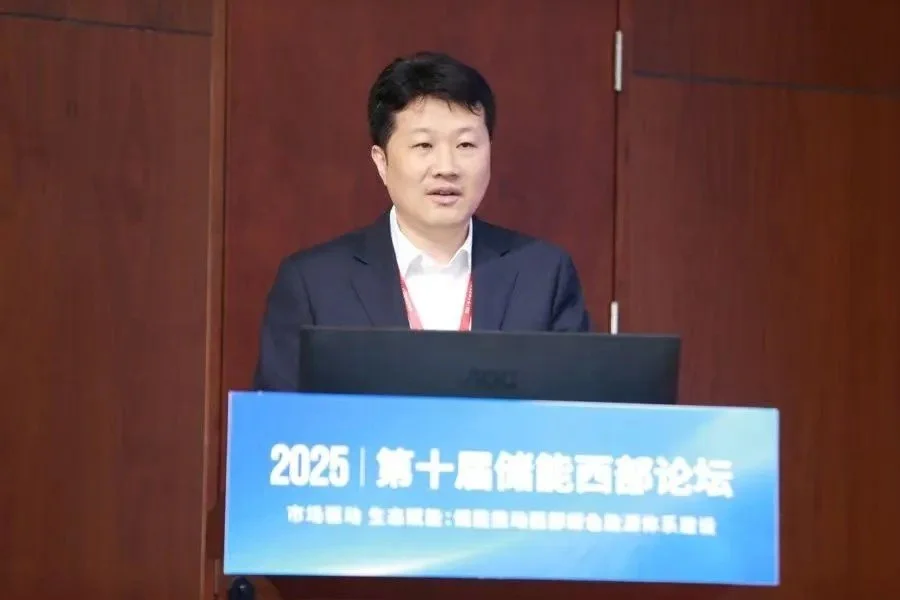
On August 19, 2025, the 10th Western China Energy Storage Forum grandly opened in Hohhot, Inner Mongolia. This forum was hosted by the China Energy Research Society, China Energy Storage Alliance, New Energy Storage Innovation Consortium of Centra SOEs, Inner Mongolia Energy Storage Promotion Association, and Hohhot Industrial Innovation Research Institute, and co-hosted by CRRC Zhuzhou Institute, HyperStrong, and Kehua Digital Energy Tech Co., Ltd. Haisheng Chen, Chairman of China Energy Storage Alliance and Director of the Institute of Engineering Thermophysics, Chinese Academy of Sciences, delivered a keynote report entitled "Current Status and Trends of New Energy Storage Industry Development," and released data on the energy storage industry for the first half of 2025.

Haisheng Chen, Chairman of China Energy Storage Alliance and Director of the Institute of Engineering Thermophysics, Chinese Academy of Sciences

1. Scale of New Energy Storage Projects

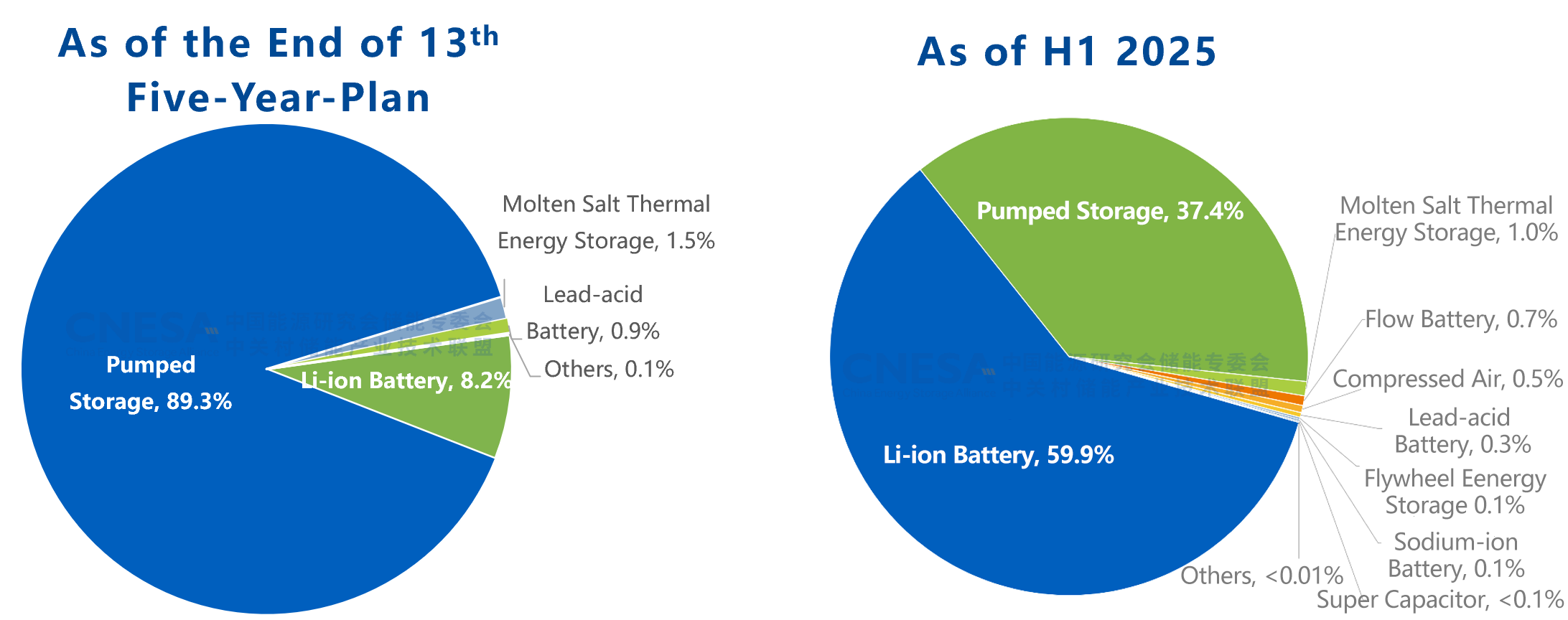
Cumulative Power Storage Installed Capacity Reaches 164.3GW, Share of Pumped Storage Falls Below 40% for the First Time
According to incomplete statistics from the CNESA DataLink Global Energy Storage Database, as of the end of June 2025, China's cumulative installed capacity of power storage reached 164.3GW, a year-on-year increase of 59%. This year marks the final year of the "14th Five-Year Plan." Compared with the end of the "13th Five-Year Plan," significant changes have occurred in the structure of storage technology routes. The share of pumped storage has fallen below 40% for the first time, while new energy storage represented by lithium-ion batteries has achieved leapfrog growth. In addition, single-technology routes are accelerating toward diversification.

Figure 1: Distribution of Cumulative Installed Capacity of Power Storage in China (Unit: GW%)

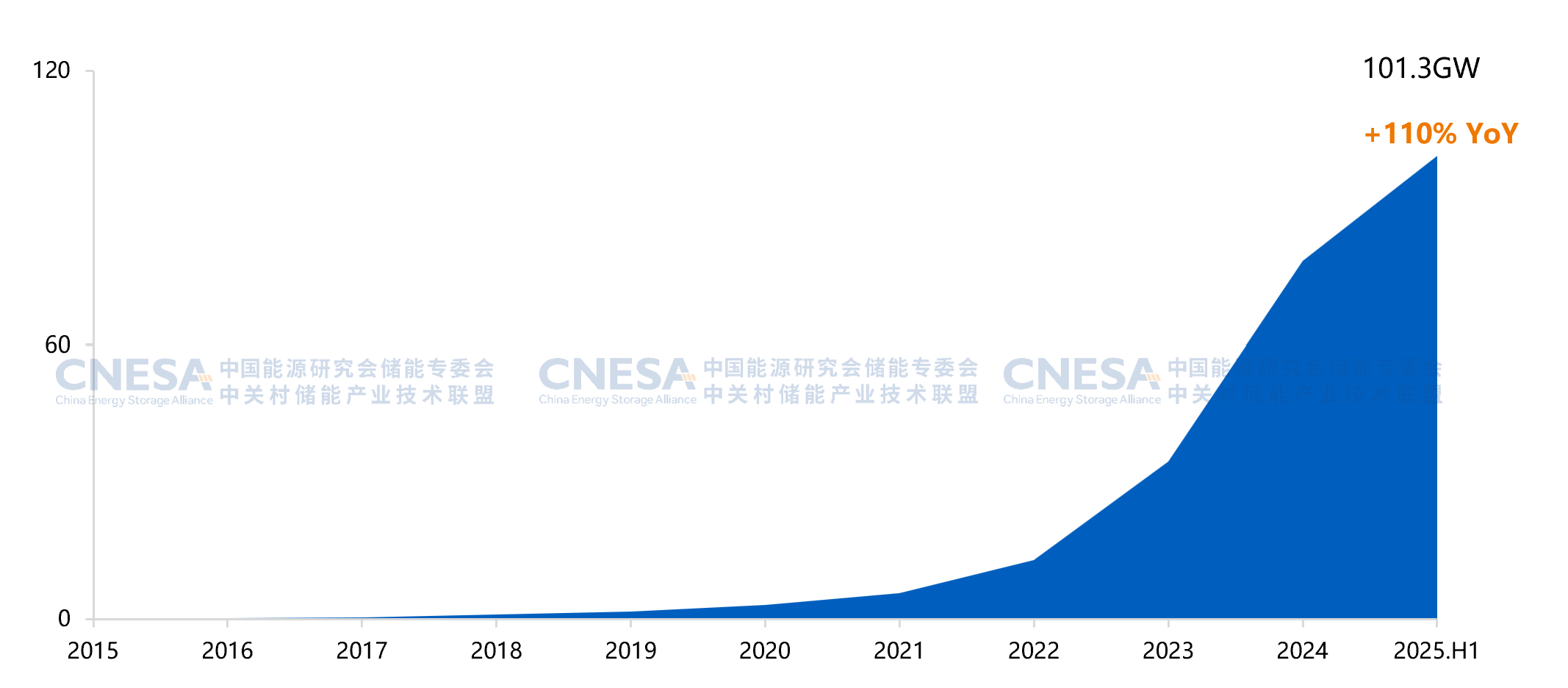
Cumulative Installed Capacity of New Energy Storage Surpasses 100GW for the First Time
As of the first half of 2025, China’s cumulative installed capacity of new energy storage reached 101.3GW, a year-on-year increase of 110%, surpassing 100GW for the first time. The cumulative installed capacity is 32 times that at the end of the "13th Five-Year Plan."

Figure 2: Cumulative Installed Capacity of New Energy Storage in China (Unit: GW)

New Energy Storage Added 23.03GW/56.12GWh
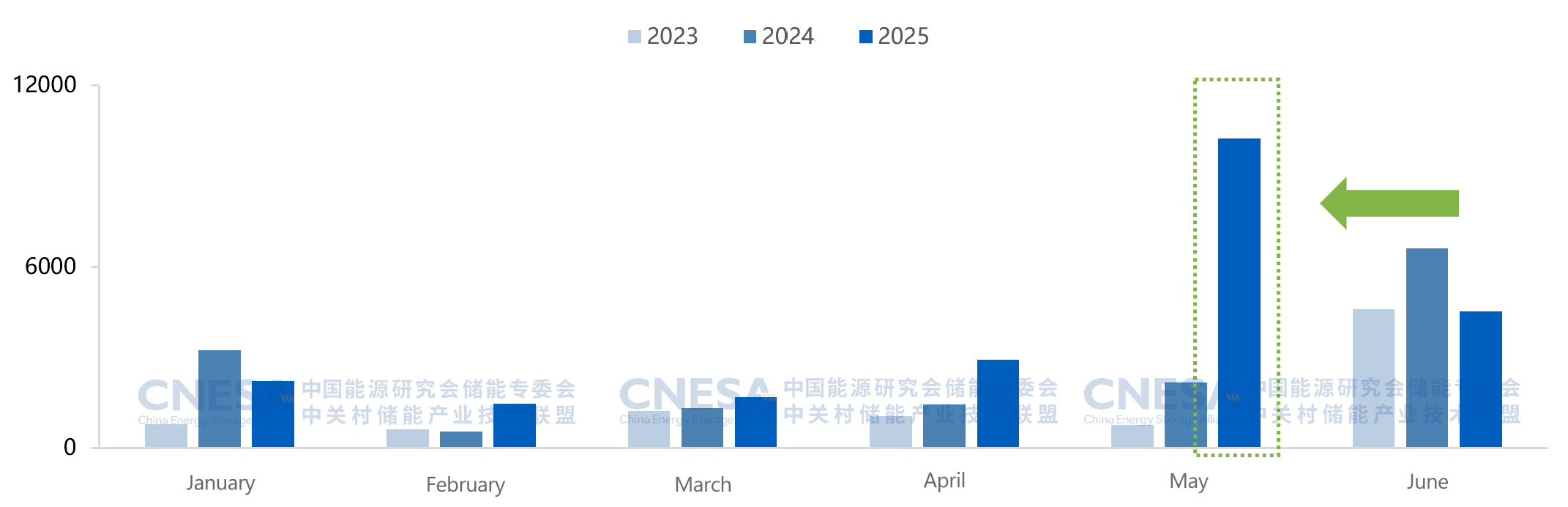
In the first half of 2025, newly commissioned new energy storage projects reached 23.03GW/56.12GWh, with both power and energy scales increasing 68% year-on-year. Due to policy adjustments, project grid-connection timelines shifted earlier to "5·31." In May, new installations hit a record monthly high of 10.25GW/26.03GWh, a year-on-year increase of 462%/527%.

Figure 3: Comparison of Monthly New Installations of New Energy Storage in China (2023-2025.H1, Unit: MW)

2. Shipment Situation of Chinese Energy Storage Companies in H1 2025
At the same time, Chairman Haisheng Chen also released the shipment data of Chinese energy storage technology providers and energy storage system integrators in the first half of 2025. CATL, CRRC Zhuzhou Institute, and Sungrow ranked at the top. The specific shipment situation is as follows:

2025.H1 Shipment of Energy Storage Batteries in the Global Market by Chinese Technology Providers
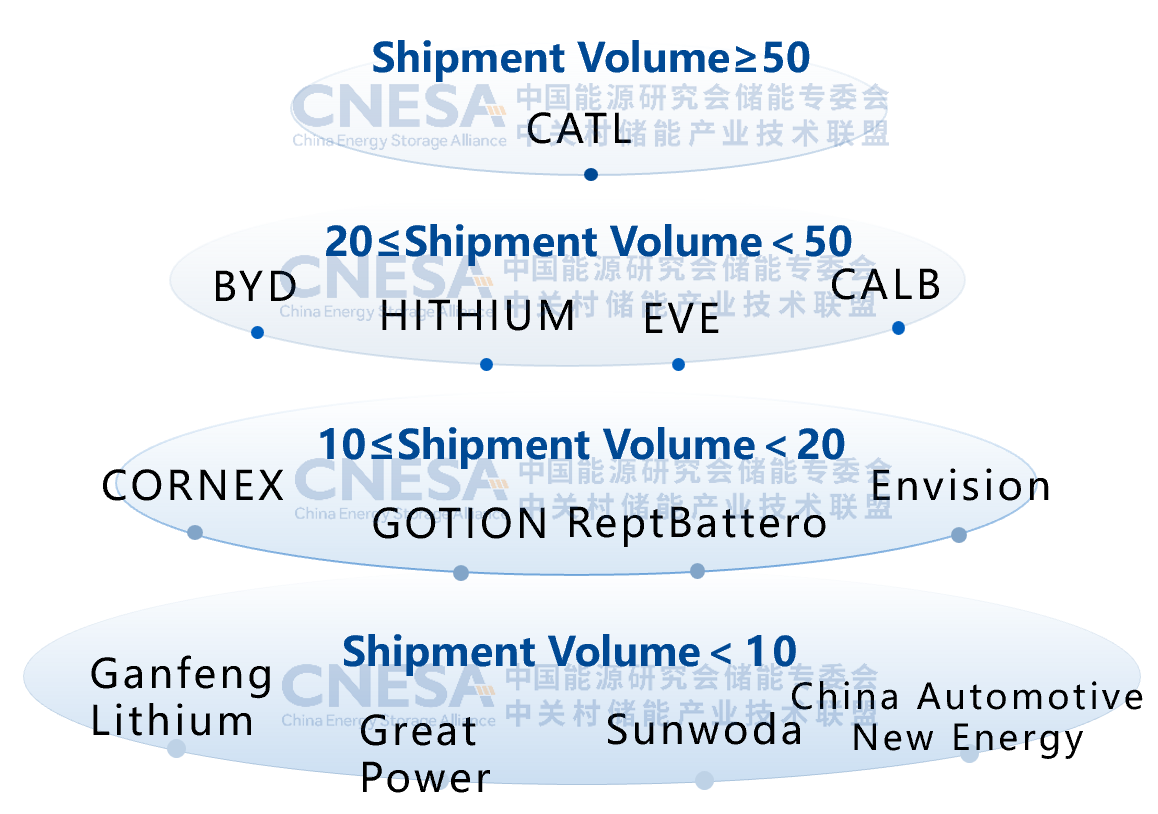
According to incomplete statistics from the CNESA DataLink Global Energy Storage Database, in the first half of 2025, shipments of energy storage batteries (excluding base station and data center cells) from Chinese companies to the global market reached 233.6GWh. Based on shipment volumes ≥50GWh, 20GWh≤shipment<50GWh, 10GWh≤shipment<20GWh, and shipment<10GWh, the shortlisted companies are shown in the figure below.

CATL still firmly holds the top position, while second-tier companies are rapidly narrowing the gap.

Figure 4: Shipment Volume of Energy Storage Batteries in the Global Market by Chinese Technology Providers in H1 2025 (Unit: GWh)

Note: (Companies within each range are listed in order of the initials of their short names in Pinyin.)
Statistical scope: Global shipment volume of energy storage cells (excluding base station and data center cells) independently produced by enterprises in H1 2025. Shipment volume is based on cells that have left the factory and been delivered to customers or project sites.

2025.H1 Top 10 Energy Storage System Integrators in the Chinese Domestic Market by Shipment Volume
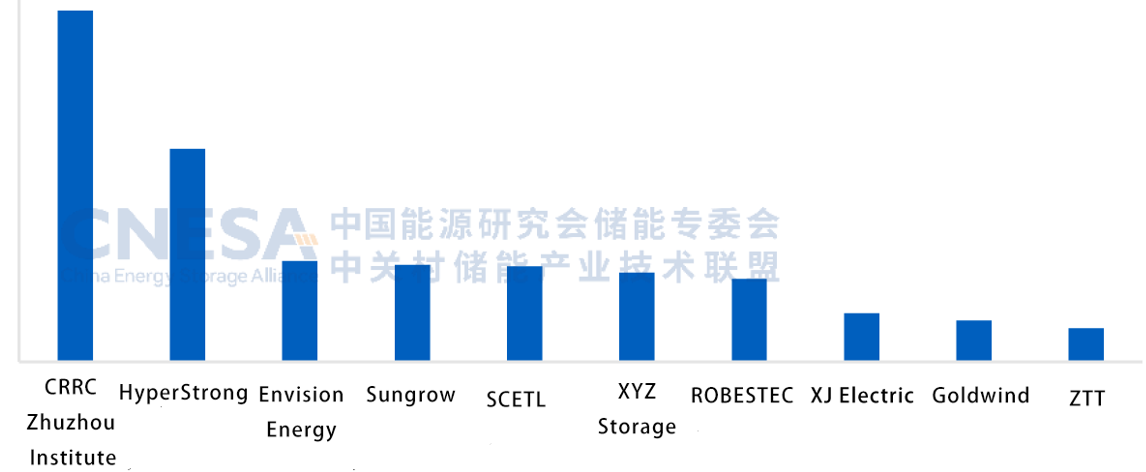
In the first half of 2025, the Top 10 Chinese companies in terms of energy storage system shipments in the domestic market were, in order: CRRC Zhuzhou Institute, HyperStrong, Envision Energy, Sungrow, SCETL, XYZ Storage, ROBESTEC, XJ Electric, Goldwind, and ZTT.

Figure 5: Top 10 Energy Storage System Integrators in the Chinese Domestic Market by Shipment Volume in H1 2025 (Unit: GWh)

Note: Energy storage system specifically refers to an AC-side system composed of an energy storage battery DC system, converter and boosting system, EMS, and related auxiliary equipment.

2025.H1 Top 10 Energy Storage System Integrators in the Global Market by Shipment Volume
In the first half of 2025, the Top 10 Chinese companies in terms of energy storage system shipments in the global market were, in order: Sungrow, CRRC Zhuzhou Institute, HyperStrong, Envision Energy, SCETL, XYZ Storage, ROBESTEC, Sunwoda Energy, CSI Solar, and Trina Storage.

Figure 6: Top 10 Energy Storage System Integrators in the Global Market by Shipment Volume in H1 2025 (Unit: GWh)

Note: Energy storage system specifically refers to an AC-side system composed of an energy storage battery DC system, converter and boosting system, EMS, and related auxiliary equipment.

3. New Energy Storage Tendering and Bidding Market

Scale of New Energy Storage Tenders and Bids
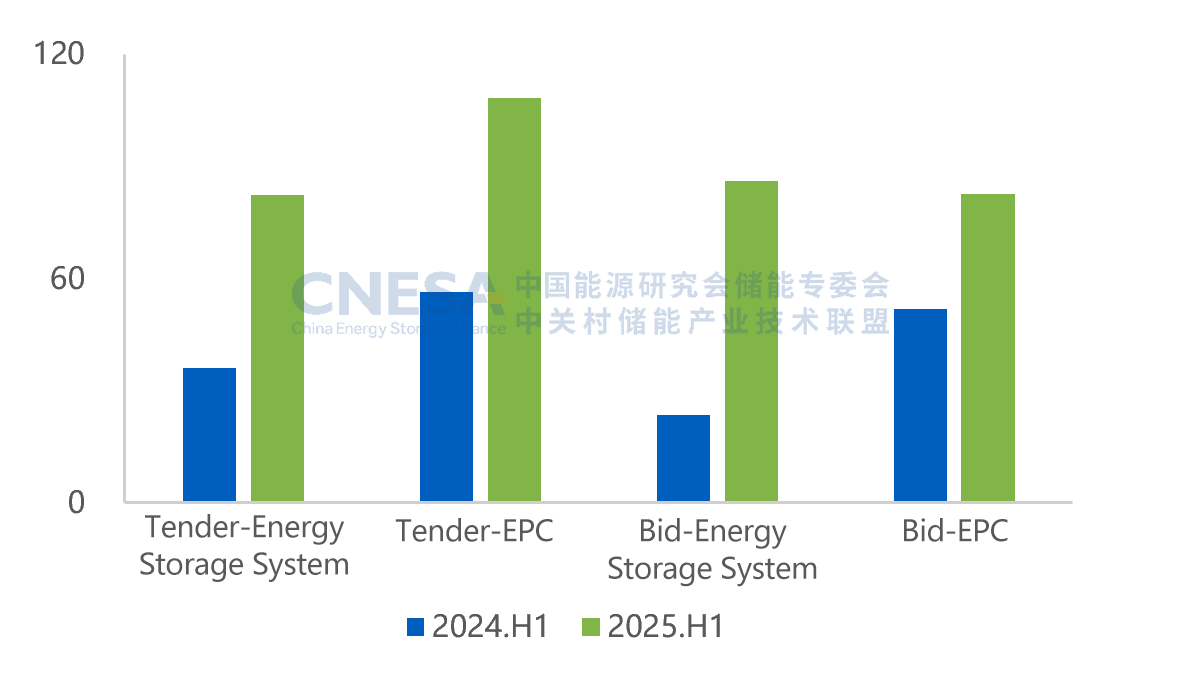
According to incomplete statistics from the CNESA DataLink Global Energy Storage Database, in the first half of 2025, China’s new energy storage tender and bid market grew significantly, especially the bidding scale of energy storage systems, reaching 86.2GWh, a year-on-year increase of 264%. The main reason was the surge in centralized procurement/framework procurement bidding scale, which increased 618% year-on-year. Several large-scale centralized/framework procurements announced bid results in the first half of this year, accounting for 69% of the total energy storage system bidding market, up 33% from the same period last year.

Figure 7: Distribution of Tender and Bid Scale in H1 2025 (excluding centralized/framework procurements, Unit: GWh)

Centralized/Framework Procurement Bidding Scale of Energy Storage Systems
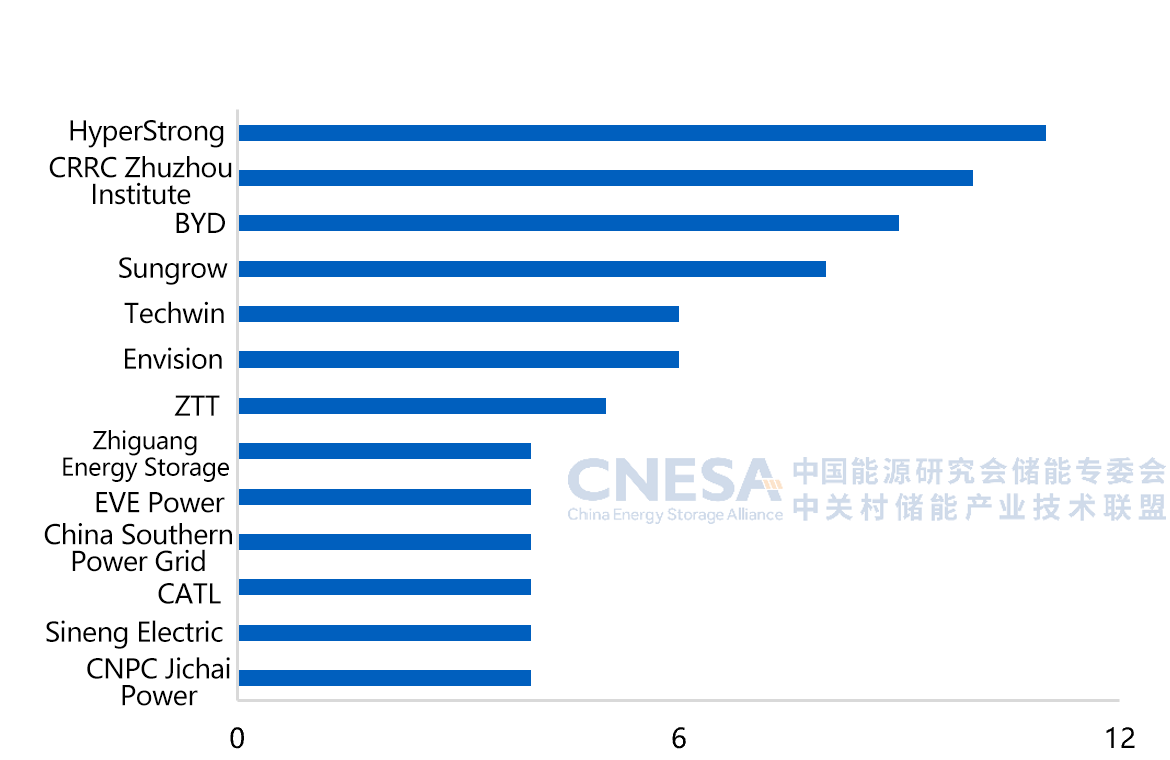
In terms of centralized/framework procurement of energy storage systems, both tendering scale and bidding scale achieved substantial growth in the first half of 2025 compared with the same period last year. Tendering scale increased by 176% year-on-year, and bidding scale increased by 606%. Among tendering entities, China Energy Engineering Corporation ranked first with a tendering scale of 25GWh, followed by SPIC and China Huadian. Among winning enterprises, HyperStrong, CRRC Zhuzhou Institute, and BYD ranked top three in terms of the number of winning bid sections.

Figure 8: Distribution of Tendering Entities with Over 1GWh in Centralized/Framework Procurement in H1 2025 (Unit: GWh)

Figure 9: Distribution of Enterprises with Four or More Winning Bid Sections in Centralized/Framework Procurement in H1 2025 (Unit: Sections)

Note: Lithium iron phosphate energy storage systems (including grid-forming type), excluding centralized/framework procurements and user-side applications.

4. Market Outlook for New Energy Storage

Looking ahead to the "15th Five-Year Plan," new energy storage will be driven by the market. Combining its green value, it will continuously expand new application scenarios, innovate business models, and promote the industry’s upgrade toward high-quality development.
First, market participation progress will accelerate. The market-oriented development of energy storage has become inevitable. Facing different needs across regional markets in the future, more innovative business models will emerge.
Second, scientific planning and coordination will gradually be achieved. Energy storage will be more closely coupled with the construction of new power systems and achieve diversified applications in zero-carbon parks, green power direct connections, and other fields, expanding new business models.
Third, the construction of capacity mechanisms will accelerate. The role of new energy storage capacity is emerging. Reasonable evaluation of the capacity value and conversion methods of new energy storage, and its coordinated development with pumped storage and thermal power as regulation resources, will be the research focus.
Fourth, the market will drive industrial upgrading. China’s new energy storage business models have already shifted. Energy storage products with high technical performance, strong safety assurance, and reasonable costs will be more competitive in the market and will also promote the industry’s continuous upgrade toward high-quality development.
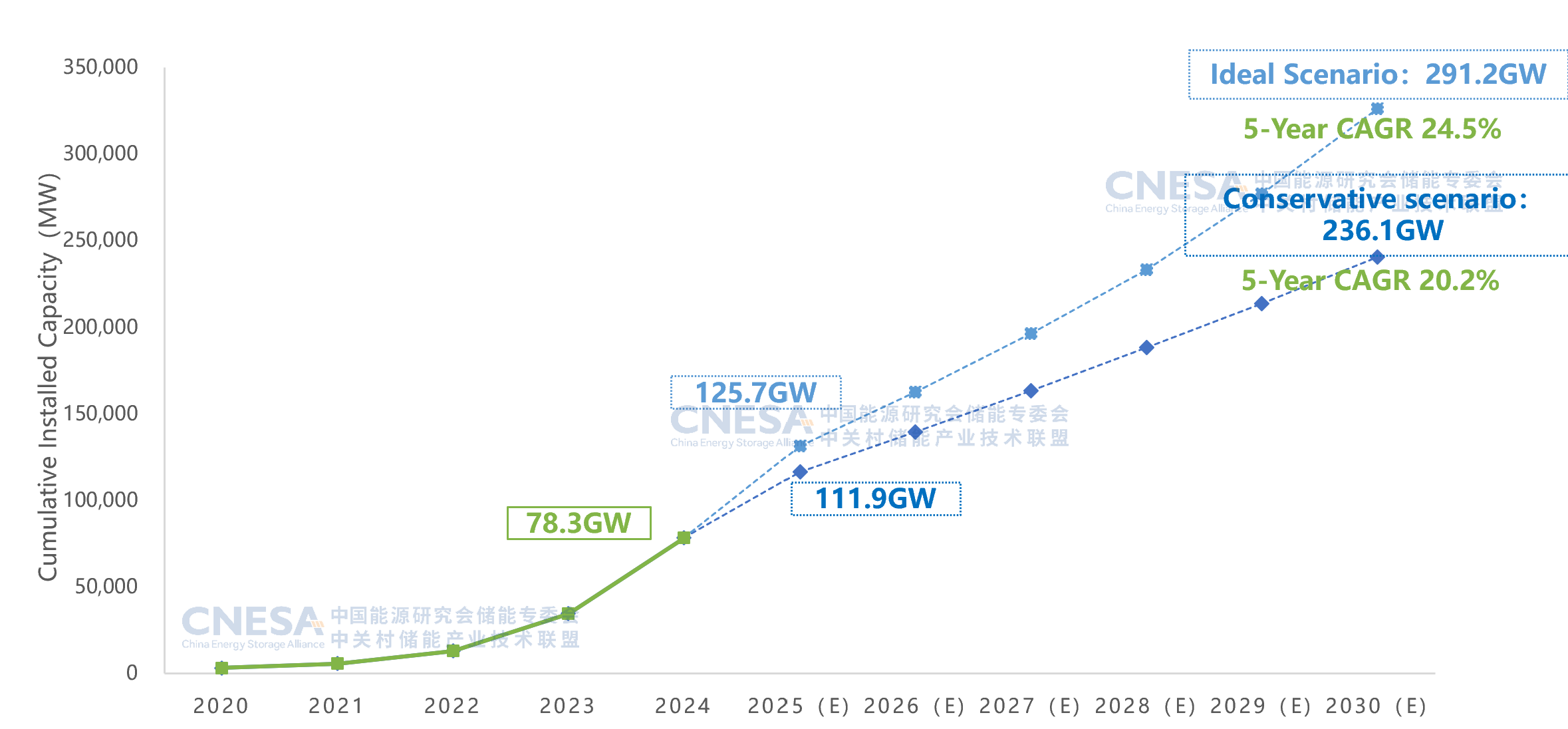
Looking to the future, CNESA forecasts that by 2030, China’s cumulative installed capacity of new energy storage will reach 236.1GW in a conservative scenario and exceed 291GW in an ideal scenario, with a compound annual growth rate of over 20% in the next five years. With the expansion of new scenarios such as desert-Gobi-wasteland large bases, zero-carbon parks, and virtual power plants, as well as collaborative innovation in materials, structures, and intelligent technologies, new energy storage will play a more central role in ensuring power security and achieving the "dual carbon" goals.

Figure 10: Forecast of Cumulative Installed Capacity of New Energy Storage in China (2025-2030)

Statera Energy Launches UK’s Largest Battery Storage Site at Thurrock

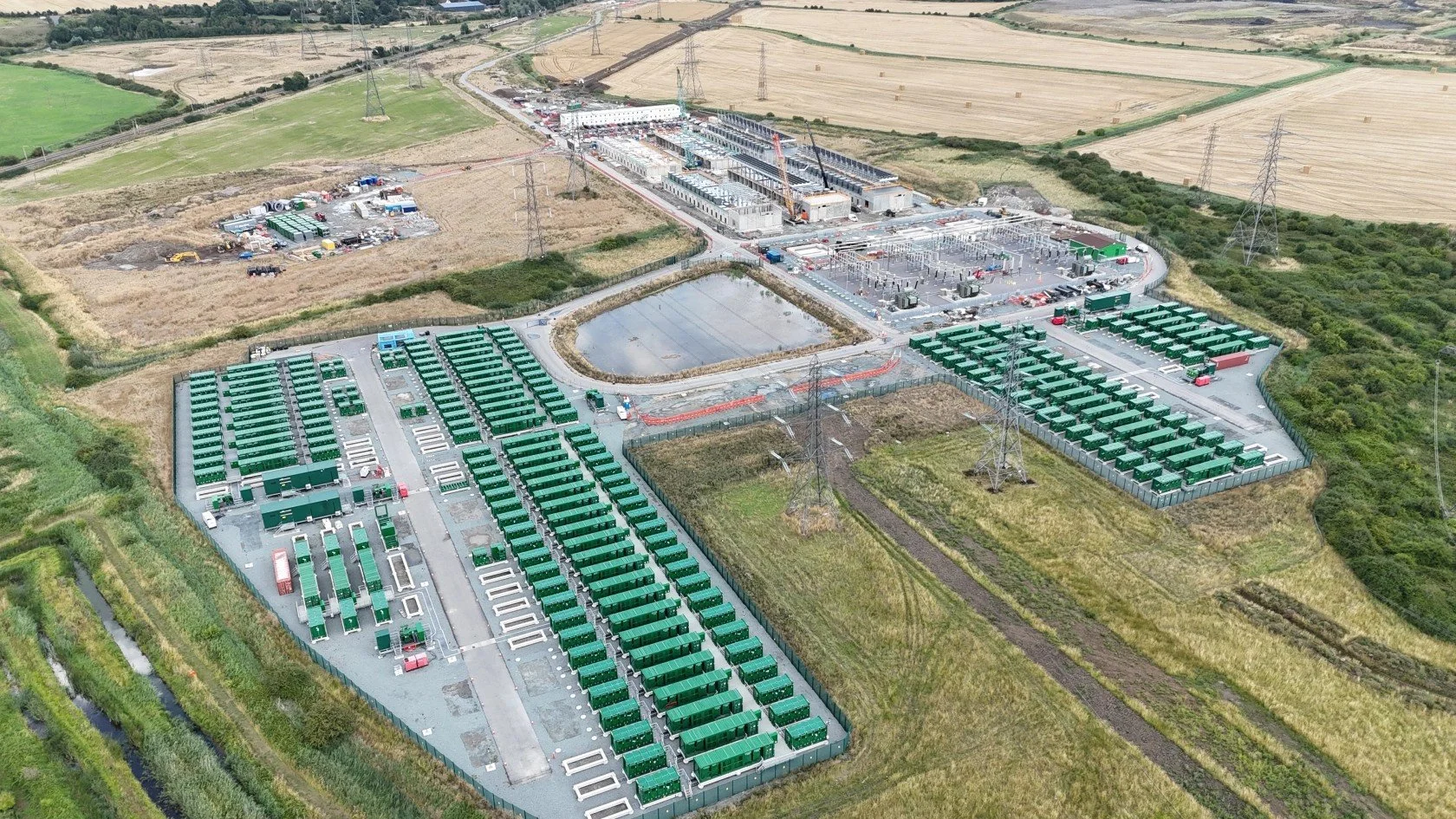
Statera Energy has brought online the country’s largest battery energy storage system, marking a major step in Britain’s clean energy transition. The 300-megawatt Thurrock Storage facility, located just north of the former Tilbury coal station, is now delivering power to the grid, according to the company’s announcement on August 18. The site can supply up to 680,000 homes with instant electricity for two hours, providing 600 megawatt-hours of output within seconds. Positioned close to London, Thurrock Storage is designed to boost the resilience of the national grid by responding rapidly to fluctuating supply and demand, helping secure energy stability at critical times. Statera said the project represents a transformation of the site’s industrial legacy into infrastructure that supports the UK’s low-carbon future.

Image: Statera Energy

The company noted that the battery system is paired with Thurrock Flexible Generation, a 450MW plant that can provide backup during longer dips in renewable output. Together, the projects form part of Statera’s wider growth strategy: the firm currently has more than 2.1GW of UK projects built or under construction and a further 16GW in the pipeline. Statera reported that it has already committed £1 billion in investment, with plans to reach £7 billion by 2030. Beyond its grid role, the new facility is expected to generate local job opportunities, including apprenticeships focused on operations and maintenance. National Grid Electricity Transmission confirmed its role in successfully connecting the site, emphasizing the importance of large-scale storage in balancing renewable generation.

According to Statera, Thurrock Storage’s launch underlines the need for robust battery capacity to ensure that renewable energy is both reliable and flexible. While details on future expansion were not provided, officials pointed to the site’s contribution as a critical milestone in the UK’s transition to a more resilient, sustainable energy system.

Harmony Energy Powers Up France’s Largest Battery Storage Project

Harmony Energy has brought online France’s largest battery energy storage system (BESS), marking a significant step in the country’s energy transition. The 100MW/200MWh Cheviré project, located at the port of Nantes Saint-Nazaire Harbour, is the first large-scale, two-hour duration BESS in France, according to the developer. Built on the site of the former Cheviré fossil fuel power station, which operated between 1954 and 1986, the project replaces a legacy of coal, oil, and gas with a facility designed to stabilise the grid and integrate more renewable power. Using Tesla’s Megapack and Autobidder technologies, the system will provide balancing services to support the shift away from fossil-fuel peaking plants. Harmony also highlighted biodiversity and community benefits, including a fund dedicated to local social and environmental initiatives.

The energisation comes as Harmony broadens its international footprint beyond the UK, where it developed some of Europe’s largest operational BESS projects. The company previously served as investment adviser to the Harmony Energy Income Trust (HEIT), a London-listed fund that held a large UK battery portfolio. With revenues in the UK market under pressure, Harmony has focused on projects across France, Germany, and Poland. Speaking at the Energy Storage Summit in London last year, its chief investment officer described a ready-to-build pipeline in these markets. Meanwhile, HEIT itself underwent a major change in ownership. In July, energy investment firm Foresight Group acquired the trust through its Foresight Energy Infrastructure Partners II fund, taking a 49% stake directly and securing the remaining 51% via its portfolio company Blackmead Infrastructure Limited, according to Solar Power Portal reporting.

The Cheviré project reflects both France’s growing storage ambitions and the broader reshaping of Europe’s battery investment landscape.

India: NTPC Seeks Contractors for 4GWh Battery Storage Projects at Thermal Plants

India’s largest power producer, NTPC Limited, has launched a major tender for battery energy storage systems (BESS) at its thermal power plants in Uttar Pradesh. According to the company’s invitation for bids issued on August 8, NTPC is seeking engineering, procurement and construction (EPC) partners to develop 1,700MW/4,000MWh of capacity across 11 sites. The projects include 300MW of four-hour duration storage, equal to 1,200MWh, and 1,400MW of two-hour duration storage, totaling 2,800MWh. The tender specifies a 12-year service life for the assets, designed for twice-daily cycling, with an annual maintenance contract also part of the scope.

The state-owned utility, formerly known as the National Thermal Power Corporation, is a key driver in India’s push for energy storage deployment. NTPC, which currently supplies around a quarter of the nation’s electricity through its 80GW of installed capacity, is also one of the government’s central agencies tendering both lithium-ion and pumped hydro storage. These efforts align with a standardized procurement framework introduced in 2022 and supported by the Union Government’s Viability Gap Funding scheme, which covers about 30% of project capital costs. According to the India Energy Storage Alliance, more than 171GWh of capacity has been tendered nationwide so far, including 55GWh in the first half of 2025.

Despite this rapid pace of bidding, progress on operational projects remains limited. Analyst Charith Konda of the Institute for Energy Economics and Financial Analysis recently noted that less than 220MWh of large-scale BESS is currently online in India. Challenges include aggressive bidding that risks financial viability, as well as grid connection and contracting delays. The NTPC initiative represents one of the largest steps yet toward scaling storage, but whether these tenders translate into timely projects remains an open question.

1GWh! Hithium Energy Storage Signs Major User-Side Energy Storage Order

1GWh! Hithium Energy Storage Signs Major User-Side Energy Storage Order

By: Hithium Energy Storage

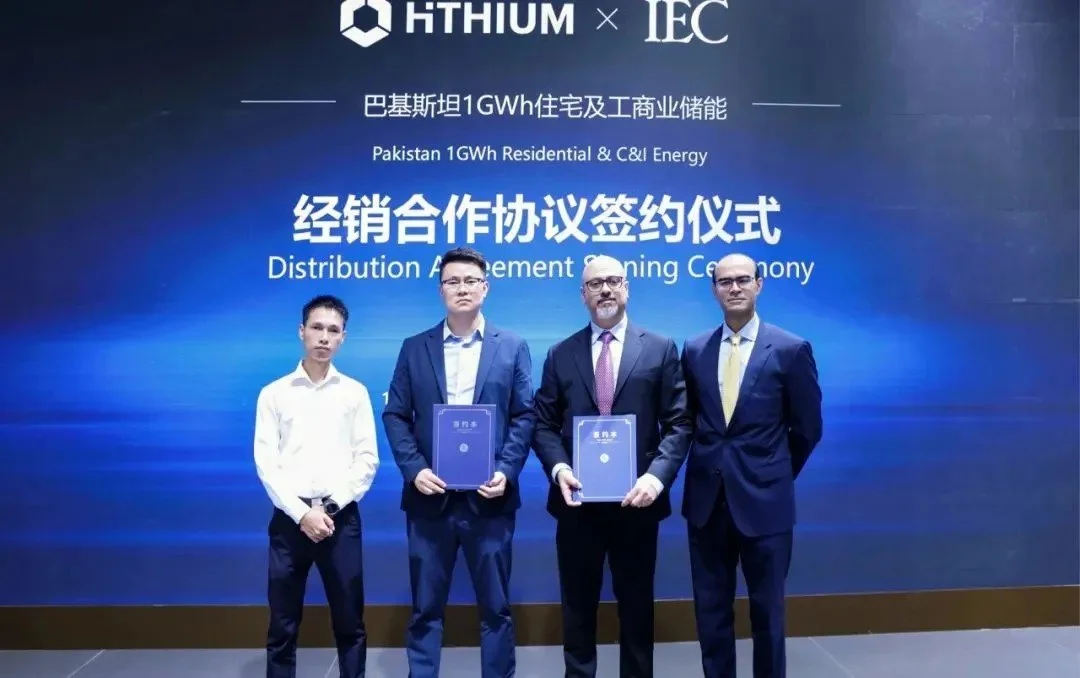
Hithium Energy Storage announced that it has established a strategic partnership with Pakistan’s well-known power system integrator The Imperial Electric Company (Pvt) Ltd. (abbreviated as “IEC”), under which the two parties will distribute 1GWh of residential and commercial & industrial (C&I) energy storage products in Pakistan. This milestone event marks another step forward in Hithium Energy Storage’s globalization strategy and also demonstrates its firm commitment to promoting energy equity.

Signing Ceremony

A new breakthrough for Pakistan’s energy landscape

The signing of this cooperation agreement brings a critical breakthrough to Pakistan’s energy sector. Hithium Energy Storage and IEC will jointly deploy 1GWh of advanced energy storage solutions, specifically tailored for residential and C&I scenarios. The core of the cooperation includes the distribution of Hithium Energy Storage’s HeroEE residential energy storage system series. With reliability and efficiency as its core, this product series, thanks to its strong environmental adaptability, can operate stably in diverse scenarios. In addition to product distribution, the two parties will also jointly develop customized energy storage systems to precisely address Pakistan’s energy challenges, ensuring the products deliver optimal performance in local environments.

According to the plan, IEC will act as the nationwide distributor of Hithium Energy Storage’s residential storage products, enabling more Pakistani households and businesses to access stable, reliable, and economical green energy. At the same time, the two parties plan to jointly establish a Hithium Energy Storage local service center, strengthening the user experience through a localized service system and laying a solid foundation for long-term market development.

Hithium Energy Storage HeroEE series: Reshaping the energy storage experience

Hithium Energy Storage redefines the future of energy storage with safe, long-lasting, and efficient green solutions, fully meeting the surging global demand for sustainable electricity. Taking the HeroEE series in this cooperation as an example, its core advantages include:

Ultimate safety and durability: Equipped with power-industry-grade lithium iron phosphate batteries, combining high safety, high integration, and high performance, achieving over 11,000 deep cycles under 90% Depth of Discharge (DOD).

Flexible expansion and adaptability: Capacity can be flexibly expanded from 16kWh to 256kWh, suitable for households, small businesses, emergency rescue, and other diverse scenarios, and supports PCS and component configuration on demand to meet specialized storage needs.

Reliable power supply and easy maintenance: Maximum discharge current reaches 200A, capable of driving multiple loads simultaneously to ensure uninterrupted power supply; modular independent design supports individual detection or replacement, significantly reducing maintenance costs.

For C&I scenarios, Hithium Energy Storage provides modular, scalable energy storage solutions that help enterprises enhance energy resilience and reduce operating costs. Its performance in safety, durability, and intelligent management has already been widely recognized by global industry clients.

Empowering Pakistan: Solving energy challenges and promoting energy equity

With a population of over 200 million, Pakistan has long been plagued by the dual problems of insufficient energy reliability and high costs. This cooperation, relying on Hithium Energy Storage’s advanced technology and IEC’s deep local experience, aims to allow more people to benefit from stable and economical green energy, contributing to the realization of energy equity.

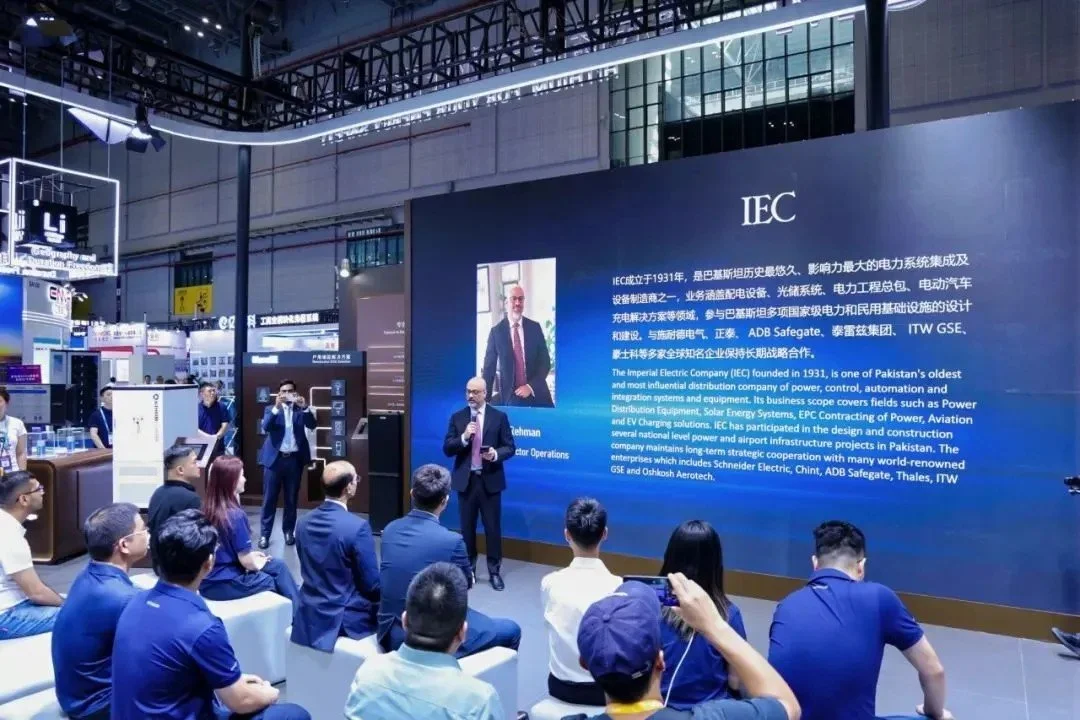
IEC Group Operations Director Reza

Mr. Reza, Operations Director of IEC Group, said: “We are very pleased to cooperate with Hithium Energy Storage. This will bring advanced energy storage technology and product solutions to Pakistan, allowing more people to be free from the impact of unstable power supply.”

You Jianyong, Deputy General Manager of Hithium Energy Storage’s Residential Storage Division, said: “This cooperation is not only a business deployment but also a mission: to bring energy fairness to Pakistani families and enterprises. By combining our advanced solutions with IEC’s local resources, we are helping communities escape the constraints of unstable energy and high costs.”

This cooperation accelerates Hithium Energy Storage’s expansion in the South Asian market, highlights Pakistan’s position as a key market for energy storage, and builds a technological exchange bridge between China and Pakistan, injecting China’s advanced energy storage solutions into Pakistan’s renewable energy development wave. Beyond commercial value, the cooperation also deepens China-Pakistan economic ties, providing strong support for sustainable development and energy access goals.

Based on this foundation, the two parties will promote continuous progress in Pakistan’s energy sector, with potential future expansion into large-scale power storage and renewable energy projects, opening broader cooperation opportunities.

About IEC

The Imperial Electric Company (IEC), founded in 1931, is one of the oldest and most influential distributors in Pakistan of electrical, control, automation, and integrated system equipment. Its business scope covers power distribution equipment, solar systems, power EPC, aviation, and electric vehicle charging solutions.

In 2025, AIDC’ Energy Consumption Will Reach 77.7 TWh, Making Energy Storage Technology Upgrades Urgent

By | Shuangdeng Group

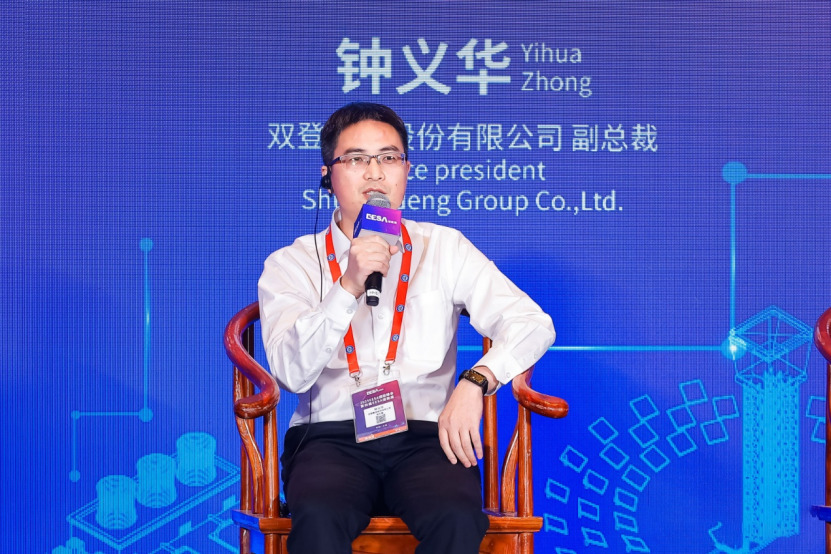
Recently, Zhong Yihua, Vice President of Shuangdeng Group Co., Ltd., stated in an interview that with the explosive growth of foundation models and AI technology, the power consumption per rack in AI data centers (AIDCs) has risen from the traditional 2–8 kW to 20–50 kW, and may exceed 100 kW in the future. It is estimated that in 2025, the energy consumption of AIDC will reach 77.7 TWh, a sixfold increase in five years. “High-density power supply, high-efficiency cooling, smaller footprint, and rapid deployment” have become the core requirements of AIDC, making energy storage technology upgrades urgent.

In response to the needs of different power supply architecture solutions for AIDC, Shuangdeng has proposed a series of “green power + energy storage” solutions, including the 220 kV “green power direct integration with generation-grid-load-storage” solution, 10 kV AC-side UPS power supply with energy storage, UPS 400 V low-voltage AC-side energy storage, Panama power supply application with energy storage, HVDC power supply with energy storage, and the future development trend SST-800 V DC energy storage. The aim is to improve energy utilization, reduce carbon emissions, and ensure power supply stability and reliability by optimizing the coordination between power sources, the grid, loads, and energy storage. This solution can not only provide emergency power support, but also enhance green power supply for AIDC and reduce fossil energy demand and carbon emissions through peak shaving and valley filling.

Shuangdeng has been deeply involved in the industry for many years, focusing on lithium batteries, sodium batteries, fuel cells, and solid-state batteries as its core technological breakthroughs. Relying on multiple solutions such as green power direct connection for data centers, immersion-protected lithium battery systems, new energy solutions, and intelligent lithium batteries, it has formed a technology matrix covering new energy storage and scenario-based applications—from batteries (cells) to system solutions to intelligent operation and maintenance energy management—meeting the diversified needs of different application scenarios. It has received honors such as National Manufacturing Single Champion, National Specialized and New “Little Giant” Enterprise, National Quality Benchmark Enterprise, National Intellectual Property Demonstration Enterprise, and National Green Factory.

Shuangdeng will continue to promote industrial upgrading through technological innovation, work with global partners to build a “green carbon ecosystem,” and enable new energy storage solutions to unleash green vitality in the era of intelligent storage.

Grid-forming National Demonstration Project! The First “Electrochemical + Flywheel” Hybrid Energy Storage Power Station in Liaoning Breaks Ground

On the morning of August 11, the groundbreaking ceremony for the Liaozhong Envision Energy Storage Power Station project was held. As a grid-forming national demonstration project, it carries the important mission of promoting the energy revolution and achieving the “dual carbon” goals, injecting strong momentum into the green transformation and high-quality development of the Liaozhong economy.

The Liaozhong Envision Energy Storage Power Station is the first “electrochemical + flywheel” hybrid energy storage power station in Liaoning. The project is located in Manduhu Town, Liaozhong District, Shenyang City, with a total investment of 580 million yuan and covering an area of 60 mu (approx. 10 acres). The project plans to build an 80MW/160MWh electrochemical energy storage facility and a 20MW/3.2MWh flywheel energy storage power station, along with supporting facilities such as the electrochemical area and the flywheel area.

According to Xue Bin, General Manager of Regional Development for Liaoning at Envision Energy, after completion, the project will not only provide large-scale energy storage capacity, but also, through flywheel technology, provide the power grid with scarce rotational inertia resources. At the same time, the project will also offer multiple services including peak shaving, frequency regulation, and emergency backup, promote the consumption of renewable energy such as wind and solar in the region, greatly enhance the flexibility and stability of the power grid, and contribute to the construction of the central Liaoning energy network, the promotion of power system reform, and the high-quality development of new energy industry models.

It is understood that after the project is completed, it will effectively enhance the grid regulation capacity of Liaozhong District, and will be of great significance in promoting the industrial structure adjustment of Liaozhong District and achieving green, low-carbon development.

Bangladesh Invites Bids for 160MW Battery Storage to Support Renewables

The Ceylon Electricity Board (CEB), Bangladesh’s state-owned power utility, has launched a competitive bidding process for large-scale battery energy storage system (BESS) projects aimed at stabilizing the national grid as more intermittent renewable sources come online. According to the request for proposals issued on July 30, the program calls for 16 standalone projects, each rated at 10MW/40MWh, totaling 160MW/640MWh of four-hour storage capacity. Selected developers will design, build, own, and operate the systems under 15-year agreements. CEB, which generates, transmits, and distributes roughly three-quarters of Bangladesh’s electricity, said the move is intended to ensure grid reliability as the country expands its use of “non-conventional” renewable energy sources, such as solar and wind.

The projects will connect to the grid at the 33kV level and occupy approximately 0.8 acres each. Proposals must include comprehensive plans covering site preparation, battery and inverter installation, energy management systems, environmental safeguards, auxiliary power, and SCADA integration, along with necessary transformers, switchgear, and transmission links to the grid termination point. CEB has not specified a preferred technology but requires proven solutions with successful track records in countries with infrastructure comparable to Sri Lanka. All equipment must be new and unused. The deadline for bid submissions is September 10, 2025, with a target completion date of May 29, 2026.

An EU-funded 2023 study previously underscored the cost-saving and reliability benefits of BESS for Bangladesh, according to Energy-Storage.news. By inviting private sector participation under a build-own-operate model, CEB aims to accelerate deployment while managing capital outlay. While the RFP outlines detailed technical and operational requirements, it does not indicate potential sites beyond specifying grid connection parameters, leaving bidders to propose optimal locations within the country’s network constraints.

Battery Gross Profit Increased Nearly Fourfold! REPT BATTERO Shipped 18.87GWh of Energy Storage in 2025H1

On August 11, REPT BATTERO released its interim results announcement.

As of the end of the reporting period, REPT BATTERO’s total assets amounted to RMB 38,892.5 million, an increase of 0.9% compared to the end of last year; net assets were RMB 10,322.5 million, basically unchanged from the end of last year.

During the reporting period, revenue reached RMB 9,491.1 million, an increase of 24.9% year-on-year. The company sold a total of 32.4GWh of lithium battery products, a year-on-year increase of 100.2%. Among them,

Energy storage battery shipments were 18.87GWh, up approximately 119.3% year-on-year, with revenue from energy storage battery product sales of RMB 5,082.6 million, up 58.4% year-on-year;

Power battery shipments were 13.53GWh, up approximately 78.5% year-on-year, with revenue from power battery product sales of RMB 4,026.6 million, up 40.9% year-on-year.

Compared with last year’s gross profit of RMB 158.8 million, the company’s power and energy storage battery products recorded a gross profit of RMB 777.7 million during the reporting period, an increase of 389.7% year-on-year. The gross margin rose from 2.6% in the same period last year to 8.5% in the reporting period, mainly due to the scale effect resulting from increased orders for power and energy storage battery products.

Signed Over 20GWh of Energy Storage Cell Purchase Agreements

In the field of energy storage business, as an industry leader, the company, driven by large cell technology, leads the development trend of large-capacity systems and long-duration energy storage. The company’s “Wending® 392Ah” cell and its supporting “PowtrixTM 6.26MWh” energy storage system, through structural and chemical system innovations, achieve better balance in key performance dimensions, and have successfully passed multiple extreme safety tests, achieving a dual breakthrough in the upgrading of energy storage safety standards and global market expansion.

During the reporting period, the company deepened strategic cooperation with leading energy storage integrators such as Customer M and Customer N, while successfully entering overseas markets, integrating into the supply chain systems of mainstream international energy storage companies and regional leaders. In addition, the company successively signed energy storage cell purchase agreements exceeding 20GWh with enterprises such as Customer O, Customer P, and Customer Q, demonstrating strong competitiveness and broad market recognition in the energy storage market.

Launched 72/100/314/320/392/587Ah cells

Power and commercial & industrial energy storage cells: Based on the original 280Ah cell dimensions, 314/320Ah series cell products were developed. Using “Wending” technology, internal space utilization was increased by 4% and AC internal resistance reduced by over 10%. At the same time, through “double high” solid-liquid interface design, high-quality energy density of 180Wh/kg, high energy efficiency of 95% (0.5P), long life (over 10,000 cycles), and high safety cells were developed. The cells have been mass-delivered to major domestic and foreign customers.

To match the next-generation 6.25MWh+ system, higher-capacity 392Ah and 587Ah cell products were developed, further increasing gravimetric energy density to 190Wh/kg, energy efficiency above 96% (0.25P), and cycle life of over 10,000 cycles, meeting the requirement of over 20 years of calendar life. In addition, to meet the market demand for 1P products, the 314Ah-1P product was upgraded and developed, with 1P energy efficiency and cycle life indicators reaching industry-leading levels. To meet longer life usage scenarios such as “solar-storage life match,” the 314Ah ultra-long-life cell product was upgraded and developed, using pre-lithiation technology to increase cycle life to 12,000 cycles, achieve “zero degradation in three years,” and possess over 25 years of ultra-durable calendar life.

Residential energy storage cells: The 72/100Ah cells, based on electrode structure design and electrolyte optimization innovations, have an energy density exceeding 165Wh/kg and a cycle life of over 6,000 cycles, meeting the need for more than 10 years of product life. At the same time, the cells can support rapid charging at minus 10°C, providing more options for applications in extremely cold regions.

5MWh Energy Storage System Passes Large-scale Fire Test

Expected 300% YOY Increase of Shipment Volume

In the energy storage field: The market competitiveness of the 5MWh energy storage system product was further consolidated. Based on the latest versions of multiple core standards including CSA/ANSI C800:25, NFPA855, and UL9540A, under the verification of third-party authoritative institutions and overseas customers, the entire cabin successfully passed a large-scale fire test. In addition, the entire cabin passed a series of functional and performance tests under extreme environments such as low temperature of -30°C and high temperature of 55°C, demonstrating excellent environmental adaptability. The expected shipment volume of the 5MWh energy storage system this year will reach three times that of last year. This growth trend not only reflects its widespread application worldwide but will also continue to deepen customer trust and enhance brand influence. Facing future applications of large-capacity cells, the company will adopt the 392Ah solution to achieve a 6.26MWh system. Under the same 20-foot standard container size, volumetric energy density will be increased by 25%, and combined with new active balancing technology, the economic benefits, performance, and safety performance of the system will all be significantly improved.

Launched 20-foot 6MWh+ energy storage product

“Wending” technology: Facing the upcoming next era of commercial & industrial cells and energy storage systems, through the use of “Wending” technology, the company plans to develop the next-generation 500~600Ah+ series high-capacity energy storage cells to effectively improve cell integration efficiency and reduce costs. The newly upgraded 6MWh+ energy storage product, while keeping the 20-foot standard prefabricated cabin volume unchanged, through the application of large-capacity cells and optimization of in-cabin layout, enables the total cabin energy to exceed 6MWh, further providing customers with an all-round energy storage system product that combines economic benefits, safety performance, and cycle life advantages. Full platform introduction of BMS active balancing, compared with conventional passive balancing, improves efficiency by 20 times, significantly reducing site operation and maintenance time costs and improving system availability. In terms of system environmental tolerance, the company will further enhance the system’s performance in extremely low temperatures (-30°C), extremely high temperatures (55°C), wind and sand resistance, low noise, sun exposure resistance, high altitude, and short-term grid-forming, enabling it to fully adapt to harsh environments worldwide and solve customer pain points. In addition, the company will develop new liquid cooling technology to enable the 6MWh+ energy storage container system to support 0.5P operating conditions.

Investment in Indonesian Battery Manufacturing Base

Phase I Annual Capacity of 8GWh

The company is committed to building a global industrial layout to meet the global market demand for high-performance battery products. At present, the company has established subsidiaries in the United States, Germany, Southeast Asia, and other regions, actively expanding the international market, and has established deep cooperative relationships with global leading energy storage and new energy vehicle enterprises. The company plans to establish production plants in Southeast Asia, Europe, and South America. These initiatives will enable the company to enhance its global brand influence, be closer to local customer resources and raw materials, and allow the company to diversify geopolitical risks. The company is investing in the construction of a battery manufacturing base in Indonesia, with the first phase planned to have an annual capacity of 8GWh of power and energy storage batteries and systems, as well as battery components.

Indonesia Unveils 100 GW Solar Initiative With Massive 320GWh Battery Storage Rollout

Indonesia has announced an ambitious plan to deploy 100 GW of solar power nationwide, combining large-scale generation with an unprecedented rural electrification push. According to pv magazine, the “100 GW Solar Power Plant Plan for Village Cooperatives,” mandated by President Prabowo Subianto, will see 80 GW installed as 1 MW solar arrays paired with 4 MWh battery energy storage systems in 80,000 villages. Operated by the village cooperative Merah Putih, these solar-plus-storage mini grids aim to provide affordable, reliable power while reducing dependence on costly diesel generators. The government has set an initial target of 10,000 operational units by August 2025. Another 20 GW of centralized solar—both on- and off-grid—will complement the distributed systems, with the goal of meeting household energy needs and boosting rural economic activity.

Fabby Tumiwa, CEO of the Institute for Essential Services Reform (IESR), told pv magazine that the solar-plus-BESS model could deliver electricity at $0.12 to $0.15 per kWh over 25 years—well below the $0.20 to $0.40 per kWh cost of diesel generation. Tumiwa called it potentially Southeast Asia’s largest rural electrification effort, but warned that building 100 GW in five years will be “very challenging.” IESR recommendations include developing skilled local workforces through university and vocational training programs, offering maintenance training, pursuing bulk equipment procurement, and using blended finance models to support project funding.

The initiative is still in the planning phase, coordinated by the Ministry of Energy and Mineral Resources alongside the Coordinating Ministries of Economic Affairs and Food. Indonesia’s technical potential for solar ranges from 3,300 GW to 20,000 GW, according to IESR estimates, while the country’s long-term energy policy targets up to 108.7 GW of solar by 2060. If implemented effectively, the program could redefine Indonesia’s energy landscape and serve as a global benchmark for large-scale distributed renewables.

Spain: Tesla Wins 400MWh Major Energy Storage Order

In Madrid, Spain, independent power producer Matrix Renewables (invested by the TPG Rise Fund) has submitted environmental impact assessment and administrative permit applications for the Visenta and Perdiguero lithium-ion battery energy storage projects.

Both power stations are located in Huesca Province, respectively situated in the municipalities of Sesué, Benasque, and Sahún in the Pyrenees, each with 100MW grid-connected capacity.

Each facility has an energy storage capacity of about 400MWh, supporting four hours of full-power discharge. The two stations have a combined usable storage capacity of 407.264MWh.

The project will use 104 Tesla Megapack 2 XL container units, configured into 52 dual-module units, with 26 transformers, each inverter having an AC output power of 0.979MW.

Supporting infrastructure includes the Pirineo 220/30 kV step-up substation, equipped with one 115/220 MVA transformer and one 180/185 MVA transformer. The construction budget for each power station is about 62 million euros.

In addition to the above projects, Matrix Renewables has deployed a diversified technology portfolio in multiple regions worldwide. As of 2024, the company owns 15.5GW of renewable energy, energy storage, and green hydrogen projects in Europe, Latin America, and North America, including 52 projects in Chile with a total of 412MW.

AIDC First Stock! Shuangdeng Co., Ltd. Passes HKEX Listing Hearing

On August 10, documents from the Hong Kong Stock Exchange showed that Shuangdeng Co., Ltd. had passed the HKEX listing hearing.

Shuangdeng Co., Ltd. was established in 2011 in Taizhou City, Jiangsu Province. At its inception, the company’s main business was energy storage for communication base stations, and it gradually established long-term cooperative relationships with communication operators such as China Mobile, China Unicom, China Telecom, and China Tower, and equipment providers. In overseas markets, the company successfully entered the supply chains of world-renowned enterprises such as Ericsson, Vodafone, and Telenor.

With business expansion, the company gradually shifted its focus to data center energy storage. In 2018, it keenly captured the demand in the data center market and successively reached cooperation agreements with Alibaba, JD.com, Baidu, GDS, and Chindata. In 2022, the company built China’s first large-scale “backup power + energy storage” composite energy storage project for data centers and successfully supplied products to the Xiong’an Urban Computing Center. The company’s data energy storage products have been applied in hundreds of data centers.

In addition, Shuangdeng Co., Ltd. is also committed to expanding its influence in the electric power energy storage field, exploring market opportunities in large-scale grid energy storage, commercial energy storage, and residential energy storage.

According to data from the China Energy Storage Alliance, in 2024, Shuangdeng Co., Ltd. ranked first globally in shipments of base station/data center backup batteries.

In terms of customers, as of the end of 2024, the company had served five of the world’s top ten communication operators and equipment providers, nearly 30% of the world’s top 100 communication operators and equipment providers, as well as China’s top five communication operators and equipment providers. The company served 80% of China’s top ten self-owned data center enterprises and 90% of China’s top ten third-party data center enterprises. In 2022, 2023, and 2024, the average service duration for the company’s top five customers exceeded ten years.

In financial performance, the company’s business results have steadily grown in recent years. From 2022 to 2024, revenue was RMB 4.072 billion, RMB 4.260 billion, and RMB 4.499 billion, respectively, with net profits of RMB 281 million, RMB 385 million, and RMB 353 million, and gross profit margins of 16.9%, 20.3%, and 16.7%, respectively. In the first five months of 2025, the company’s revenue was approximately RMB 1.867 billion, achieving a net profit of approximately RMB 127 million.

Among these, compared with the five months ended May 31, 2024, revenue for the same period in 2025 increased from RMB 1.3492 billion to RMB 1.8666 billion. The core driving force was the growth in demand for data storage and processing, which drove an increase in battery sales revenue for data centers — revenue from the data center business in the same period rose from RMB 397 million to RMB 872.9 million, an increase of nearly 120%.

United States: Risen Energy Successfully Delivers 40MW/401.28MWh Energy Storage Project in California

By: Risen Energy

Recently, Risen Energy successfully shipped 80 sets of liquid-cooled energy storage containers to the United States. This batch of energy storage systems will serve Middle River Power’s 40MW/401.28MWh power station. The power station will not only bring Middle River Power long-term and stable returns but also fully demonstrate Risen Energy’s outstanding technological innovation capability and strong delivery capacity, further expanding its influence in the North American market.

This project is located in California. As a leader in the U.S. new energy market, the California market has strict requirements for indicators such as energy storage system safety, energy efficiency, and land use. For the project, Risen Energy provided the eTron 5MWh liquid-cooled energy storage system, adopting a 0.25C storage design and a single-unit liquid cooling air-conditioning design, using the latest R513a clean refrigerant, which meets the U.S. Environmental Protection Agency’s requirements for low Global Warming Potential (GWP). Facing California’s extreme temperature environment of –30°C to 50°C, the eTron liquid-cooled energy storage system solution performed excellently, successfully solving common thermal management and uniformity issues in high-power applications and ensuring the continuous and stable operation of energy storage equipment; achieving coordinated operation of BMS, PCS, and Golden Shield system, with a five-level protection system from cell to system to ensure safety. In addition, innovative designs such as single-direction opening doors, mirror design, and square layout further save land use and enhance overall project efficiency. The application of these innovative technologies makes Risen Energy’s products stand out among similar products.

Risen Energy has extensive experience in the energy storage market, with projects across China, Australia, Europe, the United States, and the Asia-Pacific region, and has successfully implemented more than 400 energy storage projects. The successful delivery of this 402MWh California energy storage project is yet another strong proof of its powerful capabilities.

In 2025, Risen Energy officially entered the inverter sector and launched three integrated solar-plus-storage solutions for different scenarios—Shengjia, Shengqi, and Shengneng—precisely meeting the diversified needs of residential, C&I, and large-scale ground-mounted power plants, further expanding its competitiveness and influence in the global energy market. In the future, Risen Energy will actively expand into the global market, help drive the global energy transition, and contribute more to achieving sustainable development goals.

Jiangxi: 600MW/1.2GWh! Two Major Energy Storage Projects Signed

According to information from the official website of the Shangrao Economic and Technical Development Zone, Jiangxi Railway & Aviation Technology Co., Ltd. will invest 850 million yuan in the construction of a 300MW/600MWh independent energy storage power station project, and Jinko Power Technology Co., Ltd. (601778) will invest 850 million yuan in the construction of a 300MW/600MWh shared energy storage power station project. Both projects have recently settled in Shangrao City, Jiangxi Province.

It is reported that after the two projects are completed and put into operation, each will be able to achieve an annual charge-discharge capacity exceeding 180 million kWh and an annual output value exceeding 150 million yuan.

Public information shows that Jiangxi Railway & Aviation Technology Co., Ltd. was established in December 2020 as a wholly owned subsidiary of Jiangxi Railway and Aviation Investment Group Co., Ltd., a provincial state-owned enterprise in Jiangxi. The latter was established in November 2006 with a registered capital of 20.264 billion yuan. It is the main body for railway and aviation investment, construction, and operation in Jiangxi Province, and is a comprehensive industrial group integrating financial capital, road-adjacent resource development, modern logistics services, and technological innovation.

Jinko Power Technology Co., Ltd. was established in July 2011, with its headquarters located in Shanghai, and was listed on the Main Board of the Shanghai Stock Exchange in May 2020. The company focuses on the downstream industry chain of the photovoltaic power generation industry, with business covering photovoltaic power plant development, EPC, intelligent operation and maintenance, and integrated energy services.

The energy storage business is one of Jinko Power Technology's core strategic tasks for 2025. The company has already deployed energy storage business in multiple locations nationwide, covering various application scenarios including the power generation side, grid side, and user side. As of the end of 2024, Jinko Power Technology held independent energy storage power stations with a total scale of 298MWh, with an annual addition of 55MWh of grid-side energy storage and 18MWh of user-side energy storage, and newly obtained registered energy storage project capacity exceeding 1,970MWh. At the same time, relying on a large number of resources developed and reserved in the past, multiple energy storage projects exceeding 1 GWh are in the pipeline.

2.8GWh! Narada Power Wins World’s Largest Semi-Solid Battery Energy Storage Project

By: Narada Power

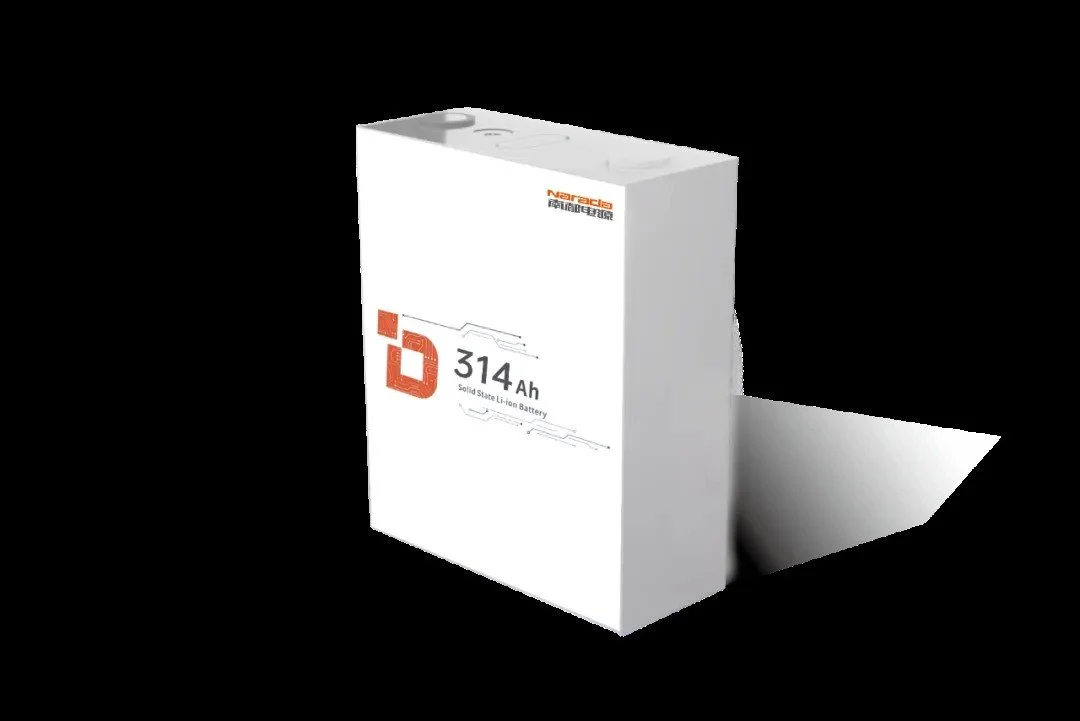
Recently, Narada Power successfully signed an independent energy storage project order with a total capacity of up to 2.8GWh, with the project fully utilizing Narada’s independently developed 314Ah semi-solid energy storage batteries. This is the largest semi-solid battery energy storage project worldwide to date, marking a critical breakthrough in the commercial application of solid-state energy storage battery technology.

Three Major Projects Launched in the Greater Bay Area, Independent Energy Storage Supports Grid Resilience

The won order consists of three independent energy storage projects, with a total capacity of 2.8GWh. Among them, the Shenzhen project scale is 1.2GWh; the Shanwei City arranges two projects, each with a capacity of 800MWh.

After completion, the projects are expected to consume more than 1 billion kilowatt-hours of new energy annually, significantly enhancing the regional grid’s capacity to accommodate renewable energy, effectively alleviating the power supply and demand contradictions in the Guangdong-Hong Kong-Macao Greater Bay Area, while reducing carbon dioxide emissions by about 1 million tons annually.

This project represents a major breakthrough in the company’s “energy storage technology + scenarios” approach. Shenzhen, as a megacity, requires extremely high safety and cycle life standards for energy storage systems; Shanwei relies on offshore wind power resources and requires energy storage to support grid stability. Narada’s semi-solid battery energy storage system precisely meets the core needs of these two application scenarios.

Semi-Solid Battery Solves Safety and Cost Challenges

The technical core supporting this mega energy storage project is Narada Power’s independently developed 314Ah semi-solid energy storage battery. This battery achieves a major leap in safety and performance through two key innovations: “oxide solid-liquid hybrid technology” and “high melting point polymer separator.”

Narada Power’s technical team has overcome key material and process technology challenges including solid-state electrolytes and interface wetting agents.

The 314Ah semi-solid energy storage battery innovatively applies an oxide-based solid-liquid hybrid electrolyte, significantly suppressing internal lithium dendrite growth, reducing thermal runaway risk, while also maintaining ionic conductivity, providing dual guarantees for long battery life and high safety.

Acceleration of Solid-State Battery Commercialization

This is the first time solid-state battery technology has achieved commercial application in a gigawatt-hour-level energy storage project globally.

The signing of this order reflects the industry’s high recognition of Narada’s solid-state technology and engineering capabilities, and also provides operational data support for the company’s subsequent expansion into data center energy storage, C&I energy storage, and other scenarios.

Solid-state battery technology can meet the core demands of “ultra-high safety” and “long-term reliability” for large-scale energy storage. For the entire industry, large-scale commercialization will strongly drive the maturation and cost reduction of the solid-state battery supply chain, injecting powerful momentum into industry technological upgrades.

Narada Power has always followed the technology development strategy of “develop one generation, reserve one generation,” continuously conducting forward-looking research. The company began solid-state battery development in 2017 and is one of the earliest enterprises in China to layout solid-state batteries.

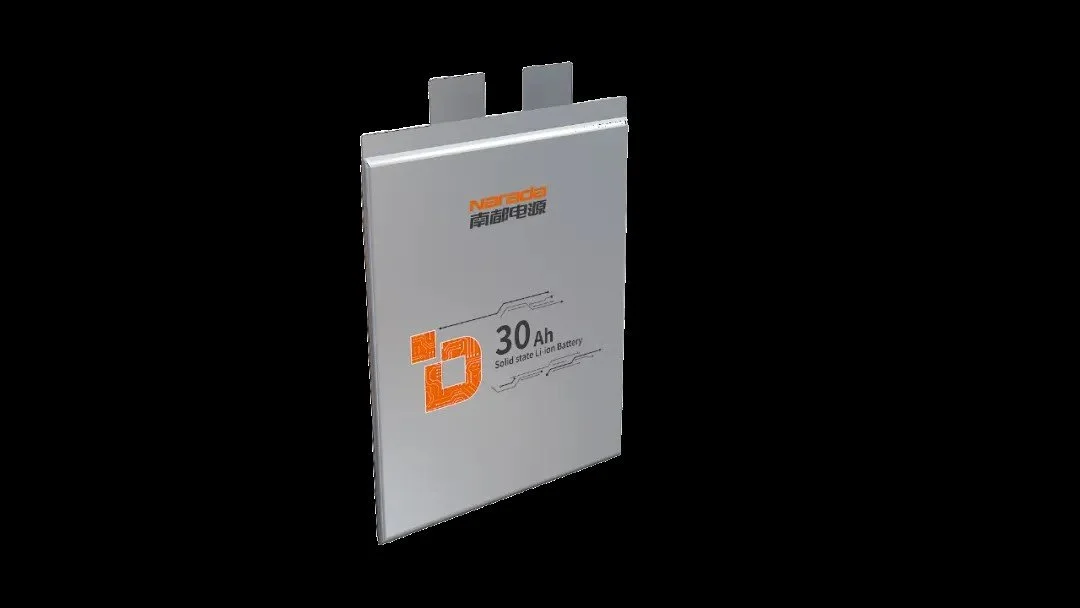
By the end of 2024, the Zhejiang Province key R&D program project undertaken by Narada Power passed acceptance evaluation, successfully developing a 30Ah all-solid-state battery that solved the “solid-solid interface” problem, effectively improving the cycle life and rate performance of all-solid-state batteries.

In April 2025, Narada Power released the 783Ah ultra-high capacity energy storage solid-state battery. Through three core technological breakthroughs—“flexible two-phase oxide solid electrolyte,” “multi-layer heterogeneous composite structure design,” and “in-situ electrolyte film formation”—the battery’s energy density and safety performance achieved a leap forward.

Australia: Federal Government’s CIS Launches Two Major Tenders Targeting WA Renewable Energy and Storage

The Australian Government’s Capacity Investment Scheme (CIS) is set to open two significant tenders in late August 2025, aiming to secure 1.6 GW of renewable energy generation and 2.4 GWh of dispatchable capacity for Western Australia’s Wholesale Electricity Market (WEM). Known as Tender 5 and Tender 6, these competitive processes will target projects connecting to the South West Interconnected System (SWIS). Tender 5 focuses on renewable generation—such as solar and wind—with an indicative target of 1,600 MW, while Tender 6 seeks 2,400 MWh of dispatchable capacity, including battery storage with a minimum two-hour duration. Both tenders require projects to have a minimum capacity of 30 MW and demonstrate credible pathways to reach commercial operation by December 31, 2030. Projects with earlier operational dates and robust development plans will be rated more favorably. AusEnergy Services Limited (ASL), formerly AEMO Services, will manage the tender process, including assessing project merit and social licence, while the Minister for Climate Change and Energy holds final approval authority. The scheme aims to bolster energy reliability and accelerate Australia’s renewable transition (according to the reference article and CIS Market Briefs).

Both tenders will implement a streamlined single-stage bidding process—consolidating technical and financial proposals—intended to shorten the tender duration from nine months to approximately six. Registrations are expected to close by late September 2025, with the question and answer period concluding shortly before bids close in late October. This approach is designed to increase efficiency, deliver results earlier, and support timely signing of Capacity Investment Scheme Agreements (CISAs). Additionally, the government has integrated social licence requirements emphasizing meaningful engagement with First Nations and regional communities. From these tenders onward, recipients will publicly report labour and workforce practices, enhancing transparency around employment conditions. A webinar slated for early September will further clarify tender details and procedural changes. The CIS continues Australia’s ambitious goal to install 40 GW of renewable and dispatchable capacity nationwide by 2030, addressing energy gaps from coal and gas retirements.

These concurrent tenders mark a key step in expanding Western Australia’s renewable infrastructure. They complement prior CIS rounds, which awarded contracts for over 650 MW and nearly 2,600 MWh of dispatchable capacity across battery projects in the state. Final tender guidelines are expected shortly, with successful projects announced by March 2026. The federal government’s commitment underlines its strategy to achieve 82% renewable electricity by 2030 while ensuring reliable energy supply for households and businesses across Australia. Further updates and detailed allocation information will be available as the tenders progress.

Australia’s Draft NEM Review Pushes for Major Energy Storage Reforms

The report states that ARENA is well-placed to support energy storage technologies. Image: Eku Energy.

Australia’s Department of Climate Change, Energy, the Environment and Water has released the draft National Electricity Market (NEM) Review, signalling significant reforms aimed at integrating more renewable energy while safeguarding grid stability. Led by Associate Professor Tim Nelson, the independent review panel identifies energy storage as essential to managing a grid increasingly dominated by variable renewable energy (VRE). The report highlights risks of supply shortfalls in South Australia and New South Wales from 2026–28, underscoring the need for large-scale solutions like the 850MW Waratah Super Battery and long-duration energy storage (LDES) systems. Central to the proposals is an Electricity Services Entry Mechanism (ESEM), designed to provide long-term investment certainty for renewable and firming projects by targeting financial risks in later project years, integrating with derivatives markets, and embedding the scheme permanently in the National Electricity Law.

According to the draft, reforms should also boost participation in Essential System Services (ESS) such as frequency control and voltage regulation, traditionally supplied by fossil-fuel plants. The review recommends market designs, pricing mechanisms, and regulatory changes to enable batteries, pumped hydro, and other zero-emissions firming technologies to deliver these services. The Australian Renewable Energy Agency (ARENA) is flagged as well-positioned to accelerate deployment of scalable, low-emissions storage solutions, with immediate government action urged to bridge funding gaps. To improve market efficiency, the report proposes a permanent Mandatory Market Making Obligation (MMO) to enhance liquidity and price transparency in NEM derivatives, benefiting smaller retailers and supporting long-term investment signals in renewables and storage.

The draft also addresses the growing influence of flexible demand and “hidden” resources like rooftop solar on price formation and system stability, calling for reforms to improve visibility, bidding practices, and market price setting. Consultation closes 17 September 2025, with the final report expected by year’s end, according to the department.

Spain Channels €148.5M into Battery-Backed Renewable Projects

On August 6, 2025, Spain’s Ministry for the Ecological Transition and Demographic Challenge (MITECO) approved €148.5 million in grants for 199 cutting-edge renewable energy installations, all paired with battery storage. According to the ministry, the funded projects will deliver 299.6 MW of mostly photovoltaic generation alongside 351.6 MWh of storage capacity, creating a more stable supply from intermittent solar power. Catalonia leads with 79 approved projects, followed by the Valencian Community (30), Castilla y León (17), and Andalusia (13), signalling broad regional participation in the shift toward renewables with built-in storage. The grants form part of Spain’s RENOINN programme, financed by the EU’s NextGenerationEU Recovery and Resilience Facility, which requires recipients to combine generation with storage for most funding lines. The scale and scope of this commitment mark a strong signal of momentum for Spain’s emerging energy storage sector.

Agrivoltaics with storage—solar arrays integrated into farmland—secured the largest share: €77.1 million for 62 projects, including 19 in the Valencian Community and 13 in Catalonia. These sites will pair crop cultivation with battery-backed solar production, and grantees must report annually for five years on both energy output and agricultural impacts. Floating solar systems, mostly for agricultural irrigation ponds, received €10.1 million for 11 self-consumption plants. Another €23.4 million went to 27 projects integrating renewables into infrastructure such as transport corridors, brownfields, and former industrial sites, adding 45.6 MW and 133.2 MWh of storage. For community energy, €18.2 million was allocated to 67 shared self-consumption projects aimed at 4,000 vulnerable users, combining resilience with potential cost savings.

The Institute for Diversification and Saving of Energy (IDAE) will manage the funding call, oversee technical assessments, and monitor performance over five years. By tying storage to nearly every funded project, MITECO’s strategy moves Spain’s renewable expansion beyond simple generation toward a more flexible, dispatchable model that can deliver power when demand—not daylight—peaks.

FlexGen Gains Court Approval to Acquire Powin Assets, Expanding Global Energy Storage Reach

FlexGen Power Systems has secured approval from the U.S. Bankruptcy Court for the District of New Jersey to acquire key assets from Powin, a fellow energy storage company currently under Chapter 11 protection. The decision marks a major step forward for FlexGen, allowing it to absorb a significant portion of Powin’s business and technology. According to FlexGen’s announcement on August 6, the acquisition includes all of Powin’s intellectual property—both hardware and software—as well as its IT systems and spare parts inventory. Once the transaction is finalized, FlexGen’s portfolio will expand to more than 25 GWh of battery energy storage projects across 200 deployments in 10 countries. This move strengthens FlexGen’s position as a global leader in battery energy storage systems (BESS), further integrating its software capabilities with Powin’s hardware strengths.

The acquisition comes amid broader industry shifts, with Powin having filed for bankruptcy in June 2024 due to financial struggles linked to U.S. tariff policies and uncertainty around federal clean energy incentives. The company had previously warned of possible layoffs and operational shutdowns by July. To sustain operations during the bankruptcy process, Powin secured a $27.5 million DIP loan—backed by FlexGen as the stalking horse bidder. FlexGen’s motivation to acquire Powin appears rooted in strategic synergies: while FlexGen brings 15 years of software and microgrid control expertise, Powin contributes strong hardware integration and battery management technology. FlexGen’s leadership emphasized that the integration will ensure service continuity for Powin’s clients and improve system performance using its HybridOS® software and Remote Operations Center.

With this court approval, FlexGen now prepares to finalize the deal and absorb Powin’s operations, aiming to deliver enhanced grid reliability and uptime for customers worldwide.

📝
🛫
👤