
How to Sell Energy Storage Systems into AIDC? Understand the White, Gray, and Black Zones First
Demand for energy storage in AIDC (AI data centers) is shifting from “whether to install” to “where to install it and what problem it solves.”
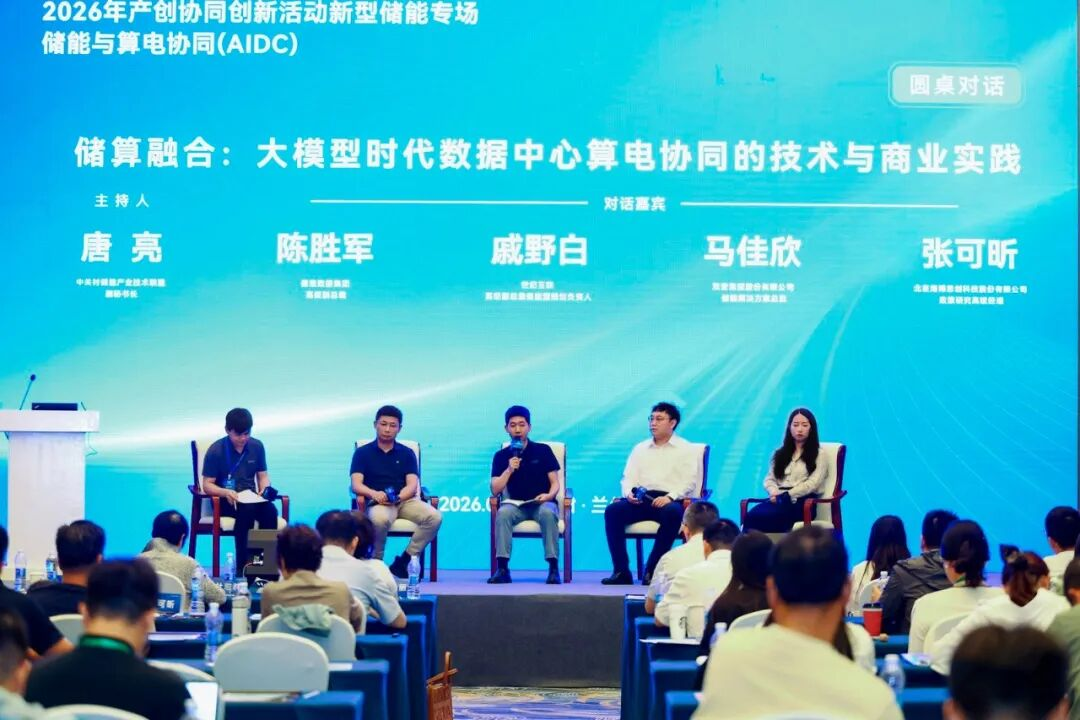
At the roundtable “Storage-Computing Convergence: Technical and Commercial Practices of Power-Computing Coordination for Data Centers in the Era of Large Models” at the recently held 11th Western Energy Storage Forum, front-line speakers from data center operators and energy storage companies pointed out that, from the campus-level energy foundation to the rack side close to GPUs, different time scales correspond to completely different storage technology routes, and no single product fits all scenarios.
The forum was hosted by the China Energy Research Society, Lanzhou University, and the China Energy Storage Alliance (CNESA). Tang Liang, Deputy Secretary-General of CNESA, moderated the dialogue, joined by Chen Shengjun, Senior Vice President of Chindata Group; Qi Yebai, Senior Vice President and Head of Energy Planning of VNET Group; Ma Jiaxin, Director of Energy Storage Solutions of Shuangdeng Group; and Zhang Kexin, Senior Manager of Policy Research of HyperStrong.
Value Ranking of Energy Storage in AIDC
Deploying energy storage in AIDC must follow the basic logic of “demand driving technology and product selection.” In other words, storage at different levels must first answer what the user’s real pain points are, rather than discussing how much revenue it can bring.

Chen Shengjun, Senior Vice President of Chindata Group, divides the value of energy storage into four levels.
The first is CAPEX (capital expenditure) — whether upfront development and O&M costs can be reduced. If a suitable storage and power supply scheme can cut related capital input, its value first shows at the initial investment stage.
The second is avoiding SLA penalties. For critical business, the value of a stable power supply far exceeds electricity price differentials. Once supply continuity is affected, penalties faced by a data center can reach hundreds of millions of yuan.
The third is reducing OPEX (operating expenditure), including daily operating costs such as electricity bills.
Only the fourth is the additional revenue gained from deploying storage. Chen stressed that simply emphasizing “how much money storage can make for me” is not the first concern of data center owners.

Qi Yebai, Senior Vice President and Head of Energy Planning of VNET Group, also said that the necessity of storage entering AIDC can be summarized in two points: first, making a real contribution to the power supply by providing power support, instantaneous supply, and reliability assurance; second, gaining verified economics. At present, however, the electricity costs saved by storage through peak-valley arbitrage and demand management account for at most 5%–10% of total OPEX — a value mismatch compared with the hundreds of billions of yuan of computing assets that need protection. The value of storage should therefore be measured not by “how much electricity was saved” but by “how much assets were safeguarded.”
Technology Routes of AIDC Energy Storage
For AIDC loads, the core of storage technology routes lies not in one battery type covering everything, but in matching capabilities across different zones and time scales. Chen Shengjun summarizes this as differentiated configuration across the white zone, gray zone, and black zone.
White Zone: Second- and Millisecond-Level Response to Power Transients
The “white zone” refers to the computer room area housing IT equipment — where server cabinets actually compute and power is directly supplied to computing — and also to the low-voltage supply area from inside the cabinet down to the chip level (generally within 48V). It is where power consumption of the entire data center is most concentrated and most volatile. During AI training, GPU load can jump from idle to full load within milliseconds, easily causing voltage sag or false triggering of overload protection.
The “white zone” therefore emphasizes power-type storage with second- or even millisecond-level response, aiming mainly to stabilize power fluctuations, suppress peaks, and reduce demand charges. To meet this need, technologies such as capacitors, supercapacitors, and high-rate lithium batteries in BBUs are more targeted.
Gray Zone: Minutes to Hours, Driving SST and High-Rate Battery Demand
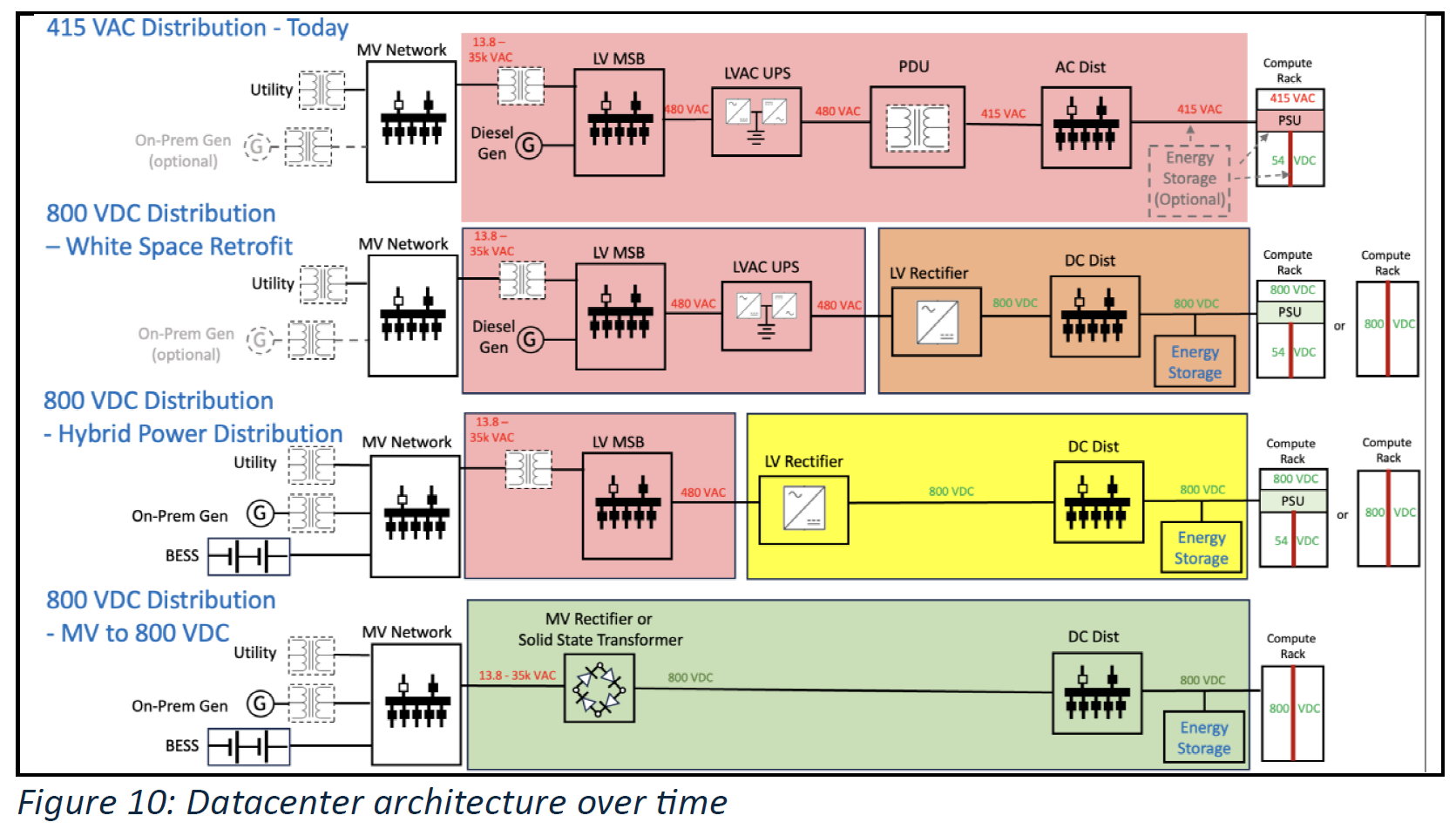
The “gray zone” refers to the area housing back-end infrastructure such as electrical and mechanical equipment, providing power supply, cooling, and other supporting functions. As cabinet power density rises, supply voltage is being upgraded from traditional AC to 800V or even higher-voltage DC to reduce line losses. SST (solid-state transformer) is seen as the key technology for gray-zone transformation: it can step down voltage directly from the high-voltage grid and output high-voltage DC matching the cabinets, simplifying the gray-zone structure and achieving AC/DC compatibility.
Compared with the white zone, the gray zone operates on longer time scales, typically from minutes up to an hour. Lead-acid batteries in traditional UPS will not be fully replaced in the short term, but options such as sodium-ion, high-rate LFP, and supercapacitors are entering retrofits and comparisons. For scenarios converting general-purpose computing rooms into intelligent computing rooms, adding high-power compensation in the gray zone is also a technology path suited to local conditions.
Black Zone: Long-Duration Storage Demand Emerges
The “black zone” refers to the connection point between the bulk grid and the behind-the-meter microgrid, covering utility access, transformers, storage, backup power, and microgrid dispatch — a critical area for ensuring supply continuity and power-computing coordination. Closer to the high-voltage side and the power source side, the black zone can also be planned in a unified way with direct green power connections. Here, long-duration storage can serve as the energy foundation and long-term backup, with demand for 6-hour, 8-hour, and even longer durations becoming evident. For scenarios combining a high share of renewables with a high share of power-electronic loads, grid-forming storage can provide regulation capability and reduce major losses from risks such as wideband oscillation.
Solution Selection for AIDC Energy Storage
Qi Yebai believes that for data centers, different technology routes suit different risk types. Meanwhile, technology routes should not be viewed statically: technology is advancing and customer awareness is changing too.
Qi also pointed out that campus-type wholesale IDC and urban retail IDC follow different logic: for the former, large customers come first and the campus is built afterwards, with customers directly setting the technical standards; for the latter, the computer room is built first and customers are found later. Since a single project of a large customer can reach hundreds of megawatts, storage solutions must be highly customized and cannot be configured along the standardized product logic of traditional utility-scale storage.

Zhang Kexin of HyperStrong noted that on the AIDC computer-room side, HyperStrong is also developing solid-state transformer (SST) products, with releases planned before the end of this year. On the energy foundation side, where wider power access and system regulation must be considered, HyperStrong proposes a “lithium-sodium synergy” approach: sodium-ion batteries handle short-duration shocks, fluctuations, and switching, while lithium-ion batteries handle longer-duration regulation and peak shaving — matching AIDC’s multi-timescale needs through a division of labor between different electrochemical systems.

Ma Jiaxin, Director of Energy Storage Solutions of Shuangdeng Group Co., Ltd., said that AIDC customers’ customization needs are completely different, with a “disruptive” impact on storage products, especially in the North American market. On one hand, cells must withstand short-duration, high-frequency, high-current discharge while also meeting long-duration operation and lifetime requirements; on the other, AIDC’s requirement for SOH (state of health) estimation accuracy may rise from the industry-common 5%–6% to 2%–3%.
Moreover, the integration of backup power and energy storage means control strategies cannot remain static: as battery capacity degrades, the system must dynamically adjust the capacity allocated to backup versus economic operation according to SOH, and thermal management strategies differ under different operating conditions. For PCS, grid-following, grid-forming, off-grid operation, and smooth switching capabilities are required.
AIDC Energy Storage Market Size
Zhang Kexin of HyperStrong looked ahead to future development models. Today’s mainstream power-computing coordination is a one-way, downstream-to-upstream demand model: computing companies demand from AIDC, and AIDC demands from the power supply. In the future it may evolve into two-way regulation between computing and power, as AIDC advances from traditional cabinet rental and server rental models into a “Token factory,” requiring more adjustable resources and giving energy storage much larger room to play.
Ma Jiaxin believes AIDC energy storage is about to enter an explosive growth period — but only after market acceptance, demonstration projects, and testing and certification of new products all run smoothly, after which development will accelerate rapidly. At the same time, overseas policy risks deserve attention: recent US bans targeting energy storage systems and related equipment will have some impact on Chinese companies entering the North American market.
Qi Yebai of VNET Group raised a neglected incremental scenario. He believes storage vendors’ thinking should not just circle between the two ends of “macro (source side)” and “micro (inside the computer room)”; in between lies a “mesoscopic” level: can Phase I and Phase II of the same customer be bridged? Can adjacent data centers be linked, using storage for DC transfer? Viewed from a broader perspective, some more differentiated value points can actually be matched. He encouraged companies to break out of inertial thinking and actively explore.
Chen Shengjun of Chindata Group stressed that next year is critical. Whether storage companies can deliver truly valuable products for data centers in 2027 will determine how large the storage market in the AIDC track can grow and how far it can go. Chen also revealed that from the end of this year into next year, new electrical architectures will be released one after another, and storage may be embedded within them.
The 15th Energy Storage International Conference and Expo (ESIE 2027) will be held on March 16–19, 2027 at the Beijing Capital International Convention and Exhibition Center. For the first time, the expo will feature an AIDC Energy Storage section, showcasing the complete AIDC storage industry chain, from high-rate cells, BBU backup power, UPS, and HVDC to solid-state transformers (SST) and complete system solutions.
China’s three major telecom operators, cloud service providers such as Tencent Cloud, third-party IDC operators such as Chindata and VNET, and leading overseas computing and cloud companies such as Amazon, Google, and Meta will gather at the event to share their on-the-ground practices in data center energy storage.
The expo will also set up an AIDC Energy Storage New Product Launch Zone, supporting companies to debut innovative products and technical solutions in the AIDC storage field. Whether entering the new AIDC storage track, launching annual innovative products, or connecting with upstream and downstream partners across the industry chain, ESIE 2027 is the industry’s key matchmaking platform.
