

Latest News
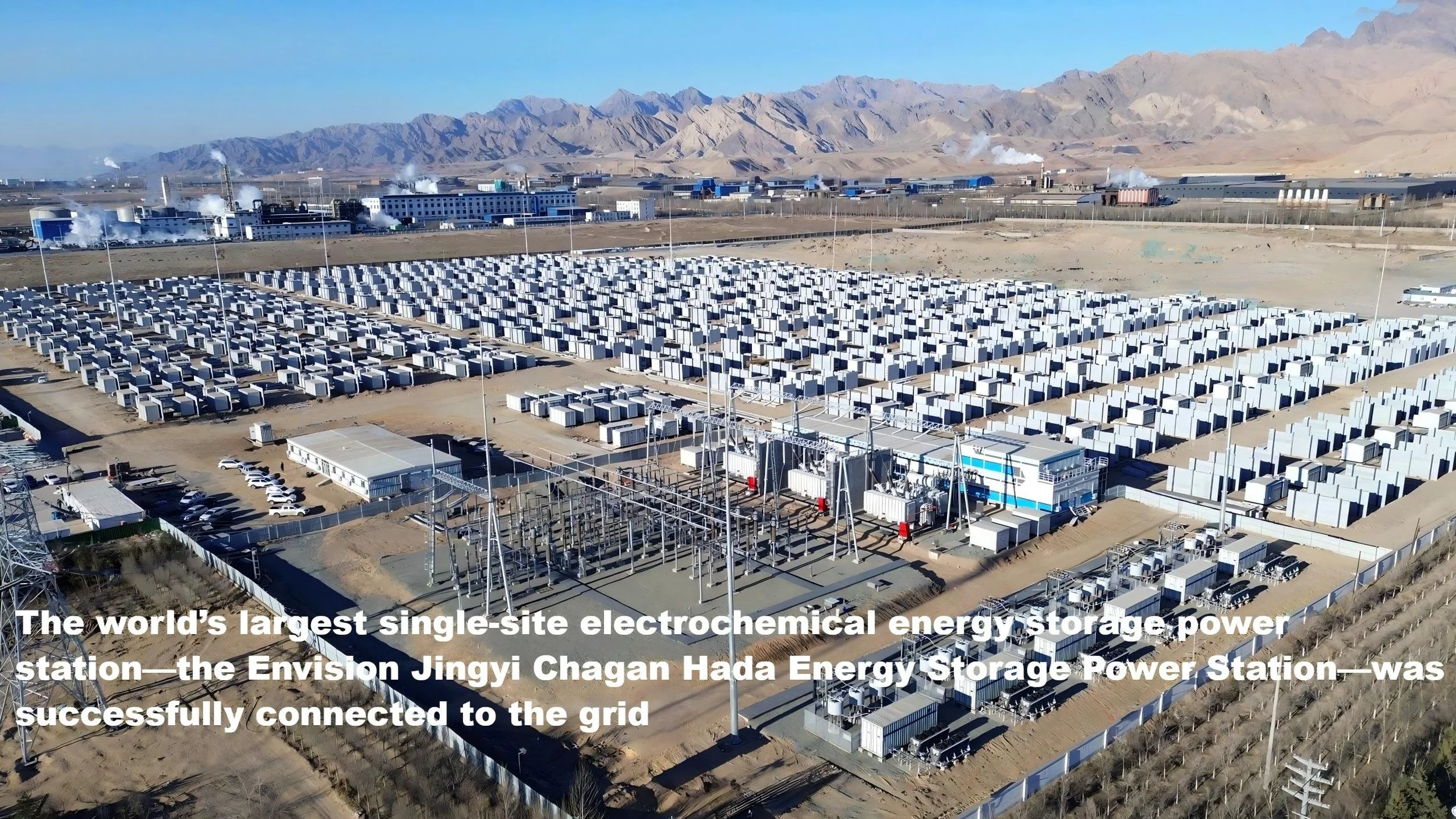
12.8 GWh Energy Storage Cluster Connected to the Grid AI-Powered Energy Storage Reshapes the Future of New Power Systems
The world’s largest single-site electrochemical energy storage power station—the Envision Jingyi Chagan Hada Energy Storage Power Station—was successfully connected to the grid, completing a 12.8 GWh AI-powered energy storage cluster in Inner Mongolia. The project sets new global benchmarks for scale, grid-connection speed, and system reliability, while demonstrating advanced grid-forming capabilities that enable rapid commissioning, deep grid interaction, and large-scale renewable integration.
Recently, the world’s largest single-site electrochemical energy storage power station—the Envision Jingyi Chagan Hada Energy Storage Power Station—was successfully connected to the grid. With a total capacity of 4 GWh, the project is fully equipped with Envision’s AI-powered energy storage system. This milestone marks the completion and grid connection of Envision’s 12.8 GWh energy storage cluster deployed across Bayannur, Ordos, Hohhot, Ulanqab, Xilingol League, and Alxa League. To date, Envision-led energy storage projects in Inner Mongolia exceed 14 GWh in total capacity.
The project passed grid verification at rated power through “three charge and three discharge” and a 72-hour continuous trial operation at one time, becoming the largest energy storage project in China to complete such testing. This achievement not only sets new global records for energy storage cluster scale and grid-connection speed, but also demonstrates Envision’s capabilities in ultra-large-scale system integration, extreme-environment adaptability, deep grid interaction, and large-scale project delivery.
Notably, the project’s grid connection coincided with the release of China’s Guidelines on Promoting High-Quality Power Grid Development by the National Development and Reform Commission (NDRC) and the National Energy Administration (NEA), highlighting strong alignment between national policy direction and industrial practice. Together, they signal that AI-centered energy storage technologies are reshaping the future of new power system from technological, market, and application perspectives.
Technology: From “Optional” to “Essential”
The Guidelines clearly state that power system regulation capabilities should be upgraded toward greater diversity and massive-scale coordination. They call for accelerated development of regulation capabilities for new grid-connected entities, including distributed renewable energy and new-type energy storage, to enable the coordinated and optimized dispatch of diverse and large-scale resources. The Guidelines also emphasize strengthening R&D in critical power grid technologies, targeting application scenarios such as deserts, Gobi and barren regions, integrated wind–solar–hydro systems, high-altitude areas, and deep and far-offshore environments. They propose piloting long-distance transmission from large-scale 100% renewable energy bases, and accelerating the engineering validation and deployment of grid-forming technologies.
It is said that Envision’s AI energy storage system deployed in Inner Mongolia integrates advanced capabilities from “grid-following” to “grid-forming”, enabled by a full-time-scale simulation platform and a three-layer grid-forming architecture spanning equipment, system, and site levels. This allows GW-scale stations to connect to the grid immediately upon energization, significantly reducing commissioning time, mitigating oscillation risks, and enhancing system support strength. As a result, energy storage evolves from a “grid follower” to a “grid builder,” providing a solid technical foundation for power systems with high shares of renewable energy.
Market: From Grid Connection to Market Participation
The Guidelines emphasize deep integration between market mechanisms and dispatch systems, and encourage exploration of new pricing mechanisms. This creates clear and predictable revenue pathways for AI-powered energy storage through participation in electricity spot markets, provision of ancillary services such as frequency and peak regulation, and access to capacity compensation and price arbitrage.
The 12.8 GWh energy storage cluster will be fully integrated into the electricity spot market. Leveraging Envision’s AI system—where trading agents and grid-forming agents operate in coordination—the project enables a closed-loop lifecycle operation covering forecasting, dispatch, trading, and self-learning. This approach not only enhances the intelligence, efficiency, and execution of power trading decisions, but also provides a replicable and scalable model for the large-scale participation of new-type energy storage in electricity markets. At the same time, it significantly improves regional renewable energy consumption and strengthens the operational resilience of the power grid. In previous deployments, Envision’s AI energy storage system has ranked first in trading forecast accuracy at several sites in Inner Mongolia for consecutive months. Based on measured operational data, the project is expected to increase total lifecycle returns by more than 20%.
Applications: From Single Use to Broad Scenarios
The Guidelines elevate smart microgrids as a key component of new-type power systems, unlocking vast opportunities for AI energy storage in industrial parks, zero-carbon parks, and remote areas. In these scenarios, AI-powered energy storage functions as a local energy brain, optimizing the coordination of generation, grid, load, and storage to maximize renewable self-consumption, enhance supply reliability, and enable higher-level grid interaction.
As power systems become increasingly clean and market-oriented, simple equipment aggregation is no longer sufficient. In high-renewable scenarios, AI-driven energy storage that balances grid stability with revenue optimization has become indispensable. The successful grid connection of the Inner Mongolia cluster underscores Envision’s leadership in physical AI and AI-enabled renewable energy solutions.
Envision has established a full industrial chain in Inner Mongolia, from battery cells and system integration to project delivery and intelligent operation. Leveraging its integrated capabilities, the project drives industrial clustering, injects new momentum into the local economy, supports the development of a new-type power system, and underpins the region’s efforts to accelerate the construction of a nationally important energy and strategic resources base.
This milestone delivery marks a successful conclusion to Envision’s energy storage business expansion in 2025. Empowered by physical artificial intelligence, Envision has secured a series of major contracts both at home and abroad this year. Building on its established global footprint, the company has successfully expanded into ten strategic overseas markets, including Australia, Chile, Italy, and Poland. Looking ahead, Envision will continue to strengthen the foundational support for next-generation power systems through innovative products and world-class project execution, accelerating the global transition toward zero-carbon and driving a new era of shared prosperity powered by Chinese renewable energy technologies.
____________________________________________________________________
Envision Energy Storage has confirmed its participation in the 14th Energy Storage International Conference and Expo (ESIE 2026). Register now to attend Asia's Largest Energy Storage Trade Show for free:
What: The 14th Energy Storage International Conference & Expo
When: Conferences: March 31 - April 2, 2026
Exhibitions: April 1-3, 2026
Where: CIECC Beijing, China
Address: No. 55 Yudong road, Shunyi District, Beijing China


EASE Rebrands as Energy Storage Europe Association for Era of ‘Unprecedented Growth’
Source: Energy Storage News
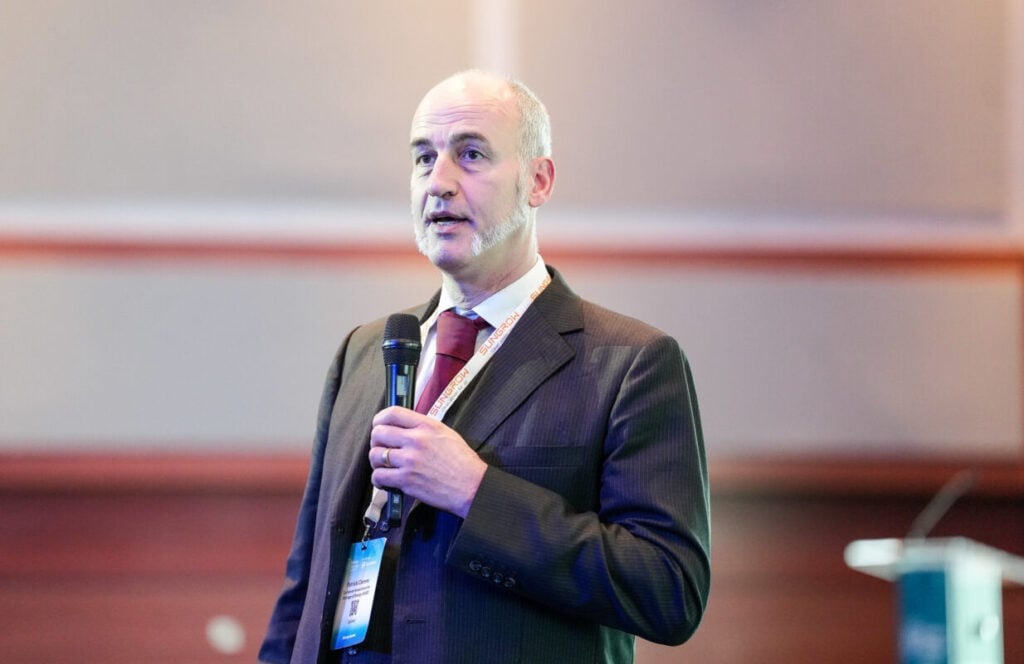
Energy Storage Europe Association secretary general Patrick Clerens, speaking at the 2025 Energy Storage Summit EU. Clerens' consulting company formed the group with industry stakeholders in 2011. Image: Solar Media.
European Association for Storage of Energy (EASE), which represents 70 member organisations across the industry value chain, has undergone a rebrand.
Now called Energy Storage Europe Association, the change marks “a new chapter for our organisation and the entire sector,” said Patrick Clerens, the group's secretary general, whose consulting group was tasked with launching EASE back in 2011.
“Europe's energy future depends on energy storage. Our new identity will amplify this message to ensure we are at the heart of policy debates,” Clerens said.
Its activities include advocacy in the decision-making processes of European policymakers and regulators; direct participation in European Union (EU) research projects; providing market intelligence, including the European Market Monitor on Energy Storage (EMMES) reports; and networking and media engagement.
EMMES is published annually by the trade association and research consultancy LCP Delta. The most recent edition, EMMES 9.0, found that 11.9GW/21.1GWh of energy storage was deployed across Europe in 2024, including 4.9GW/12.1GWh of front-of-the-meter storage.
Meanwhile, the organisation's advocacy and education efforts include a recent call for common safety standards across European markets and a best practice guide to fire safety for outdoor utility-scale lithium-ion battery energy storage system (BESS) installations.
“In 2025, Europe added new energy storage power capacity at a scale 15 times greater than just five years ago. With this unprecedented growth, a more visible identity was essential to the Association,” Energy Storage Europe Association president David Post said.
“We will continue to represent the entire value chain and all storage technologies, advocating for policies that enable the needed flexibility and strongest deployment across Europe,” said Post, who is also Enel X head of energy storage solutions.
Energy Storage Association Europe's rebrand this week reflects a broader push for increased visibility and stronger representation among industry bodies of late.
The energy storage association is itself part of Europe's Energy Storage Coalition, formed alongside counterparts in the wind and solar PV industry to advocate for a Europe-wide policy action plan on storage.
SolarPower Europe, while a member of the coalition alongside EASE, WindEurope and Bill Gates's VC group Breakthrough Energy, also founded the Battery Storage Europe Platform earlier this year.
That said, Battery Storage Europe Platform is less of a trade association and more of a direct initiative to engage policymakers and regulators, SolarPower Europe said at the July launch.
In the US, the country's only national Energy Storage Association (ESA) merged with a wind industry group in 2021, becoming part of the American Clean Power Association (ACP).
However, ACP then launched its own separate energy storage effort a few weeks ago, called, confusingly enough, the US Energy Storage Coalition.
CENSA Upcoming Events:
1. Dec.4-5 | 2025 China Energy Storage CEO Summit | Xiamen, Fujian
Register Now to attend
Read more: http://en.cnesa.org/new-events-1/2025/12/4/dec4-5-2025-china-energy-storage-ceo-summit

2. Apr. 1-3, 2026 | The 14th Energy Storage International Conference & Expo
Register Now to attend, free before Oct 31, 2025.

Sign up for our free monthly newsletter to stay informed about the Chinese energy storage market.