
Sharp Pullback! User-Side Energy Storage Additions in January Down 58% Year-on-Year
In January 2026, China’s user-side new energy storage market recorded a year-on-year decline of more than 50% in newly added capacity. The pace of project filings slowed while quality improved, and market deployment shifted toward larger single projects and more capital-intensive investments.
The user-side energy storage market experienced a clear correction, with installed capacity down 58% year-on-year. Commercial and industrial (C&I) energy storage accounted for more than 90% of total additions.
The East China region contributed over three-quarters of newly commissioned capacity. Jiangsu led the nation, accounting for 60% of total installed capacity.
Nationwide, the number of newly filed user-side projects fell by 38% year-on-year, while the average size of individual projects increased by 87%. Core markets—Jiangsu, Guangdong, and Zhejiang—continued to lead, as user-side deployment shifted from small, distributed projects toward larger-scale, more centralized investments.
Analysis of User-Side New Energy Storage Projects in January
In January, newly commissioned user-side energy storage capacity totaled 166.2 MW / 456.5 MWh, representing -58% / -39% year-on-year and -81% / -73% month-on-month. The following characteristics were observed.
(1) Installed capacity of user-side energy storage
In January, the market remained dominated by C&I applications, accounting for over 90% of total additions. Newly commissioned C&I projects reached 156.7 MW / 435.4 MWh, down 60% / 41% year-on-year and 82% / 74% month-on-month.
From a technology perspective, all newly commissioned projects adopted electrochemical energy storage. Lithium iron phosphate (LFP) batteries accounted for more than 99% of installed power capacity. In the long-duration energy storage, one 7-hour photovoltaic-plus-storage integrated smart power station project and one 4-hour solid-state lead battery energy storage project were commissioned.
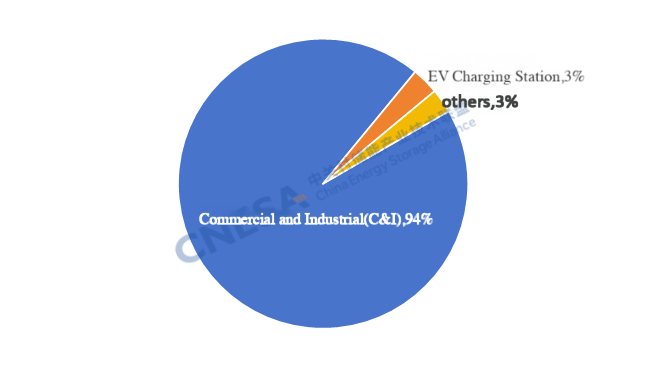
Figure 1. Application distribution of newly commissioned user-side new energy storage projects in January 2026 (MW %)
Source: CNESA DataLink
Note: “C&I” includes industrial facilities, industrial parks, and commercial buildings; “Others” include mining areas, oilfields, rail transit, data centers, etc.
(2) Regional Distribution of User-Side Energy Storage
By region, newly commissioned projects were distributed across 13 provinces, including Jiangsu, Anhui, Shandong, Sichuan, and Guangdong. East China dominated the January market, accounting for 78% of newly added capacity and 44% of total project numbers.
At the provincial level, Jiangsu ranked first nationwide, contributing 60% of total installed power capacity and 16% of newly commissioned projects. Both installed capacity and project count ranked first nationally. This performance was driven by a combination of power market reforms, demand response incentives, strong C&I demand, and the centralized grid connection of large-scale projects.
On the policy front, multiple supportive measures were introduced, accelerating the transition of user-side energy storage business models from “fixed arbitrage” to “volatility-driven optimization.” In January, Jiangsu implemented new power market reforms, with the Jiangsu Energy Regulatory Office releasing the Implementation Rules for the Jiangsu Medium- and Long-Term Power Market (Draft for Comments). These rules marked a shift in C&I electricity pricing from fixed time-of-use tariffs to fully market-based pricing. In the short term, this reduced fixed peak–valley arbitrage margins; however, in the medium to long term, more frequent price fluctuations are expected to create diversified arbitrage opportunities for projects with advanced forecasting and intelligent dispatch capabilities. In addition, as of January 1, 2026, Jiangsu officially implemented full market participation for all renewable electricity, making photovoltaic-plus-storage integration a necessity for smoothing output profiles and enhancing market-based revenues. During the critical winter peak demand period, user-side storage projects could also participate in demand response programs, earning peak-shaving compensation of up to RMB 4.8/kWh, significantly improving short-term revenue certainty and incentivizing projects to connect to the grid within the policy window.
On the demand side, structural factors continued to underpin market growth. January marked the winter peak electricity demand season in Jiangsu. On January 20, the province’s maximum load reached 135 GW, a new winter record and the highest nationwide for six consecutive years. Grid balancing and supply security pressures highlighted the system value of user-side storage. As a major manufacturing province with a high concentration of energy-intensive industries, Jiangsu faces strong demand for peak shaving, valley filling, and demand charge optimization. In January, peak–valley price spreads remained above RMB 0.6/kWh, supporting stable combined returns from energy arbitrage and demand management. Moreover, Jiangsu’s large installed base of distributed photovoltaics further amplified demand for storage, as pairing PV with storage under full market participation policies enables off-peak discharge and enhances project economics.
From a market structure perspective, growth in Jiangsu exhibited clear characteristics of scale and concentration. In January, several large projects—such as the 300 MWh user-side energy storage project of Jiangsu Huiran Industrial Co., Ltd.—along with multiple projects exceeding 5 MW / 40 MWh, were commissioned. Large-capacity projects accounted for the majority of additions, reinforcing Jiangsu’s “fewer projects, higher capacity” market profile. In addition, Jiangsu benefits from a well-developed local energy storage industrial chain. Through full-chain coordination, economies of scale, resource sharing, technology reuse, and business model innovation, system-level costs—including initial investment, operations, and lifecycle costs—can be significantly reduced, providing a strong industrial foundation for continued user-side market growth.
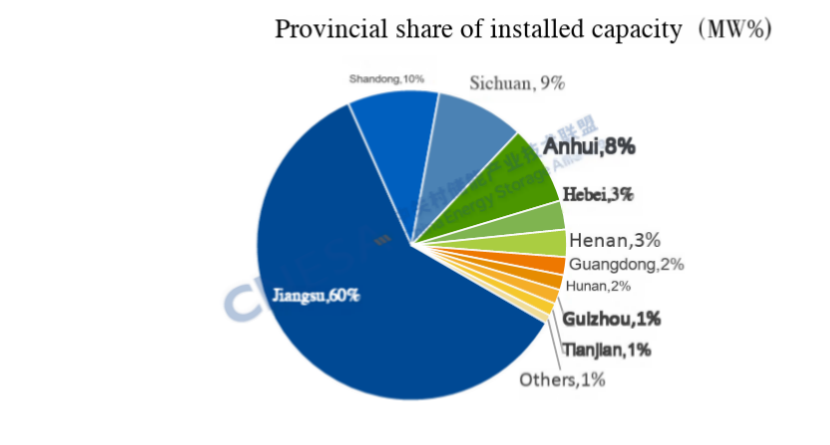
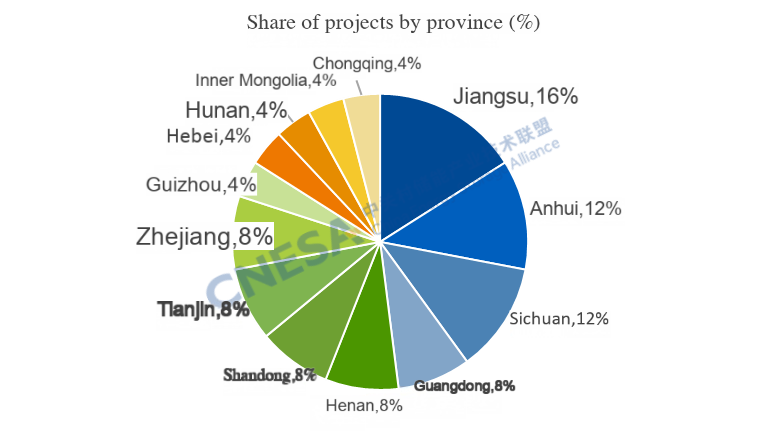
Figure 2. Provincial distribution of newly commissioned user-side new energy storage projects in January 2026
Source: CNESA DataLink
(3) Project Filings
From the perspective of project filings, January saw a “less but better” trend nationwide. The user-side market shifted from distributed expansion to scale and centralized development. The number of newly filed user-side projects fell by 38% year-on-year, while total filed capacity increased by 16%, and the average project size of single projects rose by 87%. In traditional markets, Jiangsu, Guangdong, and Zhejiang together added 321 new projects, down 42% year-on-year, while total energy capacity increased by 28%. Jiangsu recorded the largest total filed capacity, while Guangdong led in the number of newly filed projects. Over the past three years, Jiangsu has consistently seen year-on-year growth in both total filed capacity and average project size in January. This January, Jiangsu’s newly filed capacity rose 81% year-on-year, while project numbers declined 44%, resulting in an average project size roughly three times that of the same period last year—highlighting a clear trend toward larger individual projects. By contrast, Zhejiang continued to see declines in newly filed projects. In January, the number of projects fell 67% year-on-year, and total capacity declined 86%.
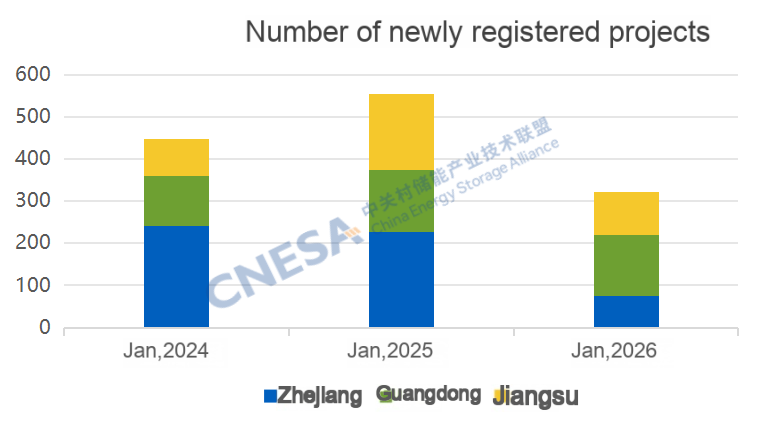
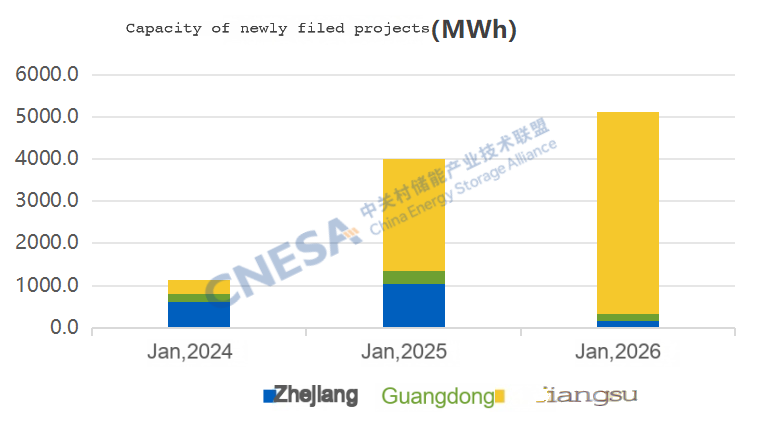
Figure 4. Newly filed energy storage projects in Zhejiang, Guangdong, and Jiangsu in January over the past three years
Source: CNESA DataLink
Overall Analysis of New Energy Storage Projects in January
According to incomplete statistics from China Energy Storage Alliance (CNESA), total newly commissioned new energy storage capacity in China reached 3.78 GW / 10.90 GWh in January 2026, representing +62% / +106% year-on-year, but -84% / -86% month-on-month. Despite the sequential decline, year-on-year growth exceeded 60%, signaling a positive start to the year for the new energy storage market.
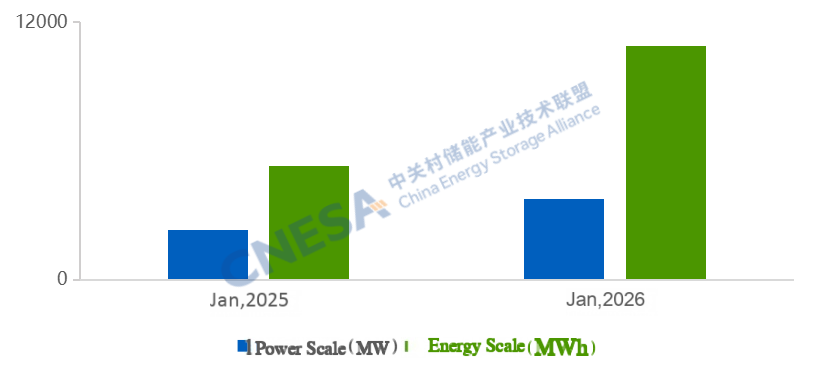
Figure 5. Newly commissioned new energy storage capacity in China in January 2026
Source: CNESA DataLink
Note: Year-on-year comparisons are based on the same period of the previous year; month-on-month comparisons are based on the immediately preceding period.
China Energy Storage Alliance adheres to standardized, timely, and comprehensive data collection methodologies to continuously track energy storage project developments. Leveraging long-term data accumulation and in-depth professional analysis, CNESA regularly publishes objective market analyses to support industry decision-making. Since June 2025, the Alliance’s monthly project analysis has been divided into two dedicated reports—Source-Grid-Side Market and User-Side Market. This issue focuses on the user-side market in January 2026.
For more comprehensive project information, authoritative data, and in-depth market insights, please visit www.esresearch.com.cn or access the CNESA DataLink mini program to explore detailed datasets and research reports. Customized data consulting services are also available through CNESA’s official support channels. CNESA is committed to providing full-cycle, high-quality data services for the industry.
At this critical juncture of diversified business model transformation for user-side energy storage, the ESIE 2026 will bring together leading enterprises from across the industry. The event will feature major launches of new C&I and residential storage products, alongside a series of high-level forums, including:Energy Storage Applications in Zero-Carbon Industrial Parks; Energy Storage + AIDC Collaborative Development;Energy Storage and Emerging Business Models;Distributed PV-plus-Storage;PV–Storage–Charging Integration;Overseas Energy Storage Project Development, Operation, and Practice;The Role and Value of Energy Storage in Virtual Power Plants.These sessions will provide in-depth analysis of market shifts and offer a one-stop platform spanning product showcases, operational best practices, and ecosystem collaboration. We cordially invite you to attend and explore pathways to breakthrough and growth in the evolving user-side energy storage landscape.
Register now to attend Asia’s Largest Energy Storage Trade Show for free:
What: The 14th Energy Storage International Conference & Expo
When: Conferences: March 31 - April 2, 2026
Exhibitions: April 1-3, 2026
Where: CIECC Beijing, China
Address: No. 55 Yudong road, Shunyi District, Beijing China
